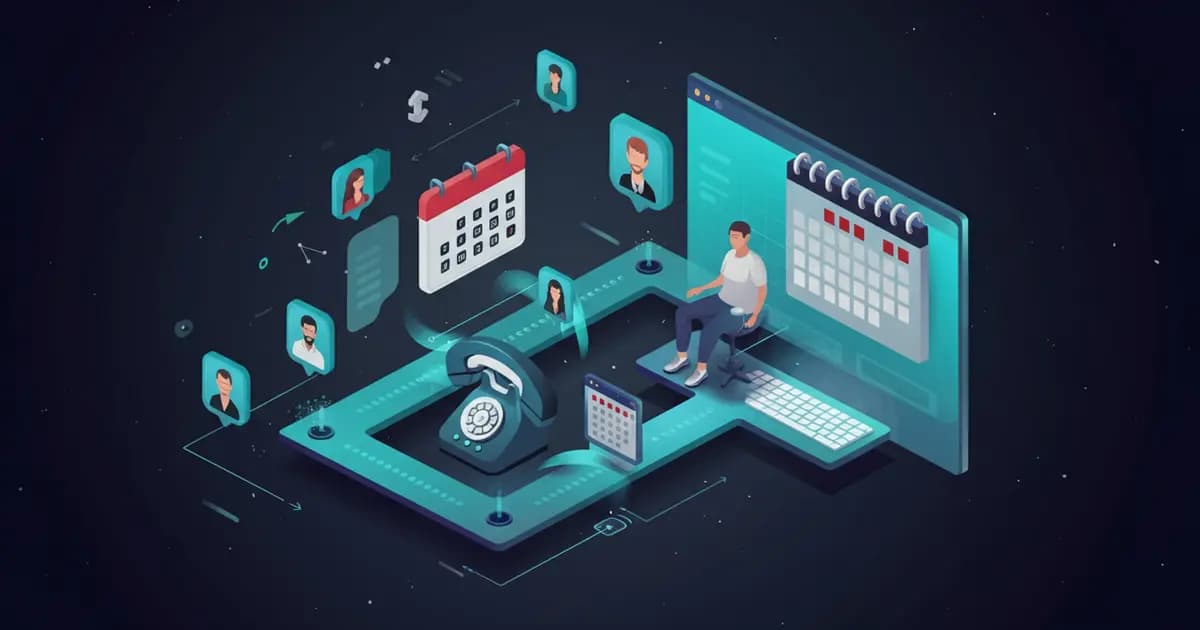
A roofing company in Phoenix was manually dialing 30 prospects per day. One rep, four hours of calling, maybe three conversations and one booked estimate. When they switched to an AI calling system, they ran 200 calls per day, booked seven estimates and the rep spent his time on the estimates, not on dialing. The revenue went up. The stress went down.
Automating sales calls is not about removing people from the sales process. It is about removing people from the parts of the process that do not require a person. This guide walks through how small businesses set up AI calling, what results to expect, the most common mistakes and how to stay on the right side of compliance rules.
What AI Sales Calling Actually Is
An AI sales agent makes outbound calls using a synthetic voice trained to carry natural conversations. It dials from your list, introduces itself on your behalf, asks qualifying questions, handles common objections and books a meeting with a real person when the prospect is interested. If the prospect is not interested, the AI notes the outcome, removes them from the active list and moves to the next call.
The AI does not handle the close. That is not what it is designed for. It handles the high-volume, time-intensive prospecting work that costs most small businesses either money (a paid salesperson doing cold outreach) or opportunity (the owner doing it themselves and not having time for anything else).
A useful way to think about it: the AI does the fishing and your sales rep reels in the catch. The AI dials hundreds of prospects to find the ones who are interested and available. Your rep takes every conversation from 'I'm interested' onward.
How to Set Up AI Calling for Your Small Business
Step 1: Define Your Ideal Prospect Profile
Before setting up any calling, write down exactly who you want to reach. Industry, geography, company size, job title or homeowner type. Tight targeting is the single biggest variable in call performance. Broad lists waste calls. Specific lists generate meetings.
Step 2: Build or Source a Verified Contact List
Get a list of verified phone numbers that match your prospect profile. Remove any contacts on the National Do Not Call Registry before importing. For B2C outreach, confirm consent requirements for your state. Quality data is what separates a 15% meeting rate from a 3% meeting rate.
Step 3: Write a Script Built for the First 10 Seconds
The first 10 seconds decide whether the prospect stays on the line. Open with who you are, one clear reason the call is relevant to them and a single qualifying question. Avoid long company descriptions at the start. Get to the reason the call matters to the prospect in the first sentence.
Step 4: Connect Your Calendar for Direct Booking
Connect your AI caller to your calendar so qualified prospects can book directly during the call. Every step between 'I'm interested' and 'meeting confirmed' loses prospects. Instant booking during the call has the highest conversion rate of any handoff method.
Step 5: Configure Compliance Settings
Set calling hours to 8am to 9pm in the prospect's local time. Add an opt-out prompt. Scrub your list against the Do Not Call Registry before each campaign. Maintain a suppression list and honor it permanently. Compliance is not optional and the cost of getting it wrong is severe.
Step 6: Review Calls Weekly and Refine the Script
Listen to call recordings every week. Find the objections that end conversations and update your script to handle them. Most scripts improve significantly after the first 200 calls. Treat early campaign data as coaching material, not just outcome data.
TCPA Compliance: What Small Businesses Need to Know
The Telephone Consumer Protection Act governs automated calls in the United States. The FCC confirmed in 2024 that AI voice calls fall under TCPA rules. Getting this wrong carries penalties of $500 per call for standard violations and $1,500 per call for willful violations. A non-compliant campaign of 10,000 calls could trigger millions in fines.
The good news is that compliance is straightforward when you build it in from the start rather than adding it as an afterthought.
The Core TCPA Rules for AI Calling
- B2B calls to business phone lines have more flexibility than B2C calls to consumer cell phones
- For B2C calls to cell phones, prior express written consent is required under TCPA
- All calls must honor the National Do Not Call Registry, updated and scrubbed before each campaign
- Every AI call must offer a clear opt-out option and honor opt-outs immediately
- Calling hours are 8am to 9pm in the called party's local time zone
- Caller ID must display an accurate number with a live callback option
TCPA compliance rules vary by state. California, Florida and Texas have additional state-level requirements beyond federal TCPA. Always confirm your state's specific rules before launching a consumer-facing calling campaign. When in doubt, consult a compliance attorney.
For more on compliance rules, read our post on AI cold calling legality and TCPA.
Common Mistakes When Small Businesses Automate Sales Calls
Mistake 1: Skipping List Verification
Unverified lists have 20 to 40% invalid or disconnected numbers. You pay per call attempt whether the number works or not. More importantly, invalid numbers drag down your overall campaign metrics and waste the time the AI spends on non-answers. Always verify phone numbers before importing any list.
Mistake 2: A Script That Opens With a Company Pitch
Opening a cold call with 'Hi, I'm calling from XYZ Company and we help businesses with...' is the fastest way to get hung up on. Prospects do not care who you are in the first 10 seconds. They care whether this call has anything to do with them. Open with relevance to the prospect, not a description of your company.
Mistake 3: No Human Handoff Plan
Automating the entire sales call, including the close, rarely works for complex or high-value services. The AI should qualify and book. A real person should close. Without a clear handoff process, qualified prospects book meetings that do not get properly followed up and the performance data looks worse than it is.
Mistake 4: Running Too Many Calls Before Validating the Script
Start with 100 to 200 calls on your first script before scaling volume. Listen to the recordings. Identify where prospects are disengaging. Revise the script based on that data. Scaling a bad script means running 10,000 calls at a 1% meeting rate instead of 500 calls at 1% and 9,500 calls at 8% after the fix.
Why AI Plus Human Handoff Is the Winning Model
The businesses that see the best results from sales call automation are not trying to remove humans from sales. They are deploying humans at the point in the process where humans actually make a difference.
A human who dials 50 cold prospects per day is not using their best capabilities. They are doing data entry with a voice. An AI can do that work at ten times the volume with consistent quality. The human is best used on the conversation with a qualified prospect who has expressed interest. That is the conversation where empathy, judgment and relationship-building matter.
The math works because the AI handles the costly, time-intensive work at the top of the funnel. By the time a human is involved, every conversation is with a prospect who has already said they are interested. Close rates on qualified, pre-booked meetings are dramatically higher than close rates on cold calls, which means the human's time is worth more per hour spent.
What to Expect in the First 90 Days
Days 1 to 30: Baseline and Script Refinement
The first month is primarily about learning. Your initial meeting rate will be lower than your eventual steady state. Expect 2 to 5% meeting rate on early campaigns while you refine the script based on real call data. This is normal and expected. Do not judge the system on month one numbers.
Days 31 to 60: Script Optimization and Volume Increase
After two or three rounds of script refinement, meeting rates typically climb to 6 to 12%. You should now have enough data to know your cost per booked meeting and begin increasing daily call volume. Most businesses double their call volume in month two once the script is proven.
Days 61 to 90: Full Production and ROI Measurement
By month three you have a consistent cost per booked meeting, a proven script and a steady flow of qualified prospects into your sales pipeline. This is when the revenue impact becomes clear and when most businesses choose to increase their budget because the unit economics are proven.
Getting Started With AI Sales Call Automation
The fastest path to getting AI calling live for your business is a done-for-you setup where the platform provider handles script writing, list sourcing, CRM integration and compliance configuration. Self-service platforms are available but they require weeks of testing and technical work before the first production call runs.
Multiply Revenue's AI sales agent is a fully managed system. You provide your target prospect profile and your calendar. We build the script, source the list, configure compliance and run the calling. The first qualified meetings appear in your calendar within the first two weeks.
Ready to see how AI calling works for your specific business? Book a demo at [multiplyrevenue.com/revenue-pilot](/revenue-pilot) and we will walk through your prospect profile, typical call scenarios and expected meeting volume.
Sources
Sources & Research
- 1.FCC: Declaratory Ruling on AI Voice Calls and TCPA 2024 | fcc.gov
- 2.Federal Trade Commission: Telemarketing Sales Rule and Do Not Call | ftc.gov
- 3.InsideSales.com: Lead Response Management Study 2025 | insidesales.com
- 4.Bridge Group: SDR Metrics and Compensation Report 2025 | thebridgegroup.com
- 5.Salesforce: State of Sales Report 2025, 7th Edition | salesforce.com
- 6.CallRail: Home Services Marketing Benchmark Report 2025 | callrail.com
- 7.Harvard Business Review: The Short Life of Online Sales Leads | hbr.org
- 8.Gartner: B2B Sales Automation Benchmark 2025 | gartner.com