
Skip to content
Back to financial services

The wealth management CRM playbook.

Everything worth knowing, written out in order. Read it end to end or jump to the part you need. No sign-up, nothing hidden behind a click.

A Large Market Where Nobody Calls Anybody

The market for financial advice is large and it is not shrinking. Households need planning, small business owners need it more, and a great deal of money is moving from one generation to the next over the next two decades.

None of that is the useful fact. The useful fact is that an adviser can only hold so many real relationships at once, somewhere around a hundred to a hundred and fifty, and the constraint on a practice is almost never demand. It is hours.

That is why growth in this business is so lumpy. A firm wins clients when an adviser happens to have capacity and happens to be in front of the right person, and goes quiet when they are servicing the book they already have. Nobody plans it that way. It is what happens when finding clients is the job that gets done with whatever time is left over.

Meanwhile the basic investment piece has been commoditised by software that charges a fraction of a point, so the thing a firm now sells is planning and attention. Both of those are relationship work, and relationship work starts with a conversation somebody has to make happen.

The rest of this guide is about that conversation: who to have it with, when and what has to be true of your software for it to happen at all.
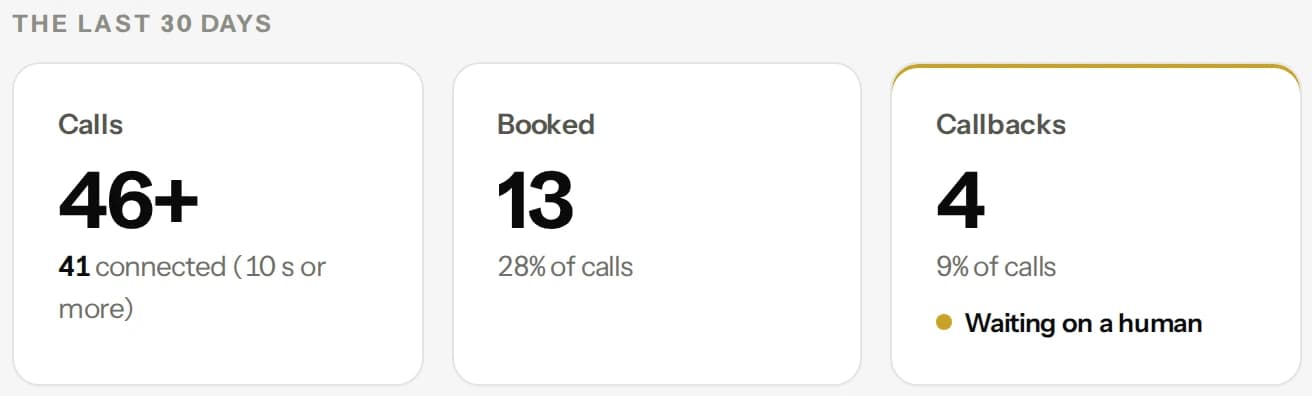

The Calls screen: 46 calls in the last 30 days, 13 booked and 4 callbacks waiting on a person
The last 30 days of calls, shown with a demo account.

Nobody Hires an Adviser on the First Conversation

This is a trust business, and trust is slow. A prospect is handing over their retirement, their tax position and in many cases the proceeds of selling the thing they spent thirty years building. They do not decide that in one meeting.

What they do instead is look at a few firms over a couple of months, talk to a friend, put it off, come back to it. Almost none of that is visible to you. What you see is a person who seemed keen and then went quiet.

So the firms that win are usually not the ones with the better pitch. They are the ones still in the conversation in month three. That is an unglamorous thing to be good at, and it is the part that almost always breaks, because staying in touch with forty half-interested prospects while running a full book is not a job anybody has time for.

It breaks in a specific way worth naming. Follow-up stops after the second attempt. Not because the adviser gave up on the person, but because the reminder sat in a calendar that was already full of client work, and client work is the work that pays this month.

That is the gap the agent covers. It calls the prospects who went quiet, on a schedule, for as long as it takes, and it stops the moment somebody asks it to. When one of them is ready, the call comes to an adviser with the whole history attached rather than as a cold start.

Three stone blocks of rising height with a brass ball balanced on the tallest

Tax Season and Life Events Decide When a Prospect Is Reachable

Demand in this business is not spread evenly through the year and it never has been. A large share of new relationships start between January and April, because that is when people are already looking at their own numbers and are, briefly, willing to think about them.

The bigger pattern is life events. Retirement. Selling a business. An inheritance. A divorce settlement. A property sale. Those are the moments when somebody who has ignored the subject for a decade suddenly needs an answer this month, and the window is short. Wait a few weeks and either they have engaged somebody else or the urgency has passed and they are back to doing nothing.

Be careful about what software can honestly promise here. We do not watch your prospects' lives and ping you when something happens. Nobody can, and a vendor who says otherwise is selling you a data product they should be describing plainly.

What works is less clever and more reliable. Call the whole list often enough that you are in the rotation when the event happens, and write down what people tell you. The prospect who says ask me after I sell the business has given you a date. The client who mentions their father is unwell has given you a reason to check in that has nothing to do with selling anything.

That is all the agent is doing. It calls on a schedule, it records the reason and the timing, and it brings them back round. The firm that is in the conversation during the month that matters is usually the firm that was in the conversation the other eleven.

A chrome funnel catching a stream of small gold spheres into a bowl

What Changes When Somebody Calls the Whole Book Every Year

Every advisory firm knows the annual review should happen for every client, every year. In practice it happens for the clients who ask and the ones who are already on the calendar, because calling the rest is nobody's actual job. The same is true of the prospect who took a meeting eighteen months ago and said not yet.

That is the work the agent does. It calls the book on a schedule to book reviews, it calls the prospects who went quiet, and it calls the CPAs and attorneys who refer to you so they hear from you before they have somebody to refer. Every call is written down and lands in your CRM against the right record.

We do not publish a conversion figure for this and you should be suspicious of anyone in this category who does. What we will tell you is what it changes structurally: the number of real conversations your firm has in a year stops being a function of how much time your advisers had left over after servicing existing clients. Whether that turns into assets depends on your minimums, your market and how good your advisers are on the phone, which is not something software can promise.

Where Growth AI Fits Alongside Your Existing Advisor Tools

Most advisory practices already run some artificial intelligence internally. Meeting recorders like Zocks and Jump transcribe client meetings and drop the notes into the CRM. Holistiplan reads a tax return. Nitrogen documents risk tolerance before a portfolio conversation starts. Advisers check questions in ChatGPT or Perplexity between meetings.

Those tools save real time on the paperwork side of the job. None of them brings a new prospect into the pipeline, which is worth saying out loud because the word AI on an invoice makes it easy to assume the growth problem is covered when it is not.

That is the gap this fills, and it is a narrow one on purpose. It runs alongside whatever CRM you already have, and sends each finished call there through Zapier or Make. It handles the outbound calls, the first qualification and the follow-up. Your notetaking and compliance tools keep doing their job on the client-facing side, and we are not asking you to move off any of them.

The practices that get value out of this are not the ones with the most software. They are the ones that were clear about which problem each tool was bought to solve, and made sure everything wrote back into one CRM so the same prospect is not living in three systems with three different stories.

A dark stone card standing upright beside a row of small brass balls and stacked stone tiles

Why an Audit Trail Is the Part Compliance Actually Cares About

A decade ago the technology available to a solo adviser and a fifty-person firm looked nothing alike. That gap has mostly closed. A single adviser can now run outreach, qualification and follow-up with the same consistency a large firm gets from a prospecting team, which is a real change in what a small practice can attempt.

The thing that makes compliance officers comfortable is not the automation, it is the record. Every call is recorded. Every qualifying question is asked the same way. Every disclosure is made the same way, on every call, which is the one thing a human caller at five on a Friday cannot promise. The reporting shows who was contacted, what they said about their assets and timeline, and why they were or were not advanced to a meeting.

The human part does not go anywhere. The agent handles the first conversation and the diary. The adviser runs every planning conversation, every portfolio review and every decision that needs judgement. The agent does not give investment advice, does not discuss performance and does not make a recommendation, because those are regulated acts and software should not be performing them.

The other thing firms want on day one is context. Each prospect record carries what an adviser would otherwise assemble during meeting prep: rough asset range, risk comfort, timeline and the reason they got in touch. That saves the first ten minutes of a meeting spent asking questions somebody already answered.

Security is a fair question and it deserves a specific answer rather than a reassuring one. Ask any vendor, including us, where call recordings are stored, who inside their company can listen to them, how long they are kept, whether they are used to train anything, and how you get them out. Ask for it in writing. A vendor who answers that clearly is telling you more than one who says the word bank-grade.

Nested dark stone arches over a brass ball

What to Check Before You Buy Any CRM for Financial Advisors, Including Ours

Up to here this guide has argued for a way of working. Point it at us first. A buyer who arrives with questions gets a better deal than one who arrives with a brochure.

Ask whether it does outbound at all. A lot of products described as AI only answer. Answering a web enquiry quickly is worth having and it does nothing about the clients who are overdue a review or the prospects who took a meeting last year and went quiet, which for most firms is where the nearest revenue sits.

Ask what it is not allowed to say. In this industry that list should be long and the vendor should be able to recite it: no investment advice, no performance figures, no recommendation, no opinion on tax or estate strategy. A vendor who has not drawn those lines has not thought about your regulator.

Ask what it says at the start of a call and whether recording is disclosed every time. Ask to hear a real call rather than a scripted sample.

Ask what happens when it does not know, and how fast a person can take the call over.

Ask which CRM it writes into, by name, and watch a booked meeting appear there. Ask who owns the recordings and the prospect records if you leave, and export on day one rather than on the day you go.

Ask who is responsible if a call goes wrong, and get it in writing.

Then ask what happens between the first call and the meeting, because in this business that gap is measured in months. A system that books a meeting and forgets the prospect who said not yet has solved the easy half of the problem.

PROFESSIONAL SERVICES

Common questions, what it costs and what it will not do are answered back on the financial services page.

Hear it run on financial services.

Twenty minutes with a real person. See it run on your business, then decide.

Book a demo
Multiply Revenue

AI that calls your leads in a natural voice, follows up by text and email until they answer, and books qualified meetings straight onto your calendar. Outbound and inbound, on one memory.

No setup fee, and no per-text charge from us.

© 2026 Multiply Revenue · 1905 Sherman Street, Ste 200, Denver, CO 80203 · (720) 735-8685
Book a demo