Skip to content
Back to mortgage

The mortgage CRM playbook.

Everything worth knowing, written out in order. Read it end to end or jump to the part you need. No sign-up, nothing hidden behind a click.

What a Mortgage CRM Has to Do That a General One Does Not

Lending is a business where the same contact is worth money repeatedly over decades, and almost every CRM treats a funded loan as the end of the record.

A borrower who closes today is a refinance candidate when rates move, a purchase candidate when they trade up, a second-home buyer eventually and a referral source the entire time. Ten years of relationship, and most systems mark the file closed and stop.

The second thing is that the trigger is external. Nothing about the borrower changes. The rate environment changes, or their equity position does, or their credit improves, and suddenly a conversation that made no sense last year makes sense today. A pipeline built around a deal moving through stages has no concept of a contact who becomes relevant again because the world moved.

The third is that the real customer is often not the borrower at all. It is the realtor, the builder or the financial adviser who decides which lender the borrower is introduced to. Those relationships are the difference between a loan officer with a predictable year and one who starts every month at zero, and they are almost never tracked with the same discipline as a loan file.

So the record has to hold the borrower over years, the partner relationships that produce introductions, and the conditions that would make a past client worth calling again. Then it has to actually place the call, which is the part no loan officer with a live pipeline has time for.


A tray of small brass balls with one large brass ball on top

Why Shared Lead Platforms Are a Treadmill

The default answer to a slow month in this industry is to buy leads, and it is worth being clear about what that purchase actually is.

A shared lead is sold to several lenders at once. The borrower submits one form and their phone starts ringing within minutes, from people who all sound roughly the same and who are all opening the conversation at a disadvantage. You are not selling a mortgage at that point. You are competing to be the least irritating of five simultaneous calls, on price, to somebody who did not expect any of them.

That is a treadmill rather than a pipeline. It produces volume while you pay for it and stops the moment you do not, and it never compounds, because nothing you buy today makes next quarter cheaper.

The alternative is not a secret and everybody in the industry knows it: exclusive contacts, which means people who came to you, borrowers you have already closed, and introductions from partners who trust you. The reason loan officers buy leads anyway is not ignorance. It is that working the exclusive sources properly is a large amount of unglamorous follow-up spread over a long period, and an active pipeline always feels more urgent.

That is exactly the work an agent absorbs. Nobody is competing for a past borrower's attention when you call them about a rate change. You are the only lender in that conversation, which is the whole point.

A brass magnifying glass over a stack of stone cards with one brass card lifted out

The Partners Who Decide Which Lender Gets the Introduction

For most loan officers, the realtor relationship is the business, and it is managed almost entirely by memory and lunch.

A realtor who trusts you sends a steady stream of pre-qualified buyers who arrive already inclined to work with you. That is the highest quality introduction in lending and it costs nothing per unit. The problem is that these relationships decay in a specific and preventable way: they fade when you go quiet, and going quiet is what happens when you are busy, which is exactly when you feel least like doing business development.

So the pattern repeats. A good quarter, a full pipeline, no time for partner calls, then a thin quarter and a scramble to reconnect with people who have found somebody else in the meantime.

Breaking that cycle is a scheduling problem rather than a relationship problem. Somebody has to be in touch with every partner on a sensible rhythm, whether or not this month is busy, and has to know which partners have gone quiet and how long it has been.

An agent does that at a volume no loan officer sustains by hand. It calls partners on a business line about business: what is coming up, anything needing pre-approval, anybody struggling to qualify that is worth a second look. It also keeps track of the ones who used to send you work and have not lately, which is the list that matters most and the one nobody maintains.

Builders, financial advisers and accountants work the same way with different rhythms.

Stone steps rising to the right with a brass ball on each step

What the Agent Actually Says on a Mortgage Call

Lending is regulated, borrowers are anxious, and a careless call is a compliance problem rather than an awkward one. So here is exactly what the call is.

It opens by saying what it is. The agent identifies itself as a digital assistant calling on behalf of the company and says the call is recorded. Every call, every state.

On a new enquiry it establishes the shape of the situation without pretending to underwrite it. Whether they are buying or refinancing, roughly where they are in the process, whether they are working with a realtor, what timeline they are on, and whether they have spoken to a lender already. Then it books the call with a licensed loan officer, which is the only correct outcome.

On a call to a past borrower it says why it is calling and it stays general: something has changed that may be worth a conversation, would they like one.

What it does not do is the part that matters. It does not quote a rate. It does not state a payment. It does not say whether somebody qualifies, or how much they can borrow, or what programme suits them. It does not take a credit authorisation or discuss credit details. Every one of those is licensed work and the correct behaviour is to get a person.

It also honours do-not-call preferences as a system rule rather than a habit, because in this industry that is not a courtesy, and a vendor who is vague about how that is enforced is telling you something.

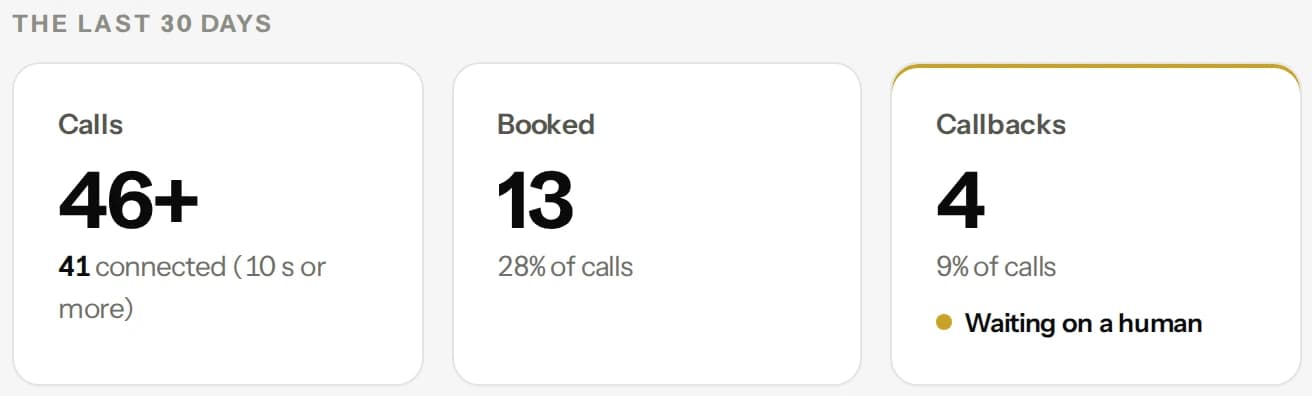
The Calls screen: 46 calls in the last 30 days, 13 booked and 4 callbacks waiting on a person
The last 30 days of calls, shown with a demo account.

It Has to Land Where the Loan Officer Already Works

A booked call that lives in a vendor dashboard is not booked, and in a business where borrowers are talking to competitors the same afternoon, a delay of hours is a lost file.

Loan officers live in a loan origination system and usually a separate CRM, and the day is driven by conditions, deadlines and whatever is closest to closing. A sales layer that does not write into those tools is asking the busiest person in the building to check another inbox.

So the test is mechanical and should be run on your own stack. When the agent books a call, does it reach the right loan officer's calendar with the context attached. When a past borrower says they are thinking about moving next spring, does that become a call next spring or a line in a transcript. When a realtor mentions a buyer who needs pre-approval, does it reach somebody who can act today.

Backwards matters as much. If a loan funds, falls through or moves to another officer, the agent needs to know before it calls anybody about it. A cheerful follow-up about an application that was declined last week is the kind of call people remember.

And ask about record keeping directly. Regulated businesses need to be able to show what was said to whom and when. Ask where recordings and transcripts live, how long they are kept and how you retrieve one, and get it in writing.

A dark stone card standing upright beside a row of small brass balls and stacked stone tiles

What to Check Before You Buy Any Mortgage CRM, Including Ours

Use this on us as hard as on anybody else, and harder than in most trades, because this one is licensed.

Ask whose list it calls. Ours is your own past borrowers, your own enquiries and the partners who already introduce business to you. If the answer is a purchased list of consumers, ask precisely how do-not-call obligations are handled and who carries the liability. Get that answer in writing.

Ask exactly what the agent will never say. Rates, payments, qualification and amounts should all be on that list, and a vendor who has not thought about it has not sold into this industry.

Ask how do-not-contact is enforced, and whether it takes effect immediately or at the next overnight sync. Overnight is not good enough here.

Ask where call recordings and transcripts are stored, how long they are retained and how a specific one is retrieved.

Ask whether it writes into your origination system and CRM, and make them prove it on your own account.

Ask whether it can act on a rate or equity change as a trigger, or only on a date.

Ask whether it tracks which partner an introduction came from, because if you cannot see that you cannot tell which relationships are worth your time.

Ask what it does when it does not know. It should stop and fetch a licensed person. And get in writing who answers for it when a call goes wrong, because here a bad call is a compliance question and not only a service one.

PROPERTY AND MOVING

Common questions, what it costs and what it will not do are answered back on the mortgage page.

Hear it run on mortgage.

Twenty minutes with a real person. See it run on your business, then decide.

Book a demo
Multiply Revenue

AI that calls your leads in a natural voice, follows up by text and email until they answer, and books qualified meetings straight onto your calendar. Outbound and inbound, on one memory.

No setup fee, and no per-text charge from us.

© 2026 Multiply Revenue · 1905 Sherman Street, Ste 200, Denver, CO 80203 · (720) 735-8685
Book a demo