Skip to content
Back to automotive

The car dealership CRM playbook.

Everything worth knowing, written out in order. Read it end to end or jump to the part you need. No sign-up, nothing hidden behind a click.

What a Dealership CRM Has to Do That a General One Does Not

A dealership is really three businesses sharing a car park. New and used sales, service and the finance conversation that decides most of what happens in the first. A CRM that only understands the sale is missing where the customer relationship actually lives.

The record has to hold the vehicle, not just the person. What they bought, when, the mileage, what has been done to it, when the lease or finance term ends. That last field is the single most valuable thing in a dealership CRM, because a customer approaching the end of a term is the easiest sale on the lot and the one most often missed.

It has to connect sales and service, which in most dealerships are two systems that do not speak. The customer in for a third repair on a six-year-old car is a trade-in conversation, and nobody is having it because the salesperson cannot see the service record.

And it has to cope with the volume of enquiries a dealership gets versus the number that turn into anything. Hundreds of leads across the portals, the website and the phone, most of which go nowhere. Anything that needs a salesperson to hand-sort that will not be used.


A brass box and a small brass ball on a dark stone tray in warm window light

Speed Is the Whole Game on a Vehicle Enquiry

Somebody enquiring about a specific car has usually enquired about three, at three dealerships, in the same ten minutes. They are not choosing a dealership yet. They are choosing whoever tells them the car is still there.

The industry knows this and still loses on it. Enquiries arrive in the evening and at weekends, which is when people shop for cars and when your sales floor is thinnest. The lead that came in at nine on a Saturday night gets a call on Monday, by which point they have seen two cars elsewhere.

The agent calls back straight away, whatever the hour. It confirms the vehicle is available, asks what they are driving now, whether there is a trade-in and whether they are financing, and books them in with a real time rather than an invitation to drop by.

Those trade-in and finance answers matter more than the appointment. A salesperson who knows both before the customer walks in is having a different conversation from one who starts with what brings you in today.

And it keeps working the ones who do not answer, which on vehicle enquiries is most of them.

A brass ball resting on a dark stone beside a folded white cloth

The Customers You Already Sold To Are Your Service Department

The most valuable list at a dealership is not a lead source anybody pays for. It is everybody who has already bought a car from you.

What usually happens after the sale is drift. The warranty period passes, the customer stops being reminded to come in, they take the car somewhere cheaper and more convenient for a routine job, and once they have been to that independent shop twice they have a new place. You did not lose them over price or service quality. You lost them because nobody was in touch and the other place was closer.

That is a follow-up problem with a schedule already written into it. You know what they bought and when. You know roughly when a vehicle of that age and mileage is due for something. You know when a lease is approaching its end, which is the single most valuable moment in the whole relationship, and you know which vehicles are at trade-in age.

Each of those is a specific reason to call a specific person, and none of them is a broadcast. The service reminder is genuinely useful to the customer. The lease-end call is a conversation they need to have with somebody anyway, and it may as well be you. The trade-in call at the right moment is how a sold customer becomes a sold customer twice.

The reason none of it happens consistently is the same reason as everywhere else in this guide. It is a great many small calls, and the people who could make them are busy with the customers standing in front of them.

Gold spheres travelling around a brass double ring

An Internet Lead Is Worth Whatever Your Response Time Makes It Worth

An internet lead is only worth what your response time makes it worth. The shopper who filled in your form filled in three others in the same sitting, and by the time somebody on your floor gets to it they have already spoken to a salesperson somewhere else. Nothing else in your marketing matters if the reply comes hours later, and some enquiries never get a reply at all because they arrived while the floor was busy.

The software answers every enquiry in seconds by phone and text, asks what they are looking for, what they are driving now and when they want to buy, and books the test drive straight onto a salesperson's calendar. It keeps calling the ones who do not pick up rather than marking them dead after two tries.

The outbound side works your own list: unsold showroom visits, service customers whose vehicle is at trade-in age, leases coming to term. Those people already know your store, and nobody else is calling them about it.

What the Agent Actually Says on a Call About a Vehicle

Plenty of vendors will describe an AI agent to you without ever letting you hear it work. Here is what the conversation is, so you can judge it.

On an inbound enquiry it opens by saying what it is, a digital assistant calling from your store, and that the call is recorded. It confirms the vehicle they asked about and whether it is still the one they want, because half of internet enquiries name a car that has sold and the shopper will happily look at the one next to it.

Then it asks the four things a salesperson would ask before setting an appointment. What are you driving now and are you looking to trade it. Are you paying cash, financing or coming off a lease. Is there a timeline, or is this early. And when could you get in, because a test drive is the only outcome that matters on this call.

It does not quote a payment, appraise a trade or promise a price. Those are the floor's job, and a number given by software is a number your desk has to walk back in person. It says that plainly rather than dodging.

When somebody asks something it cannot answer, or says they would rather speak to a person, it stops and hands them over. A vendor whose agent never gets stuck is showing you a demo.

Everything said is written against the lead in the CRM, so the salesperson who picks it up already knows what the shopper told it at ten last night.

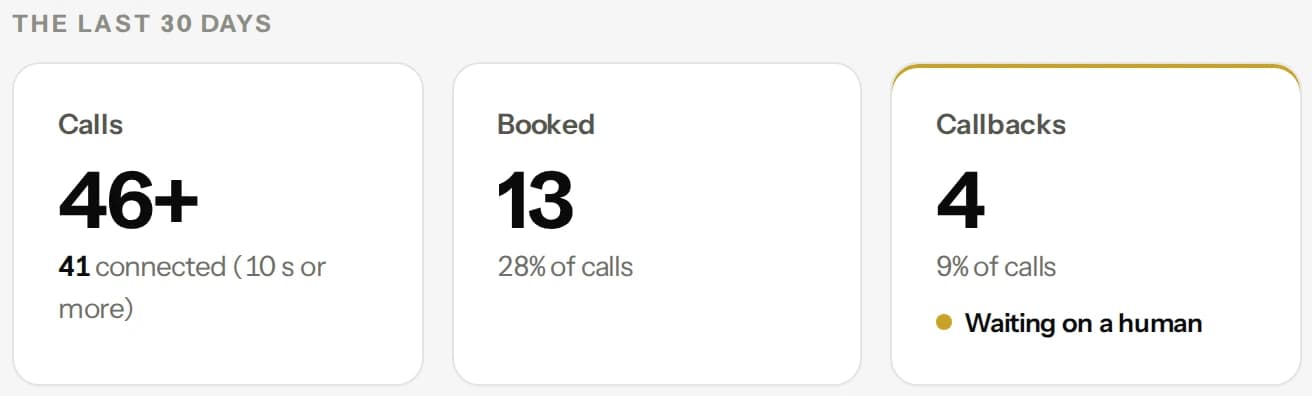
The Calls screen: 46 calls in the last 30 days, 13 booked and 4 callbacks waiting on a person
The last 30 days of calls, shown with a demo account.

It Has to Land in the CRM Your Floor Already Runs

An appointment that lives inside a vendor's dashboard is not an appointment. It is a message waiting for somebody to notice it.

This is where dealership software quietly fails. The call goes well, the shopper is qualified, the transcript is perfect, and then nobody greets them at the door, because your floor works out of the CRM and the desk log and neither one heard about it. A store usually runs a CRM, a DMS, an inventory feed and a service scheduler, and software that does not write into the ones that matter is adding a second place to check rather than removing work.

So the test is mechanical, and you can run it inside a demo. When the agent sets an appointment, does it appear in the CRM against the right lead, with the stock number, the trade and the timeline attached, and does it show on the calendar the salesperson opens in the morning. When a shopper says they are sixty days out, does that date land somewhere that will call them back.

It has to work backwards too. When a unit sells, the agent has to stop calling people about it. When a lead is marked sold or dead, the outbound has to know the same day.

Ask any vendor, ours included, to show that path end to end on your own CRM rather than on a demo account. Watch a call happen, then watch the record appear where your people work. If getting it there needs a Zapier chain and a nightly export, you have found the real price of the product.

A dark stone card standing upright beside a row of small brass balls and stacked stone tiles

What to Check Before You Buy Any Dealership CRM, Including Ours

Everything above this point is an argument about how to run the phones. Run it at us as hard as at anybody else. A buyer with a checklist gets a better deal than a buyer with a brochure.

Ask whether it does outbound at all. A lot of products sold to dealers only answer. Answering an internet lead quickly is worth having, but it does nothing about the unsold showroom visits, the service customers at trade-in age and the leases coming to term, which is the cheapest inventory of conversations a store owns.

Ask whose list it calls. Ours calls yours. If a vendor is calling strangers in your zip code under your rooftop's name, you are renting a short-term gain against a reputation you cannot buy back locally.

Ask what it says at the start of a call and whether recording is disclosed every time. Then ask to hear a real call rather than a scripted sample, and ask what it is not allowed to say. A vendor who cannot name the limits has not thought about them.

Ask what happens when it does not know, and how fast a live person can take the call over.

Ask how it writes into your CRM and DMS, by name, and who owns the recordings and the contact records if you leave. Export on day one rather than on the way out.

Ask who is responsible if a call goes wrong, and get that in writing.

Then ask what happens after the appointment is set, because the show rate is the number that decides whether any of this was worth buying. A system that books a visit and never confirms it has solved the easy half of the problem.

RETAIL AND COMMERCE

Common questions, what it costs and what it will not do are answered back on the automotive page.

Hear it run on automotive.

Twenty minutes with a real person. See it run on your business, then decide.

Book a demo
Multiply Revenue

AI that calls your leads in a natural voice, follows up by text and email until they answer, and books qualified meetings straight onto your calendar. Outbound and inbound, on one memory.

No setup fee, and no per-text charge from us.

© 2026 Multiply Revenue · 1905 Sherman Street, Ste 200, Denver, CO 80203 · (720) 735-8685
Book a demo