
Skip to content
Back to chiropractic

The chiropractic practice software playbook.

Everything worth knowing, written out in order. Read it end to end or jump to the part you need. No sign-up, nothing hidden behind a click.

What a Chiropractic CRM Is, and What It Is Not

Start with the thing that causes the most wasted money in this corner of the market. A chiropractic CRM and chiropractic practice software are not the same product, and a lot of practices go shopping for one and buy the other.

Your practice management or EHR system is the clinical and administrative record. It holds the notes, the schedule, the billing and the compliance trail. It is the system of record and you should not be replacing it to solve a follow-up problem. If what you need is charting, coding and claims, this guide is not about that and we do not sell it.

What that software almost never does is reach out. It will happily show you a list of patients who have not been in for three months and then wait, indefinitely, for somebody at the front desk to do something about it. In most practices nobody does, not through carelessness but because the desk is dealing with the people physically standing in front of it.

That gap is the whole job of a CRM here. It is the layer that looks at who has drifted, who enquired and never booked, who cancelled and never rebooked, and then actually makes contact.

It is worth being blunt about scale, because a vendor who is not will happily take your money. This is a small-list business. A chiropractic practice does not have tens of thousands of contacts. It has a few thousand at most and a few hundred that matter right now. The value is not in volume. It is that the few hundred are people who already trusted you with their back.
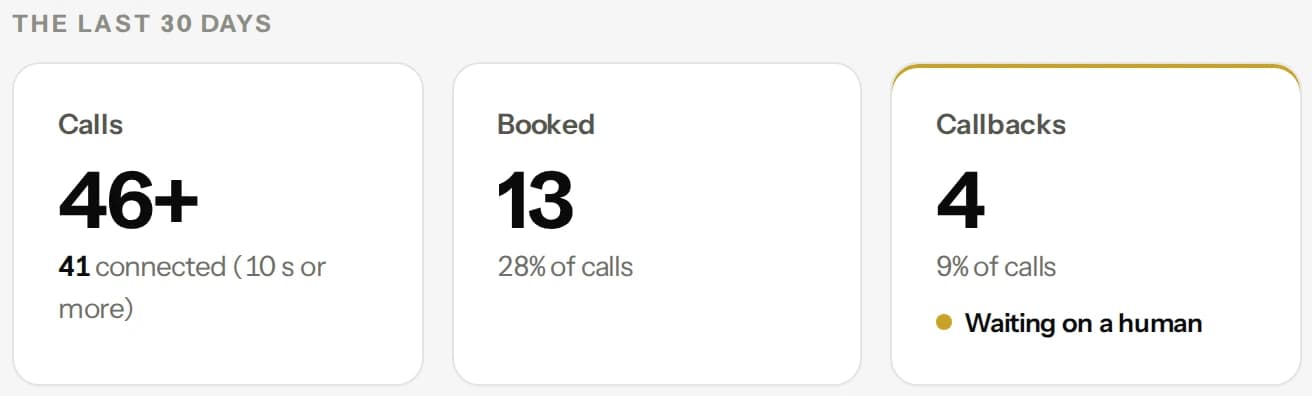

The Calls screen: 46 calls in the last 30 days, 13 booked and 4 callbacks waiting on a person
The last 30 days of calls, shown with a demo account.

The Patients Who Stopped Coming Mid-Plan

Every practice has them and most practices do not look at the list, because looking at it is uncomfortable.

Somebody came in with real pain, started a course of care, felt better, and then attendance thinned out and stopped. Not because they decided anything. Because the acute problem eased, life got busy and the appointments were the easiest thing to let slide. Very few of these people are unhappy. Most of them describe the practice warmly if you ask. They simply drifted.

What makes this different from an ordinary lapsed customer is that drifting off mid-plan often means the thing that brought them in comes back, and when it does, a good share of them go and search again from scratch rather than call the practice they already know. You lose the patient twice: once quietly, and once to whoever ranks well on the day the pain returns.

The call that prevents that is short and unremarkable. We noticed we have not seen you in a while, how is the back, would you like to come in. It is not a sales call and it should never sound like one.

The reason it does not happen is arithmetic. That is hundreds of individual calls, most of them reaching voicemail, spread across a list that grows every month. It is nobody's job and there is never an hour for it.

An agent will work the whole list without finding it tedious, book the ones who want to come in, and mark the ones who have moved away or now go elsewhere so the list gets truer instead of just longer. All of them are your own patients. Nobody here is being called out of the blue.

The Enquiry That Never Became a First Visit

The second list is the one that leaks fastest, and it leaks in hours rather than months.

Somebody in pain searches, finds you, fills in a form or rings while you are with a patient. Pain is an impatient motivator. If nobody gets back to them quickly they will keep looking, and the practice that answers first very often gets the patient regardless of who has the better website.

Evenings and weekends are the worst of it, which is precisely when backs seize up and when nobody is at the desk. A voicemail box is not an answer to this, because somebody in discomfort will not wait for a callback when three other practices are a tap away.

That is the clearest case for an agent answering immediately: it picks up at any hour, has a real conversation, takes the details a first appointment needs and books it into the schedule the practice already runs.

The related list is the enquiry that did get answered and never converted. They rang, they asked about availability or cost, they said they would think about it and they never called back. Most practices treat that as a no. It is usually a not yet, and a short, polite call some weeks later catches a meaningful share of them.

There is a tone line that matters here and it is worth drawing clearly. Somebody in pain is vulnerable, and using that to pressure them into booking is both wrong and bad business. The right call offers help and a time. It does not lean on the symptom.

A brass ball resting on a dark stone beside a folded white cloth

What a New Patient Actually Hears When It Calls

This needs more care than a trade call, because the person on the other end is a patient.

Every call opens by saying what it is. It opens by saying it is a digital assistant calling for the clinic, and that the call is recorded. Every call, in every state.

On a reactivation call it keeps the reason general. That it has been a while since your last visit and the practice wanted to check in is enough to have a useful conversation. The purpose is to find a time, not to discuss anybody's health over the phone with somebody whose identity has not been confirmed and who may be sitting in an open-plan office.

On a new enquiry it does the front desk job. What is going on in general terms, how long it has been happening, whether they have been to the practice before, whether they can get in during the day or need an early or late slot, and how they would like to be contacted. Then it books the first appointment.

What it does not do is the important part. It gives no clinical opinion and no advice about a condition, an exercise or a treatment. It does not speculate about what is wrong. It does not discuss details of a patient's history with whoever happens to answer the phone. It leaves no health information on a voicemail.

And there is a hard stop. If somebody describes numbness, weakness, loss of control, severe or sudden pain, an injury from an accident, or anything that sounds urgent, the agent stops trying to book anything and gets a human at the practice immediately. That behaviour should be tested before go-live, not assumed.

What It Will Not Say About Your Treatment, and Why That Protects You

A chiropractic practice is a licensed healthcare business, and the most important thing any phone tool does is stay inside its lane.

Start with privacy. Patient information is not ordinary business data and the rules do not soften because a machine placed the call. You need clear answers on where the data sits, who can reach it, what is kept, for how long, and what the vendor will actually sign. A supplier who gets vague at this question has answered it.

Then scope. The agent books the appointment and chases the ones who did not answer. The moment it starts answering questions about a condition or a treatment, somebody is practising without a licence and it is the practice that carries that, not the software company. The correct response to a clinical question is to stop and pass it to a person. Test it deliberately: ring your own agent, describe a symptom and see what it does.

Then consent. Recording is disclosed every time. Anybody who asks not to be contacted is not contacted again, and that has to be enforced in the system rather than by somebody remembering.

Then identity. Before anything specific is said, the agent confirms it is speaking to the right person, and if it cannot, it says very little.

Then tone, which is not a soft concern in healthcare. A practice is built on being the place people trust with their spine. A pushy automated call undoes more of that in thirty seconds than a year of good care builds.

A brass ball balanced on a stack of dark stone tiles

What to Check Before You Buy Any Chiropractic CRM, Including Ours

Run every one of these at us as hard as at anybody else.

First, be clear about which product you are buying. If you need charting, coding and claims, you need practice management software and this is not it. If you need somebody to actually contact the patients who drifted, that is this.

Ask whose list it calls. For a practice the honest answer is your own patients and your own enquiries, nobody else. If a vendor offers to call local people who never contacted you, understand exactly what is being proposed before anyone agrees.

Ask whether it works alongside your existing practice software or expects to replace it. Replacing a clinical record is a large project and almost never what you actually wanted.

Ask to see an appointment appear in your own schedule on a real day, not on a demo account.

Ask what it says at the start of a call, and hear a real recording.

Ask what it does with a clinical question and test that yourself before go-live.

Ask what it does when somebody describes something urgent. There is only one right answer.

Ask where patient data lives, who has access, what is retained and for how long, and what the vendor will sign. Get it in writing.

Ask how somebody is removed from the list and how fast. And ask who is responsible if a call goes wrong, also in writing.

Chiropractic Practice Software: Where EHR, Billing and a CRM Each Fit

Chiropractic practice software is an umbrella phrase, and it covers three jobs that are worth keeping apart.

The first is clinical documentation. A chiropractic EHR, sometimes called an EMR, holds charting, intake forms, treatment notes and the records an insurer or auditor may ask to see. Cloud based versions let you reach those records from any room in the clinic. This is the system of record, and it is built to be compliant and boring on purpose.

The second is billing. Claims, insurance verification and patient statements live in a billing tool, often bundled with the EHR. It answers the question of who owes what.

The third is growth, and this is where a CRM sits. It answers a different question: who should we be talking to this week? That means the enquiry that came in last night, the care plan that was quoted and never started, the patient whose visits tapered off and the referring practice that has gone quiet.

Most clinics already own the first two and have nothing for the third, which is why the follow-up lives in someone's head. Our software does not replace your charting or your billing and does not try to. It works the list you already have, answers new enquiries quickly, books the first visit and keeps a record of every contact so the front desk can see what happened.

A useful test when you compare tools: ask which of the three jobs each product actually does well. A bundled suite that does charting well and follow-up poorly will leave the same gap you have now.

A tray of small brass balls with one large brass ball on top

Chiropractic Clients, Intake Forms and Insurance: Keeping Front Desk Work Moving

The front desk of a chiropractic clinic carries a lot: new clients on the phone, intake forms to send and chase, insurance questions before the first visit and a schedule that changes by the hour. When any of it slips, the cost is a first visit that never happens.

The cleanest fix is to put the early steps in order. A new enquiry gets a prompt reply. The person receives the intake forms before they arrive, so the first appointment is spent on care and not paperwork. Insurance questions get a clear answer about what the clinic will check, and a person handles anything about claims or coverage. Reminders go out the day before and the morning of.

Those steps are repeatable, and repeatable work is what an agent does well. It answers the call, collects the details, sends the forms and books the visit, then records everything against the client so documentation of the contact exists if someone asks later. The charting and the billing stay in your EHR. The CRM only covers the part that happens before and between visits.

For a small clinic that means the front desk spends time on the people in front of them, and the enquiries that arrive while they are busy are still answered.

Cloud Based EHR Software, Charting and Medical Billing: What to Look For

If you are choosing chiropractic software for charting and medical billing, a short list of features does most of the work. Look for a cloud based system so notes are available from any room and nothing lives on one computer. Look for electronic documentation that is quick to complete, because charting that takes too long gets done late. Look for integrated billing so a visit becomes a claim without retyping, and for compliant handling of patient data.

Then be honest about what an EHR does not do. It does not call the patient who stopped coming, answer the enquiry that arrived at night or chase the care plan that was quoted and never started. That is the customer side of the business, and it needs its own tool.

The flexible answer is to keep your EHR for medical records and add a CRM for engagement. The two do not compete. One manages the clinic's documentation and the other manages the relationship, so the clinic grows without the front desk drowning in follow-up.

Stone steps rising to the right with a brass ball on each step

Chiropractic Clinic Management Software: Features, Efficiency and Growth

Clinic management software for a chiropractor is judged on efficiency. How many clicks to book a patient, how long to find a record and how much of the day goes on admin instead of care.

The features that matter for growth are different from the ones that matter for charting. They are speed of reply to a new enquiry, an easy way to see who is overdue, automated reminders and a single record of every contact. A clinic that has these answers more calls, books more first visits and loses fewer clients mid-plan.

That is the job of our software. It is built for a small clinic, it is easy to learn and it adds the follow-up your management software leaves undone, so the health of the business matches the health care you deliver.

HEALTHCARE PRACTICES

Common questions, what it costs and what it will not do are answered back on the chiropractic page.

Hear it run on chiropractic.

Twenty minutes with a real person. See it run on your business, then decide.

Book a demo
Multiply Revenue

AI that calls your leads in a natural voice, follows up by text and email until they answer, and books qualified meetings straight onto your calendar. Outbound and inbound, on one memory.

No setup fee, and no per-text charge from us.

© 2026 Multiply Revenue · 1905 Sherman Street, Ste 200, Denver, CO 80203 · (720) 735-8685
Book a demo