
Skip to content
Back to medical practice

The healthcare CRM playbook.

Everything worth knowing, written out in order. Read it end to end or jump to the part you need. No sign-up, nothing hidden behind a click.

What a Medical CRM Has to Do, and Where Your Practice Software Stops

There is a category confusion in this market that costs practices real money, so it is worth clearing up before anything else.

Your practice management system and your clinical record hold the appointments, the notes, the coding and the claims. They are the system of record, they are heavily regulated, and nothing in this guide suggests replacing them. If a vendor's answer to a follow-up problem is to migrate your clinical record, walk away.

What those systems do not do is reach out. They will show you a recall list, a referral that has not been scheduled and a column of missed appointments, and then they will wait. In most practices they wait a long time, because the front desk is fully occupied by the people physically present and the phone that is already ringing.

So the job of a CRM in a medical setting is narrow and specific. It is the layer that works the lists the practice already has: patients due for review, referrals received and never booked, appointments missed and never rebooked, new enquiries that came in out of hours.

None of that is prospecting and it should never be sold as such. Almost every valuable name is already a patient of the practice or has already been referred to it by somebody else. The work is administrative follow-through at a volume humans cannot reach, which is a very different proposition from selling, and it is the only version of this that belongs anywhere near healthcare.

A brass ball resting on a dark stone beside a folded white cloth

The Recall List Nobody Has Time to Work

Every practice has a list of patients who are due for something and have not booked it. Annual reviews, chronic condition checks, post-procedure follow-ups, screening intervals, medication reviews.

The list is not a mystery. It is sitting in the system, usually accurate, usually growing. What is missing is somebody to work through it by phone, because letters and texts are easy to ignore and phone calls are what actually produce a booked appointment.

The arithmetic is the obstacle, as it is everywhere else in this guide. Several hundred patients, most calls reaching voicemail, each one taking a few minutes, against a desk that is already fully committed. It never becomes the most urgent thing, so it never happens, and the list becomes a quiet reproach that everybody has stopped looking at.

An agent works through it steadily, gets some people live, offers a time, books it into the schedule the practice already runs, and updates the record for the ones who have moved, changed practice or died, which matters as much as the bookings do. A recall list that gets smaller and truer is worth more than one that only grows.

Missed appointments are the same problem with a shorter clock. A patient who does not turn up is usually not refusing care, they forgot, or something came up, or the slot stopped working. A prompt, friendly call to rebook recovers a good share of them and keeps a gap in the diary from becoming a gap in somebody's care.

Referrals are the third list and often the worst-served. A referral arrives, nobody reaches the patient, and it sits.

Answering the Enquiry That Arrives at Eight in the Evening

The other half of this is inbound, and it is where practices lose new patients without ever knowing it happened.

People deal with their health admin outside working hours, because working hours are when they are working. An enquiry that lands at eight in the evening, or on a Saturday, is extremely common and is usually met with a voicemail box. Some of those callers leave a message. A lot of them try the next practice on the list.

An agent that answers immediately, at any hour, changes that without adding a night shift. It takes the details a new patient appointment needs, answers the ordinary logistical questions about location, parking, what to bring and what the practice does and does not offer, and books the appointment into the real schedule.

It also protects the practice from the opposite failure. Not every enquiry should become an appointment. Somebody asking for a service the practice does not provide is better told so kindly at eight in the evening than given a slot that wastes their time and yours.

One thing deserves emphasis because it is where automation in healthcare most often goes wrong. Speed is only a virtue if the thing being answered is not urgent. An enquiry that involves chest pain, difficulty breathing, severe bleeding or anything else acute is not a booking opportunity, and the only acceptable behaviour is to stop and direct the caller to emergency care immediately. That has to be built in, tested, and demonstrated to you before anything goes live.

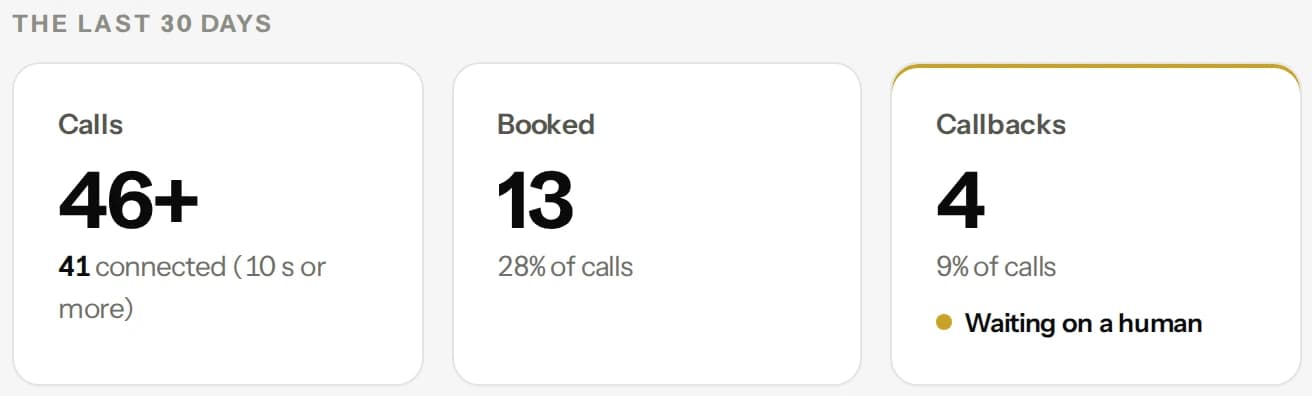
The Calls screen: 46 calls in the last 30 days, 13 booked and 4 callbacks waiting on a person
The last 30 days of calls, shown with a demo account.

Word for Word, What a Patient Hears When It Answers

Here is what the calls actually are, in a setting where getting it wrong matters more than anywhere else in this guide.

Every call opens by saying what it is. It begins by identifying itself as a digital assistant calling for the practice and confirming that the call is recorded. Every call, in every state.

On a recall or rebooking call it keeps the reason general. That the practice has them down as due, or that an appointment was missed and the practice wanted to offer another time, is enough. It does not name a condition, a medication or a result, because the person answering the phone may not be the patient and a phone is not a private channel.

On a new enquiry it handles logistics: what they are looking for in general terms, whether they have been to the practice before, whether they need a particular day or time, and how they would like to be contacted.

What it does not do is the product. It gives no medical advice, no opinion, no interpretation of anything. It does not discuss test results. It does not confirm or deny that somebody is a patient to a caller whose identity has not been confirmed. It does not leave clinical detail on a voicemail or with a family member.

And the hard stop again, because it is the single most important behaviour: anything that sounds acute or urgent ends the booking conversation and goes to a human or to emergency care immediately. Test it yourself with a scripted symptom before you go live. Do not take a vendor's word for it, and that includes ours.

A brass rotary desk phone on a stone block with a row of brass handsets beside it

The Questions It Is Built to Refuse, and Why That Matters Here

In healthcare the restraint is the product. A capable agent that does not know where to stop is a liability dressed as an efficiency.

Privacy first. Patient information is regulated and the rules do not care whether a person or a system made the call. You need plain answers about where data is stored, who can access it, what is retained and for how long, what happens to recordings, and what agreement the vendor will sign. If a supplier becomes vague here, that is the answer to your question. Get it in writing and have somebody who knows this area read it.

Scope second. The agent books people in and follows up the ones who never called back. It does not advise, diagnose, triage clinically or interpret. Every one of those is a licensed activity and the practice carries the consequence, not the vendor.

Consent third. Recording is disclosed on every call. Contact preferences are honoured and removal is enforced by the system, immediately, not at the next overnight sync.

Identity fourth. Nothing specific is discussed until the agent has confirmed who it is speaking to, and if it cannot, it says very little and offers to try again.

And the emergency behaviour above all of it. There is exactly one correct response to an acute symptom and it is to stop and get the patient to a human.

A practice that has spent years earning trust can lose a patient in one badly handled phone call. Any vendor unwilling to talk about these limits in detail is telling you what they have thought about.

A brass ball balanced on a stack of dark stone tiles

What to Check Before You Buy Any Medical CRM, Including Ours

Use this on us harder than on anyone else, because healthcare is where a soft sales process does the most damage.

Be clear which product you are buying. If you need charting, coding or claims, you need practice management software. This is the layer that contacts people, and it should sit alongside that system rather than replace it.

Ask whose list it calls. For a practice the only honest answer is your own patients, your own referrals and your own enquiries.

Ask to see an appointment appear in your own schedule on a real day, on your own system.

Ask what it says at the start of a call, and hear a real recording rather than a script.

Ask what it does with a clinical question, and test it yourself.

Ask what it does when somebody describes an acute symptom, and test that too. This is the one that matters most.

Ask where patient data lives, who has access, what is retained, for how long, what happens to recordings and what the vendor will sign. Get it in writing and have it reviewed.

Ask how a patient is removed from contact, and whether it takes effect immediately or overnight.

Ask who carries responsibility if a call goes wrong, in writing.

And ask what happens after the appointment is booked, because a tool that fills tomorrow and forgets the patient due again next year has solved the easy half of the problem.

Healthcare CRM: Customer Data, Engagement and Growth for a Practice

A healthcare CRM is the part of your business that deals with people before they become patients and after they stop being active ones. It is not your clinical system, and it should never try to be.

Think of the two jobs separately. Your clinical software holds charts, notes and orders. A CRM holds the business side of the relationship: who asked about an appointment, who was offered one and never booked, who was due back and did not come, and who has not heard from you in a year. That customer data is what drives growth, and most practices have it scattered across a phone log, an inbox and a paper list.

A good CRM makes the data usable in three ways. First, access: every call, text and email about one person sits in one record, so whoever picks up the phone sees the full story. Second, action: the system tells you who to contact today and why, so follow-up does not depend on someone remembering. Third, insight: you can see which sources bring in booked visits and which only bring in enquiries.

The AI agent adds the speed. It answers a new enquiry in minutes, asks what the person needs, offers a time from your calendar and sends a confirmation. When the question is clinical, it passes the conversation to a person and does not guess.

Before any patient information goes near it, we review the privacy requirements with you, including whether a Business Associate Agreement is needed, so the rules are settled before launch and not after.

Rising brass bars on a stone slab with a brass magnifying glass leaning on the tallest

The Patient Journey: Engagement and Experience Insights for a Healthcare Business

Every healthcare business has a patient journey, whether it is mapped or not. It starts with a search or a referral, passes through a first call and a first visit, and ideally continues with follow-up care and a reason to come back. The experience at each step decides whether the next one happens.

The weak points are usually small. A call that goes to voicemail. An enquiry that waits a day for a reply. A recall that nobody sends. None of these show up in a clinical record, which is why a health business can feel busy and still lose people.

A CRM gives you the engagement view. You can see how long a new enquiry waited, how many contacts it took to book and which patients are overdue. Those insights tell you where the experience is breaking, so you fix the step and not the whole practice.

The AI agent improves the earliest steps. It answers quickly, asks what the person needs, offers a time and sends a reminder before the visit. It says it is a digital assistant, and clinical questions go to a person.

HEALTHCARE PRACTICES

Common questions, what it costs and what it will not do are answered back on the medical practice page.

Hear it run on medical practice.

Twenty minutes with a real person. See it run on your business, then decide.

Book a demo
Multiply Revenue

AI that calls your leads in a natural voice, follows up by text and email until they answer, and books qualified meetings straight onto your calendar. Outbound and inbound, on one memory.

No setup fee, and no per-text charge from us.

© 2026 Multiply Revenue · 1905 Sherman Street, Ste 200, Denver, CO 80203 · (720) 735-8685
Book a demo