Skip to content
Back to dental & med spa

The med spa CRM playbook.

Everything worth knowing, written out in order. Read it end to end or jump to the part you need. No sign-up, nothing hidden behind a click.

What a Dental CRM Has to Do That a General One Does Not

Practice management software and a CRM are not the same thing, and the confusion between them costs practices more than almost anything else they buy.

Your practice management system is the clinical and scheduling record. It knows the chart, the appointments and the ledger. It is very good at telling you what happened. What it rarely does is reach out. It will show you a recall list and wait, and the list gets worked when somebody at the desk has a quiet afternoon, which is never during the months you most need it worked.

That gap is what a dental CRM is for, and it has to fit around the practice rather than replace it. It has to know which patients are due, which accepted treatment and never booked it, which enquired and never came in, and which have not been seen for long enough that they have probably gone somewhere else.

The shape of the problem is different from ordinary sales in one important way. Almost none of it is new business. The people who represent the most value are already in your own records. They have sat in your chair, they know the practice and somebody there knows their name. This is follow-up, not prospecting, and any tool that treats a patient list like a prospecting list has misunderstood the job and will embarrass you.

It also has to be built for a setting where the front desk is busy with people physically standing there. A system that adds admin has made things worse no matter how good the reporting looks.

Two stone blocks of different heights with a brass ball on the taller one

The Treatment Nobody Scheduled Is Sitting in Your Own Chart

Ask a practice where growth comes from and you will usually hear about new patients. Then look at the unscheduled treatment list.

These are people who sat in the chair, heard the recommendation, understood it and agreed. They meant to book. They walked out to a busy desk, or they wanted to check a date with work, or the cost needed thinking about, and the moment passed. Nobody followed up, because following up on that list properly is a long sequence of slightly awkward individual phone calls and there is always something more urgent at the desk.

This is the single most valuable list in most practices and the least worked. It does not need persuading. It needs asking, at a reasonable time, by something that will actually get through all of it.

The same is true of consultations that did not convert. Somebody came in about aligners or an implant, took the information away and did not come back. The reason is usually timing or money, and both of those change. The practice that calls politely some months later is not being pushy. It is being the one that remembered.

A word on tone, because this is a clinical relationship and not a sale. The right call is short, warm and specific: we noticed this was recommended and never got booked, would you like us to find a time. The wrong one leans on the recommendation to create pressure. That distinction is not just taste, it is the difference between a practice people recommend and one they leave. Any tool you buy should make the first easy and the second hard.

A stone booking board with round slots and a brass ball resting in one

Hygiene Recall Is a Calendar Problem, Not a Marketing One

A hygiene book with gaps in it is rarely a marketing failure. The patients exist, they are due, and most of them would come in if somebody asked at a moment they could say yes.

What actually happens is that the recall list grows faster than the desk can work it. A card goes out, a text goes out, and both are easy to ignore because neither requires an answer. The ones who do not respond stay on the list, the list gets longer and less current, and after a while nobody looks at it because the size of it is discouraging.

Working it by phone is what moves it and everybody knows that. The obstacle has always been the arithmetic of doing so.

An agent does not find a list of several hundred people discouraging. It works through it, gets somebody live, offers a time and books it into the schedule the practice already runs, and it does that in the evenings and at the weekend when people can actually talk. Crucially it also updates the record for the ones who will never come back, the ones who moved, the ones who now go elsewhere, so the list gets smaller and truer instead of just older.

For a med spa the same mechanics apply to a different cycle. Treatments that want repeating on a schedule, packages that were part used and left, consultations that did not convert. It is the same problem wearing different clothes: a list of people who already know you, a natural moment to call and nobody with the hours to do it.

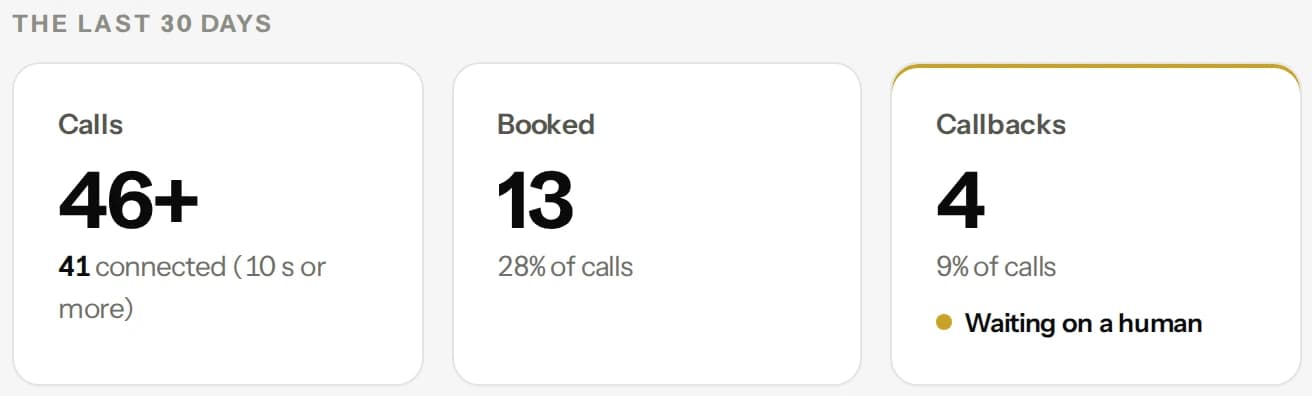
The Calls screen: 46 calls in the last 30 days, 13 booked and 4 callbacks waiting on a person
The last 30 days of calls, shown with a demo account.

What Somebody Booking a Treatment Actually Hears

This deserves more care than any other industry in this guide, because the person being called is a patient, not a prospect.

The call opens by saying what it is. It says up front that it is a digital assistant calling for the practice, and that the call is being recorded. Every call, every state, regardless of what the state requires.

On a recall or follow-up call it keeps the reason general rather than clinical. That we have you down as due, or that something discussed at a previous visit was never booked, is enough to have a useful conversation. The purpose is to find a time, not to discuss care over the phone with somebody whose identity has not been confirmed and who may not be alone.

On a new enquiry it does the sensible front desk work. What they are looking for, whether they have been to the practice before, whether it is urgent or discomfort is involved, whether they have a preference for a particular day, and how they would like to be contacted.

What it does not do matters more here than what it does. It does not give clinical advice or opinions. It does not confirm or discuss details of a condition. It does not quote a price for treatment that has not been examined. It does not leave detailed messages on voicemail or with whoever answers, because a phone is not a private channel and you do not know who is holding it.

And if anybody describes pain, swelling, bleeding or anything that sounds like an emergency, it stops trying to be helpful and gets a human at the practice, immediately.

Gold spheres travelling around a brass double ring

Where It Stops Talking and Hands You the Patient

Healthcare is the one setting where a capable AI on the phone is a liability as much as an asset, and a vendor who will not talk plainly about that is telling you something.

Start with privacy. Patient information is not ordinary business data, and the rules that cover it do not care that a machine made the call rather than a person. Anything that handles it needs a clear answer on where the data lives, who can reach it, what is retained, for how long and what agreement the vendor will actually sign. If a supplier is vague here, that is your answer.

Then scope. The agent is a scheduling and follow-up tool. The moment it starts answering questions about a condition, it is doing something nobody has licensed it to do, and the practice owns that, not the software company. The correct behaviour when a clinical question arrives is to stop and pass it to a person, and you should test this deliberately before you go live rather than hope.

Then consent and contact. Recording is disclosed on every call. People who ask not to be called are not called again, and that has to be enforced by the system rather than by somebody remembering.

Then identity. Before anything specific is discussed, the agent should confirm it is speaking to the right person, and if it cannot, it should say very little and offer to try again.

None of this is decoration. A practice is a licensed business with a reputation built over years, and a tool that is careless on the phone can do more damage in a week than it earns in a year.

A chrome funnel catching a stream of small gold spheres into a bowl

What to Check Before You Buy Any Dental CRM, Including Ours

Use this against us as hard as you use it on anyone else.

Ask whose list it calls. The honest answer for a practice is your own patients, and nobody else. If a vendor offers to call people who are not your patients, understand exactly what is being proposed before anyone agrees to it.

Ask whether it works alongside your practice management system or expects to replace it. Replacing the clinical record is an enormous project and almost never what you actually wanted.

Ask to see the appointment appear in your own schedule, on your own system, on a real day. Not on a demo account.

Ask what it says at the start of a call, and hear a real recording rather than a script.

Ask what it does with a clinical question, and test it yourself before go-live.

Ask what it does when somebody mentions pain or swelling. There is only one right answer.

Ask where patient data lives, who has access, what is retained and for how long, and what the vendor will sign. Get that in writing.

Ask how somebody gets taken off the list, and how fast.

Ask who is responsible if a call goes wrong, and get that in writing too.

And ask what happens after the appointment is booked, because a tool that fills tomorrow and forgets the patient who is due again in six months has solved the easy half.

HEALTHCARE PRACTICES

Common questions, what it costs and what it will not do are answered back on the dental & med spa page.

Hear it run on dental & med spa.

Twenty minutes with a real person. See it run on your business, then decide.

Book a demo
Multiply Revenue

AI that calls your leads in a natural voice, follows up by text and email until they answer, and books qualified meetings straight onto your calendar. Outbound and inbound, on one memory.

No setup fee, and no per-text charge from us.

© 2026 Multiply Revenue · 1905 Sherman Street, Ste 200, Denver, CO 80203 · (720) 735-8685
Book a demo