Skip to content
Back to fitness & gyms

The gym CRM playbook.

Everything worth knowing, written out in order. Read it end to end or jump to the part you need. No sign-up, nothing hidden behind a click.

What a Gym CRM Has to Do That a General One Does Not

A general CRM is built around winning a deal. A gym or a studio does not really have deals. It has a membership, which is a relationship that starts, continues by default and ends quietly, and almost everything that matters financially happens after the sale.

That inverts what the software has to be good at. Getting somebody to join is a single moment. Keeping them is hundreds of small ones. A member who joined and then stopped coming is still paying you today and will almost certainly cancel soon, and nothing in a normal pipeline has any idea that is happening, because from a sales point of view that record closed successfully months ago.

So the useful signal is not pipeline stage. It is attendance. Somebody who came four times a week and has not been in for a fortnight has told you something important without filling in any form. That is the single most valuable piece of data in the building and most gyms do nothing with it, because acting on it means noticing it per person, every week.

The second thing is that enquiries here are impatient and local. Somebody deciding to join is usually deciding this week, often comparing two places within a short drive, and frequently doing it in the evening after a day that made them think about it. An enquiry that waits until the morning for a reply has often already joined somewhere else.

So what a gym CRM has to do is the opposite of storing records neatly. It has to notice a pattern changing and say something while it still matters.


Gold spheres travelling around a brass double ring

The Member Who Stopped Coming Has Not Cancelled Yet

Every gym has a group of members who are paying and not attending. Owners know it, and the instinct is to leave them alone because the money is arriving and a reminder might wake them up.

That instinct is expensive. They are not going to keep paying forever. What actually happens is that the direct debit runs for a few more months, they feel a bit worse about it each time, and then they cancel in a slightly irritated frame of mind and tell a friend that the gym never once noticed. You lose the member, the referral and the goodwill, and you delayed the loss rather than preventing it.

The alternative is a short, friendly, genuinely useful call at the point the pattern breaks rather than at the point the card gets cancelled. Not a sales call. An are-you-alright call. People stop coming for ordinary reasons: an injury, a shift change, a new baby, one embarrassing session, a class they liked disappearing from the timetable. Several of those you can actually solve, and the rest you can at least offer a pause to instead of losing them entirely.

The reason this does not happen is arithmetic again. It is a lot of individual calls, each one small, and nobody at the desk has an hour a day free while people are standing in front of them.

An agent will work through that list every week without finding it tedious, hand the ones that need a human to a human, and put the rest back on a class. Every one of these people is already a member, which means none of this is cold contact and all of it is welcome if the tone is right.

The Trial That Never Converted Is Still a Person Who Walked In

The second list is the one people forget entirely: everybody who tried and did not join.

A day pass, a free week, a taster class, a tour booked on the website. They came in, saw the place, met somebody, and then did not sign up. Most gyms treat that as a closed no. It is nothing of the kind. It is a person who was interested enough to physically turn up, which is far more than most of your marketing ever achieves, and who decided not to right then for a reason that is often temporary.

The reasons are boring and that is what makes them workable. The contract felt long. It was the wrong month. They wanted a class that clashed with work. They meant to and forgot, which is more common than any of the others.

A call some weeks later that says we noticed you came in and never got started, is anything different now, converts a share of that list and costs nothing but the call. The same applies to online enquiries that never turned into a visit at all, which in most gyms is the largest and least-worked list in the system.

There is a timing point worth being specific about. January is not the only moment. September behaves like a second January in most towns, and both are followed by a wave of people who joined with enthusiasm and stopped within a couple of months. Those two cohorts are predictable, they are already in your records and they are the closest thing this business has to a schedule you can plan against.

A chrome funnel catching a stream of small gold spheres into a bowl

What the Agent Actually Says on a Call to a Member

This is a consumer business and the tone matters more than the script, so here is what the calls are.

Every call opens with what it is. The agent identifies itself as a digital assistant calling on behalf of the gym and says the call is recorded. Every call, every state.

On a new enquiry it does the front desk job properly. What they are looking to do, whether they have a gym in mind or are comparing, what times they would realistically come, whether they want classes or the floor, whether anything about a previous membership put them off. Then it books them in to come and look, which is the only thing that actually converts, and puts it on the calendar somebody is on shift for.

On a call to a quiet member it is softer and shorter. It says it noticed they have not been in for a while and asks whether everything is alright. If they are injured, it does not push. If the timetable stopped working, it says what has changed. If they want to pause, it takes that as a win rather than a failure, because a paused member comes back and a cancelled one does not.

What it does not do is worth stating. It does not give training or dietary advice, and it does not comment on anybody's health, weight or goals. If somebody mentions an injury or a medical condition, it stops and gets a person. It does not argue with somebody who wants to cancel. It does not call people who asked not to be called, and that is enforced by the system rather than by somebody remembering.

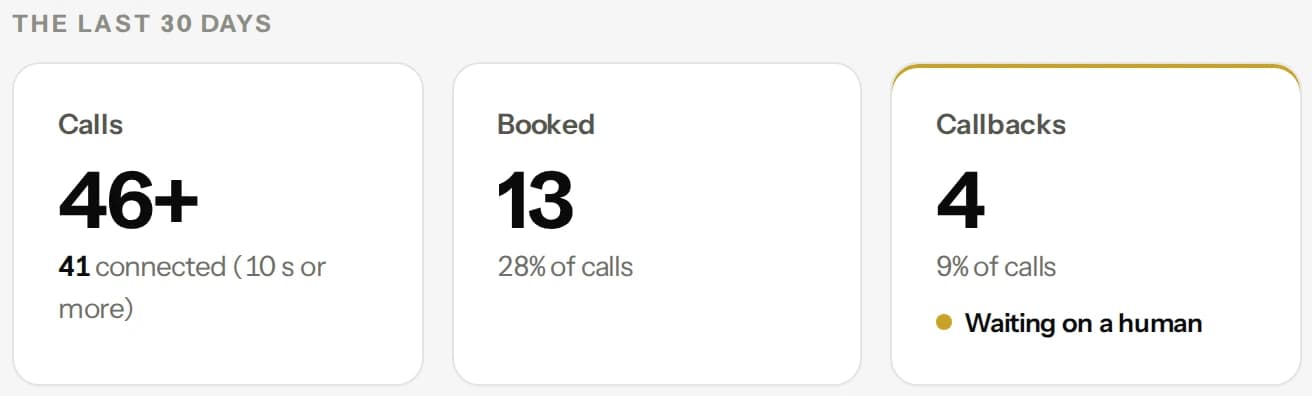
The Calls screen: 46 calls in the last 30 days, 13 booked and 4 callbacks waiting on a person
The last 30 days of calls, shown with a demo account.

It Has to Land in the System That Takes the Payment

A booked tour that lives in a vendor dashboard is not booked, and a save that never reaches the billing system is not a save.

Gyms already run membership software that holds the contracts, the payments, the attendance and the class timetable. That is the system of record and nobody should be replacing it to add a phone agent. What matters is whether the agent can read it and write back to it.

Read, because the whole point is acting on attendance. If the agent cannot see who has stopped coming, it is guessing, and a call to somebody who was in yesterday makes you look foolish.

Write, because the outcome has to stick. If a member agrees to a pause, the pause needs to exist in billing. If somebody books a tour, it needs to be on the rota for the person who will be on the desk. If somebody asks never to be contacted again, that has to be recorded somewhere permanent rather than in a call log.

So the test is concrete. Ask to see attendance data flow in and an outcome flow back out, on your own system, on a real day. Ask what happens when your membership platform is down. Ask how quickly a cancellation or a do-not-contact request takes effect, and whether it is immediate or waits for an overnight sync, because an overnight sync means somebody gets a cheerful call the morning after they quit.

A brass box and a small brass ball on a dark stone tray in warm window light

What to Check Before You Buy Any Gym CRM, Including Ours

Ask us these before you ask anybody else.

Ask whose list it calls. For a gym the honest answer is your own members, your own trials and your own enquiries. If a vendor offers to call local people who have never contacted you, understand exactly what is being proposed, and what the rules are about calling consumers who did not ask to hear from you.

Ask whether it reads attendance, or only contact records. If it cannot see who has gone quiet, it cannot do the most valuable thing on this list.

Ask whether it writes back into your membership and billing platform, and make them prove it on your account rather than a demo one.

Ask what it says at the start of a call and whether recording is disclosed every time. Ask to hear a real call, especially a retention call, because tone is the entire product here and a script reads nothing like the real thing.

Ask what it does when somebody mentions an injury or a health condition. There is one right answer and it is to stop and fetch a person.

Ask how somebody gets removed from the call list and how fast that takes effect.

Ask how you pause it, because there are weeks where you do not want it running.

Ask what it stores, where that lives and how you export it. And get in writing who answers for it when a call goes wrong with a member who is already paying you every month.

Gym Management Software vs a Fitness Studio CRM

Gym management software and a fitness studio CRM overlap, which is why owners often buy one and then wonder why members still slip away.

Gym management software runs the building. It handles class booking, access, billing and membership contracts, the credit card on file and the monthly fee that comes out of it. Tools such as Glofox sit in this category, and for boutique studios running classes all day they do that job well. If you have no system for members, classes and payments, start there.

A CRM runs the relationship before and around that. It deals with the person who filled in a form for a trial, the one who visited once and did not come back, the member whose attendance dropped before they cancelled and the lead who asked about a family plan and never heard back. Those people are not in the billing screen, because they are not paying yet, or they have just stopped.

The difference shows up in a simple way. Billing tells you the number of active members. A CRM tells you who is likely to leave and who is ready to join.

Our agent works from the second list. It answers a new enquiry quickly, asks what the person wants from training, books a trial class or a consultation and follows up if they do not show. For members who have gone quiet, it reaches out with a short message on the channel they actually reply to.

Most studios run both kinds of tool side by side. The question is not which one to pick but which job is currently going undone in your business.

Two stone blocks of different heights with a brass ball on the taller one

Gym Management Software for a Boutique Fitness Business: Classes, App and Billing

Boutique fitness is run on classes, and the software around a class business has to do three things well: take bookings, take payment and keep people coming back. The first two are covered by gym management software and a member app. The third is where most studios, from yoga rooms to CrossFit boxes and martial arts schools, still rely on memory.

Start with what the app does. Members book a class, see the schedule and pay by card, and the studio gets a clean view of attendance. That is management, and it works. Now look at what the app cannot see. It cannot see the person who asked about a family membership by phone and never got a reply. It cannot see the member whose visits dropped from three a week to one. It cannot tell you which lead sources bring in people who stay.

A CRM for a fitness business fills that gap. Every enquiry, trial and conversation goes into one record, and the agent follows up on the ones that went quiet. Coaches and front desk staff see the same history, so a lead is never asked the same question twice.

For a studio with more than one location, the same record follows the person, so a member who moves classes between sites is still one customer. You keep your booking and billing tools and add the follow-up they do not do.

FITNESS AND MEMBERSHIP

Common questions, what it costs and what it will not do are answered back on the fitness & gyms page.

Hear it run on fitness & gyms.

Twenty minutes with a real person. See it run on your business, then decide.

Book a demo
Multiply Revenue

AI that calls your leads in a natural voice, follows up by text and email until they answer, and books qualified meetings straight onto your calendar. Outbound and inbound, on one memory.

No setup fee, and no per-text charge from us.

© 2026 Multiply Revenue · 1905 Sherman Street, Ste 200, Denver, CO 80203 · (720) 735-8685
Book a demo