
Skip to content
Back to coaching

The coaching business CRM playbook.

Everything worth knowing, written out in order. Read it end to end or jump to the part you need. No sign-up, nothing hidden behind a click.

What a CRM for Coaches Has to Do That a General One Does Not

Coaching is a business where one person is the product, the salesperson and the delivery team, and that single fact breaks most sales software before it starts.

A normal CRM assumes somebody is available to work the pipeline. In a coaching business the person who would work it is in a session, and the hours they are most likely to be busy are exactly the hours somebody browsing for a coach decides to enquire. The pipeline does not stall because the coach is disorganised. It stalls because the coach is doing the work they are paid for.

The second thing is that the sale happens on a call rather than on a page. Nobody buys coaching from a website. They book a conversation, and everything before that conversation exists to make it happen and everything after it depends on how it went. So the metric that matters is not visitors or even enquiries. It is discovery calls that actually take place with people who could plausibly say yes.

The third is that a coaching relationship ends by design. A programme finishes, the client moves on, and in most practices the record goes cold at exactly the moment that person is most likely to recommend somebody or to want a second engagement themselves.

So the software has to answer when the coach cannot, qualify before the calendar fills with conversations that were never going to convert, and keep a finished client from disappearing.

A dark stone obelisk with a brass ring circling it

The Discovery Call Is the Whole Funnel, and Most of It Leaks

Ask a coach where the business is lost and they will usually say they need more leads. Watch the actual sequence and the leak is almost always between the enquiry and the call.

Somebody fills in a form at nine in the evening after a bad day at work, which is when people decide they want a coach. The reply comes the next afternoon, by which point the feeling has passed. Or a call gets booked a week out and they do not turn up, because a week is long enough for the urgency to fade and there is no cost to not appearing.

Both of those are timing problems rather than persuasion problems, and both are fixable without changing anything about the coaching itself.

Answering immediately matters more here than in almost any trade in this guide, because the emotion that produced the enquiry is perishable. A conversation while somebody is still sitting with the thought converts at a completely different rate from a reply the following day.

The no-show is the second half. A booked call that is confirmed, and reconfirmed close to the time, with a human voice rather than only a calendar invitation, simply happens more often. That is unglamorous and it is most of the problem.

And then the ones who did not book at all. An enquiry that never turned into a call is not a rejection, it is an unfinished conversation, and it sits in every coaching business unworked because chasing it feels like chasing.

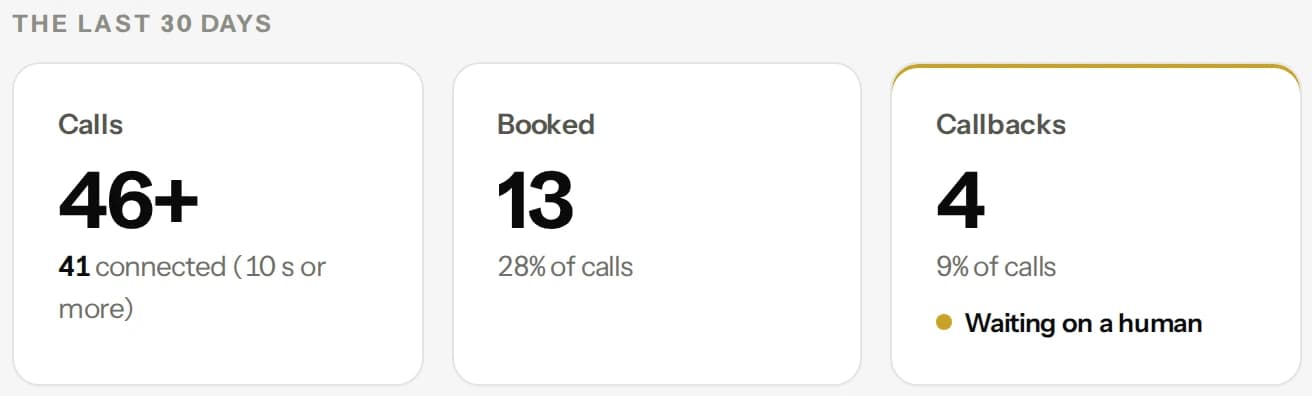
The Calls screen: 46 calls in the last 30 days, 13 booked and 4 callbacks waiting on a person
The last 30 days of calls, shown with a demo account.

Qualifying Before the Call, Not During It

The other half of the discovery call problem is the opposite of not enough calls. It is a calendar full of the wrong ones.

A coach with five discovery calls booked and four of them going nowhere has lost most of a working day and will describe themselves as busy. Free consultations attract people who want free consultations, and the reason a coach ends up giving away an hour of actual coaching to somebody who was never going to buy is that nobody established anything before the call started.

Qualifying has a bad name because it is usually done badly, as an interrogation that makes somebody feel measured. Done properly it is a few honest questions that serve both people: what they are actually trying to change, whether they have tried working with somebody before, whether this is something they are ready to start now or thinking about for later, and whether they are the one who decides, which matters in corporate and executive work.

And yes, budget, handled like an adult. Not a price interrogation, just enough to know whether the programme being discussed is in the same universe as what they expected. A coach who finds that out on the call has already spent the hour.

An agent can do all of that before anything reaches the calendar, and it can say no kindly, which is the part most coaches find hardest to do themselves.

Brass arcs rising like sound waves over a brass ball on a stone plinth

What the Agent Actually Says on a Call to an Enquiry

Coaching enquiries often arrive from people in a difficult moment, and a clumsy call does real harm to a practice built on trust. So here is the call.

It opens by saying what it is. It opens by saying it is a digital assistant calling on your behalf, and that the call is recorded. Every call, every state.

On a new enquiry it asks what they are hoping to change, in their own words rather than a category. How long it has been on their mind. Whether they have worked with a coach before and how that went. What their week actually looks like, which decides whether any programme is realistic. Whether anybody else is involved in the decision, which for executive and corporate work is usually a yes. Then it books the discovery call at a time close enough that the reason they enquired is still live.

On a call to somebody who enquired and went quiet it is short and unembarrassed: you got in touch a while back, is this still something you are thinking about.

What it does not do matters. It does not coach. It does not give advice, reassurance or an opinion on somebody's situation, because that is the coach's work and doing it badly on an intake call devalues it. It does not push somebody who says no. And if a caller describes something that sounds like a mental health crisis, it stops immediately, does not attempt to help, and gets a person, because the distance between a coaching enquiry and somebody in real distress is smaller than most sales software has ever considered.

Three stone blocks of rising height with a brass ball balanced on the tallest

The Client Who Finished Is Not a Closed Record

The most overlooked list in coaching is the people who already did the work.

A client who finished a programme and got something out of it is the warmest possible contact in the business, and in most practices the relationship simply ends. No contact, no check-in, nothing, until they surface on their own or do not.

Two things are being left there. The first is a second engagement. People's circumstances change: a promotion, a new team, a business that grew past the thing they solved last time. A coach who is politely in touch is the one they call, and a coach who vanished is somebody they remember fondly and do not ring.

The second is referrals, which is where most coaching businesses actually get clients and which almost nobody asks for systematically. Not a mass request. A specific conversation with somebody who had a good outcome, at a moment when the outcome is still obvious to them.

The reason this does not happen is that it feels like asking for a favour, so it gets postponed indefinitely. An agent does not find it awkward, and a short call that checks how things have held up since the programme ended is genuinely welcome rather than extractive.

Same rule as everywhere else in this guide: these are people who already worked with you. Nothing here involves contacting a stranger, and a coaching practice in particular should be careful with any vendor offering to do that.

Stone steps rising to the right with a brass ball on each step

What to Check Before You Buy Any CRM for Coaches, Including Ours

Use this on us as hard as on anybody else.

Ask whose list it calls. Ours is your own enquiries, your own past clients and the people who were introduced to you. A coaching practice trades entirely on reputation, and a vendor offering to cold-call strangers on your behalf is offering to spend the only asset you have.

Ask how fast it answers a new enquiry and at what hours, and make them show you a real timestamp rather than a target. Evenings and weekends are when this business arrives.

Ask what it asks before it books, and whether you can change it. The questions are the difference between a full calendar and a useful one.

Ask what it does about no-shows, and whether it actually calls to confirm or only sends a reminder.

Ask what it says at the start of a call and whether recording is disclosed. Ask to hear a real one.

Ask what it will never do. Coaching, advising and opinions on somebody's situation should all be on that list.

Ask what it does if somebody sounds like they are in crisis. There is one right answer, it is to stop and get a person, and you should test it yourself before go-live.

Ask how somebody is removed from contact and how fast. And get it in writing who answers for it when a call goes wrong, because it is your name on the relationship.

PROFESSIONAL SERVICES

Common questions, what it costs and what it will not do are answered back on the coaching page.

Hear it run on coaching.

Twenty minutes with a real person. See it run on your business, then decide.

Book a demo
Multiply Revenue

AI that calls your leads in a natural voice, follows up by text and email until they answer, and books qualified meetings straight onto your calendar. Outbound and inbound, on one memory.

No setup fee, and no per-text charge from us.

© 2026 Multiply Revenue · 1905 Sherman Street, Ste 200, Denver, CO 80203 · (720) 735-8685
Book a demo