
Skip to content
Back to personal training

The personal trainer software playbook.

Everything worth knowing, written out in order. Read it end to end or jump to the part you need. No sign-up, nothing hidden behind a click.

What a CRM Has to Do for a Trainer Who Is Also the Business

Most CRM software assumes there is somebody whose job is admin. A personal trainer does not have one. You are the coach, the salesperson, the scheduler and the person who chases the payment, and every hour you spend on the last three is an hour you are not paid for. So the test for any software here is simple and it is not the feature list. Does it reduce the number of things you do between sessions, or add to them.

That rules out most of the category immediately. A system that needs you to log an outcome after every session will be abandoned inside a month, because after a session you are setting up for the next one. What works is a system that fills itself in from the booking, the call and the text, and asks you to type almost nothing.

The second thing is that your record has to be about the person and not the transaction. When somebody paused in March, the useful information is why: an injury, a house move, a baby, money. That is what makes the call in September a conversation rather than a sales pitch, and it is exactly the detail that lives in your head and nowhere else until you forget it.

The third is that your business is small enough that the pipeline is a list of names, not a funnel. You do not need a dashboard. You need something that makes sure every one of those names hears from you at the right time, and that is a scheduling job.
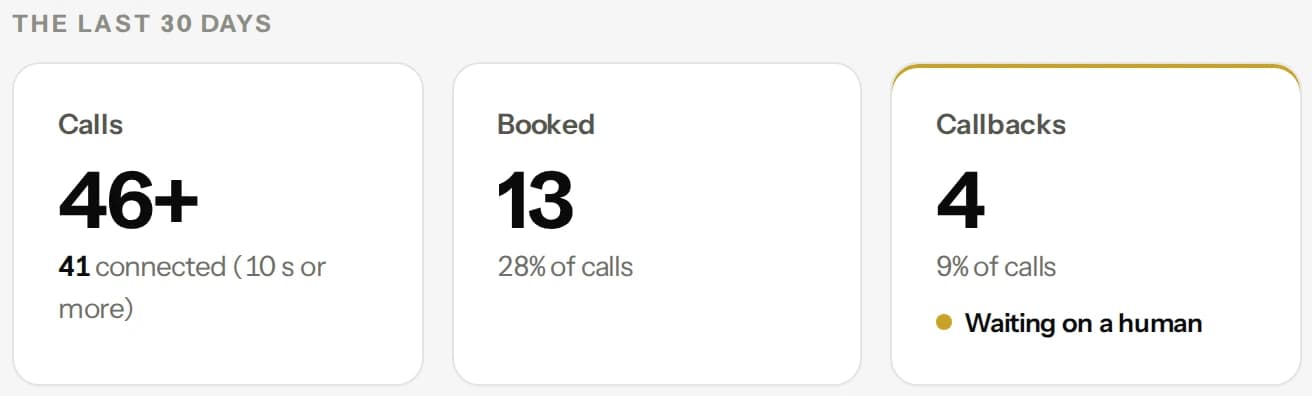

The Calls screen: 46 calls in the last 30 days, 13 booked and 4 callbacks waiting on a person
The last 30 days of calls, shown with a demo account.

Your Past Clients Are the Whole Business

Almost every trainer who has been going more than a couple of years is sitting on more former clients than current ones, and almost nobody calls them. It feels like going backwards. It is the opposite: those people already paid you, already know how you work, and most of them stopped for a reason that has since gone away.

Think about who is actually on that list. The client who trained hard for eight months and stopped when the project at work got busy. The one who got injured and never came back because they were embarrassed about losing progress. The one who moved gyms. The one who finished a twelve-week block, said they would restart in the new year, and never did. Each of those is a warmer prospect than anybody you could find, and each of them needs a different sentence.

The software works that list on a schedule rather than when you happen to think of it. It calls, asks what changed, and books a reassessment if there is anything there. It does not pester the ones who say no, and it writes down what they said so the next call is not a repeat of this one.

The same applies to the people who enquired and never started. Somebody who asked about your pricing eight months ago and got one reply is not a dead lead, they are a person whose situation has probably changed. That list is short, it is free, and working it is the highest-return hour in the business.

The Gym Floor Is Not a Lead Source

Most trainers build their business by being visible: being on the floor, being friendly, being the person members ask. It works, and it caps you exactly where you would expect, because it depends on you being physically present and not training somebody at that moment.

The hidden cost is the enquiries that arrive when you are with a client, which is most of them. Somebody messages your Instagram at eight in the evening asking about your packages. You see it at ten, reply, and they have already spoken to somebody else or lost the impulse. It is not a lack of leads. It is that the reply is always late because the reply is always you.

The agent answers those in seconds, whatever the hour, asks what they are trying to change and what they have tried, and books a consultation on your calendar. It follows up the ones who do not answer instead of leaving them in an inbox.

There is a second source most trainers never touch, and it is not a stranger. Local employers run wellness budgets, and physiotherapists, chiropractors and doctors refer people who need supervised exercise. Those are business calls to business numbers in business hours, and they produce clients in groups rather than one at a time. They are also relationships, which means they need contact on a schedule rather than one hopeful email.

A brass magnifying glass over a stack of stone cards with one brass card lifted out

What the Agent Actually Says on a Call to a Lapsed Client

It is fair to be uneasy about an AI calling your clients, because this business is personal in a way that most are not. So here is what the conversation is made of.

It is short and it is not a pitch. It introduces itself as a digital assistant from your studio, says the line is recorded, and gives the actual reason for calling: it has been a while, how did things go, is training something they are thinking about again. Then it listens. If the honest answer is that money is tight or life is full, it says that is fair, asks whether they want a call in a few months, and gets off the phone. That is the correct outcome and it protects the relationship, which in a small local business is worth more than the session.

If there is interest, it establishes the useful things before you meet: what has changed since they trained with you, any injury, what they want to be able to do, and when they can realistically train. Then it books the reassessment on your calendar and writes it all down, so you walk in already knowing where to start.

Every call is transcribed and scored by a coach against how you want to sound, and you can read a bad one, hear what happened and change what it says next time. Ask any vendor for that. Being able to inspect the conversations matters more here than a booking count, because your name is on every one of them.

Gold spheres travelling around a brass double ring

It Has to Fit the Way You Already Book People

If your bookings live in a calendar app and your payments in a separate one, the last thing you need is a third place to look. A system that becomes its own island means you now have two versions of the truth about who is training on Thursday, and you will trust the wrong one at least once.

So the question for any vendor is not whether it has a calendar. It is whether a booking made by the agent appears in the calendar you already open, against the client record you already have, without you retyping it. If it uses a booking tool you already run, ask directly whether it writes into that or replaces it.

The same goes for your number. Calls should come from the number your clients already have saved, not a strange one they will not answer, and the confirmation text should read like you.

The honest version of what you should end up with is unglamorous: one place where you can see who is training, who has gone quiet and who you owe a call, and nowhere that you type the same thing twice.

A dark stone card standing upright beside a row of small brass balls and stacked stone tiles

What to Check Before You Buy Any CRM for Personal Training, Including Ours

This is the part most vendors leave out, so here is the honest version, including where it does not suit us.

Ask to hear real calls, not a demo. Ask specifically for one where the person was not interested, because that is the call that decides whether you would be comfortable having this thing represent you.

Ask what it does with a no. An agent that pushes a former client who has said they cannot afford it right now will cost you that person permanently, and in a local business word travels.

Ask how long before it is useful. Most of this category takes weeks to set up before it produces anything, and nobody advertises that. Get a date.

Ask what it costs in a heavy month rather than a quiet one, especially if pricing is per minute. Your busiest month is January, which is also the month you most need it working.

Ask about consent and recording. Calling your own past clients and local businesses stands on solid ground. Calling strangers does not, and a vendor who shrugs at that question is handing you the risk, because a complaint names you and not the software.

Ask what happens to your client list if you leave. It should come out without an argument.

And be honest about scale. If you are a solo trainer with a full book and a waiting list, this is not your problem and you should not buy it. It earns its place when you have a list of former clients and unanswered enquiries that nobody is working, which for most trainers past their first couple of years is exactly the situation.

Personal Trainer Software and CRM: What to Compare Before You Buy

Trainers are offered two kinds of software and they are often confused. Training and booking tools such as Mindbody, Trainerize and TrueCoach manage programs, sessions and payments for the clients you already have. A personal trainer CRM does something different: it handles the people who are not yet clients.

That difference matters because most trainers lose money in the gap between a first inquiry and a first paid session. Someone asks about rates, you reply that night, they go quiet and you never follow up because you are on the gym floor. A CRM closes that gap by answering the inquiry at once and following up until there is a yes or a clear no.

Here is what to compare. Speed of first reply, because the first trainer to answer usually wins. Follow-up that continues for weeks, not one message. A single record that shows every text, call and email with a person. A booking link that lands a free consultation on your calendar. And a view of your numbers: inquiries, consultations and new clients each month.

Also check the cost honestly. Some tools charge per client, so the bill rises just as you succeed. Ours starts at $97 a month with no setup fee, and the prices are published.

Keep your existing booking and training software. It does its job well. Add the CRM in front of it, so that every new inquiry becomes a conversation before it becomes a client.

Two stone blocks of different heights with a brass ball on the taller one

How a Personal Trainer Can Use a CRM to Fill a Calendar

A full calendar is rarely about one big marketing push. It comes from a handful of small habits done every week without fail.

First, answer every inquiry within minutes. A text that arrives while you are mid-set can be answered by the agent, which asks what the person wants, what has stopped them before and when they could come in for a free session.

Second, work the ones who went quiet. Anyone who asked about packages and did not book is still a lead. A friendly call or text two days later, then a week later, then a month later brings back a surprising share of them.

Third, look after the people who are about to leave. A client who has missed two sessions is thinking about quitting. A prompt to reach out personally keeps them training and keeps the revenue.

Fourth, ask for referrals at the right moment, which is just after a client hits a goal. Your CRM can prompt you at that moment so it does not slip.

Last, measure. If you know how many inquiries become consultations and how many consultations become clients, you know where to improve. If nine in ten consultations buy, you need more inquiries. If one in ten buy, you need a better first session.

FITNESS AND MEMBERSHIP

Common questions, what it costs and what it will not do are answered back on the personal training page.

Hear it run on personal training.

Twenty minutes with a real person. See it run on your business, then decide.

Book a demo
Multiply Revenue

AI that calls your leads in a natural voice, follows up by text and email until they answer, and books qualified meetings straight onto your calendar. Outbound and inbound, on one memory.

No setup fee, and no per-text charge from us.

© 2026 Multiply Revenue · 1905 Sherman Street, Ste 200, Denver, CO 80203 · (720) 735-8685
Book a demo