Skip to content
Back to consulting

The consultant CRM playbook.

Everything worth knowing, written out in order. Read it end to end or jump to the part you need. No sign-up, nothing hidden behind a click.

What a B2B CRM Has to Do for a Firm That Sells and Delivers

Most CRM software assumes a sales team whose job is selling. A consulting firm does not have one. The people who win the work are the people who deliver it, which means prospecting stops the week a project starts and restarts in a panic when it ends. Every consultant knows this cycle and almost nobody has solved it, because the solution has always been either hiring a salesperson who cannot speak credibly about the work or doing it yourself at the expense of billable hours.

So the first thing to look for in a B2B CRM is whether it can carry the pipeline while you are heads down. Not remind you to carry it. Carry it. A reminder is just a notification you dismiss on the way into a client workshop.

The second is whether the record is built around the relationship rather than the deal. Consulting revenue comes back: the client from three years ago whose new VP has a problem, the prospect who could not get budget last cycle and can now, the partner who refers you twice a year. A pipeline view that closes a record when the deal closes throws all of that away.

The third is that your firm's real advantage is what you know about your own past work. Which industries you win in, which problems you solve fastest, which size of company gets the most value. That is a targeting instruction, and a CRM should let you point the outreach at it rather than at a bought list of everyone.


Two stone blocks of different heights with a brass ball on the taller one

The Referral Pipeline Is the Problem, Not the Solution

Most consulting firms get the large majority of their work from referrals, and most consultants describe that as a strength. It is, right up until the month it is not. Referrals arrive on somebody else's schedule. They cluster and then they stop, and the gap has nothing to do with how good your work is.

The feast and famine cycle costs you twice. Once in the empty months, obviously. But mostly in what a thin pipeline does to your pricing. A firm with three live conversations takes the project it is offered at the rate it is offered. A firm with fifteen chooses on fit and quotes accordingly, and that difference in leverage is worth more over a year than the extra projects themselves.

The fix is not to abandon referrals. They are your best-converting source and they always will be. The fix is to make sure something is happening in the weeks when no referral arrives, so the pipeline has a floor under it.

That is a scheduling problem more than a sales problem. The outreach that fills the gap is not difficult work and it is not even high volume. It is a consistent number of real conversations every week with companies that look like your best clients, which is exactly the work that stops the moment a project starts.

A chrome funnel catching a stream of small gold spheres into a bowl

Your Best Clients Are the Targeting Instruction

The list matters more than the pitch, and most outbound fails on the list. A bought database of everyone with a job title is why cold outreach has the reputation it has.

Your own client history is a better list and you already own it. Look at the engagements that went well: the industry, the company size, the role of the person who hired you, the problem they had when they called. That pattern is your ideal client profile, derived from evidence rather than from a workshop, and it is what the outreach should be pointed at.

There is a second list that gets ignored entirely. Past clients whose sponsor has moved on, proposals that lost on timing rather than on merit, prospects who took a call two years ago and said not now. Those people know your name and know what you do, which makes the conversation completely different from a first contact. Nobody works that list because it feels like old news, and it is usually the warmest thing a consulting firm owns.

The agent works both on a schedule. It calls decision makers on their business line, says plainly why it is calling, finds out whether the problem you solve is a live problem for them right now, and books the meeting on your calendar when it is. It calls back the ones who did not pick up rather than giving up after two attempts, which is where most outreach quietly dies.

Gold spheres travelling around a brass double ring

What the Agent Actually Says on a B2B Call

It is reasonable to be wary of an AI representing your firm to a senior buyer, so here is the substance rather than a promise that it is good.

The call is short and it is honest about what it is. It introduces itself as a digital assistant from your firm, says the line is recorded, and gives a specific reason for calling that relates to the company rather than a generic pitch. Then it asks the only question that matters early: whether the thing you fix is currently a problem worth somebody's time. If the answer is no, it says thank you and gets off the phone, which is a feature and not a failure.

If the answer is yes, it establishes enough to make your meeting worth having. What have they tried. Who else is involved in a decision like this. Is there a timeline or a trigger, a new system, a reorganisation, a deadline. Then it books directly on your calendar and writes the whole conversation down, so you walk into that meeting already knowing the shape of the problem.

Every call is transcribed and scored by a coach against how you want your firm to sound, which matters more here than in most trades: a consulting firm is selling judgement, and a call that sounds like a call centre undoes that in ten seconds. You can read a bad call, hear exactly what happened and change what the agent says next time. Insist on that from any vendor. You should be able to inspect the conversations, not just the meeting count.

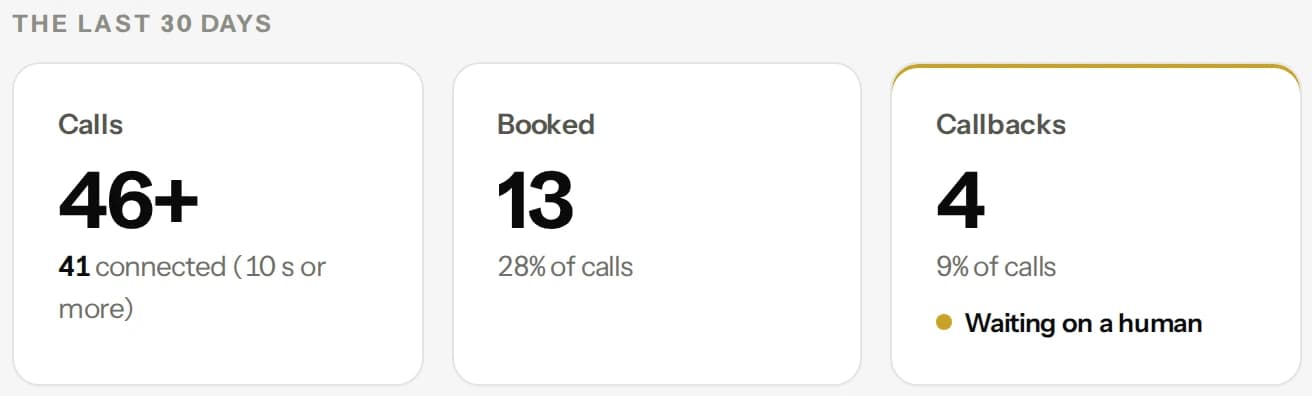
The Calls screen: 46 calls in the last 30 days, 13 booked and 4 callbacks waiting on a person
The last 30 days of calls, shown with a demo account.

It Has to Land in the Pipeline You Already Run

A B2B CRM that becomes a second place to look is worse than no CRM, because now the truth about a prospect lives in two systems and neither one is complete. If your firm already runs on HubSpot, Pipedrive, Salesforce or a spreadsheet that genuinely works, the test is not whether the new thing has its own pipeline view. The test is whether a booked meeting and its notes appear where your partners already look without anyone retyping them.

Ask it concretely. Does the meeting land on my calendar and the record in my CRM. Does it match the company that is already in there or create a duplicate. When a deal closes or dies, does that come back so the outreach stops calling them. Vague answers here mean you are buying a parallel system, and parallel systems get abandoned in month three when somebody stops doing the double entry.

The same applies to how you are represented. Calls should come from your firm's number, not a strange one, and the follow-up email should come from your domain. A prospect who gets a call from one company and an email from another assumes it is a scam, and they are not entirely wrong to.

What you want at the end is one place where the history of a relationship is complete, and no place where anybody types the same thing twice.

A brass magnifying glass over a stack of stone cards with one brass card lifted out

What to Check Before You Buy Any B2B CRM, Including Ours

This is the section most vendors leave out, so here is the honest version, including the parts that do not flatter us.

Ask to hear real calls, not a demo recording. Any voice product sounds good reading a script to a friendly listener. Ask for a call where the prospect was busy, sceptical or annoyed, because that is what a senior buyer usually is.

Ask what it does when the answer is no. An agent that argues with a prospect who is not interested is worse than no outreach at all, because it costs you the relationship and your reputation in a small market.

Ask how long until it is doing anything useful. Most of this category quietly takes a couple of months to configure before it produces a meeting, and almost nobody publishes that. Get a date in writing.

Ask what it costs when you use it hard, and work out the bill for a heavy month rather than an average one. Per-minute pricing looks cheap in a quiet quarter.

Ask about consent and recording, and be specific about it. Calls to businesses on their published lines stand on much firmer ground than calls to consumers, and any vendor who waves the question away is handing you the liability, because a complaint names your firm and not your software.

Ask what happens to your data if you leave. Your prospect list, your call recordings and your history should come out without a negotiation.

And be honest about whether the problem is software. If your close rate on meetings you already get is poor, more meetings will not fix it and will just make the leak bigger. This is worth buying when the meetings are the constraint, which for most consulting firms living on referrals they genuinely are, but not always.

PROFESSIONAL SERVICES

Common questions, what it costs and what it will not do are answered back on the consulting page.

Hear it run on consulting.

Twenty minutes with a real person. See it run on your business, then decide.

Book a demo
Multiply Revenue

AI that calls your leads in a natural voice, follows up by text and email until they answer, and books qualified meetings straight onto your calendar. Outbound and inbound, on one memory.

No setup fee, and no per-text charge from us.

© 2026 Multiply Revenue · 1905 Sherman Street, Ste 200, Denver, CO 80203 · (720) 735-8685
Book a demo