Skip to content
Back to home services

The AI field service management playbook.

Everything worth knowing, written out in order. Read it end to end or jump to the part you need. No sign-up, nothing hidden behind a click.

What Home Service Software Has to Do That a General CRM Does Not

A general CRM assumes one customer buys one thing once. A home service business is the opposite of that in almost every way, which is why so many of them end up with a scheduling tool, a separate contact list, a notebook in the van and nothing that joins them up.

The first difference is that the customer is really an address. The boiler, the panel, the drain and the roof belong to a house, and the house often outlives the relationship with the person. When somebody new buys it, everything you know about that property is still worth knowing.

The second is that the work is not one thing. If you run more than one trade, or a handyman operation, the same customer can be a small repair in March and a replacement in November, and those two jobs have nothing in common except the driveway. A pipeline built around a single deal size will mis-handle both.

The third is urgency, and it cuts two ways. Some calls need a van today and everything else stops. Others are planned work that can sit for weeks and will quietly die if nobody touches it. A system that treats those identically will either panic about a quote or ignore a flood.

So the record has to carry the property, the history of what has been done to it, what was quoted and refused, what was recommended and deferred, and whether this customer is on a plan. And the software has to act on that, because a home service business almost never fails for lack of information. It fails because the information sat there and nobody had a spare hour to do anything with it.


A chrome funnel catching a stream of small gold spheres into a bowl

The Job You Already Did Is the Cheapest Job You Will Ever Sell

Every home service business is sitting on a list of people who have already let one of your vans onto their drive, watched your technician work and paid the invoice. That is the hardest part of selling, and it is already done.

Then almost nobody calls them again.

It is not negligence. It is that following up properly means noticing that a particular repair was two years ago, that a particular quote was declined for a reason that has probably changed, and that a particular technician wrote down a recommendation the customer deferred. Those notes are scattered across years of jobs and nobody has time to comb them.

That combing is exactly what software is for, and calling on what it finds is exactly what an agent is for. The recommendation your technician made and the customer put off is a real reason to call, with a real date attached. The quote that went quiet has a reason written next to it. The repair you did on a part with a known service life has a date when it becomes a conversation rather than a cold call.

There is a version of this that goes wrong and it is worth naming. A blanket reminder blasted to everyone teaches people to ignore you, and it is what most businesses try first because it is easy. The difference between that and what actually works is whether the call is about this house and this job, or about your calendar.

Membership and service plans deserve their own mention. A plan that renews silently is revenue you keep by accident, and a plan that lapses silently is revenue you lose the same way. Knowing which is which, and calling the second group before they drift, is the least glamorous and most reliable growth in this trade.

A dark stone card standing upright beside a row of small brass balls and stacked stone tiles

The Property Managers and Builders Who Send You Work

The other half of the pipeline has nothing to do with homeowners. It is the businesses that decide which van gets called: property managers with a portfolio, landlords, letting agents, builders and general contractors, realtors who need something fixed before a sale closes, facilities people at small commercial sites.

These relationships behave differently from consumer work. They start slowly, they are won on reliability rather than price, and once they are working they produce steady volume without you bidding for it every time. They also do not churn dramatically. They fade.

That fading is the problem worth solving. You do a good job for a letting agent, you are on their list, they call you for a while, then a new person takes over the desk or you were unreachable on a bad week and the calls thin out. Nobody decided anything. A year on, somebody else is getting the work.

That is a follow-up problem with a specific shape, and it is the same shape as the lapsed customer: a relationship that already exists, gone quiet, with a moment worth reappearing at. The agent calls those contacts on a business line, in business hours, about work. It asks what is coming up, whether anything needs doing before a tenancy changes or a sale completes, and whether they want you to hold a slot.

That is the whole outbound posture, and it is worth saying plainly: the agent works the list you already have and the businesses that already know you. It is not for dialling strangers, and a home service business trading on local reputation should be extremely careful with anyone who offers to do that on its behalf.

A brass box and a small brass ball on a dark stone tray in warm window light

What the Agent Actually Asks on a Home Service Call

Here is the actual call, because a general claim about qualifying leads does not help you decide anything.

It says what it is at the start. The agent identifies itself as a digital assistant calling on behalf of your company and says the call is recorded, every time, in every state.

On an inbound call the first job is triage, and getting this wrong is expensive in both directions. It establishes what is happening, whether anything is actively leaking, sparking or without heat, and whether this is an emergency that needs a van now or planned work that wants a proper slot. It confirms the address and whether the caller is the owner or a tenant, which decides who can authorise the work and is the question most often skipped. It asks what the system is and roughly how old, because that changes who you send.

On a call to somebody already in your records, it says why it is calling. Your technician flagged this last time. This was quoted and left. This unit is at the age where it is worth a look before winter.

It handles the ordinary questions: roughly when you could get there, how you charge for a call-out, whether you cover that area. It does not diagnose a fault down the phone and it does not price a job nobody has seen, because both of those come back as an argument on the day.

When the job is real it gets it onto the board. When it is not, it says so and ends politely rather than sending a van into a wasted hour. When somebody wants a person, it stops and gets one.

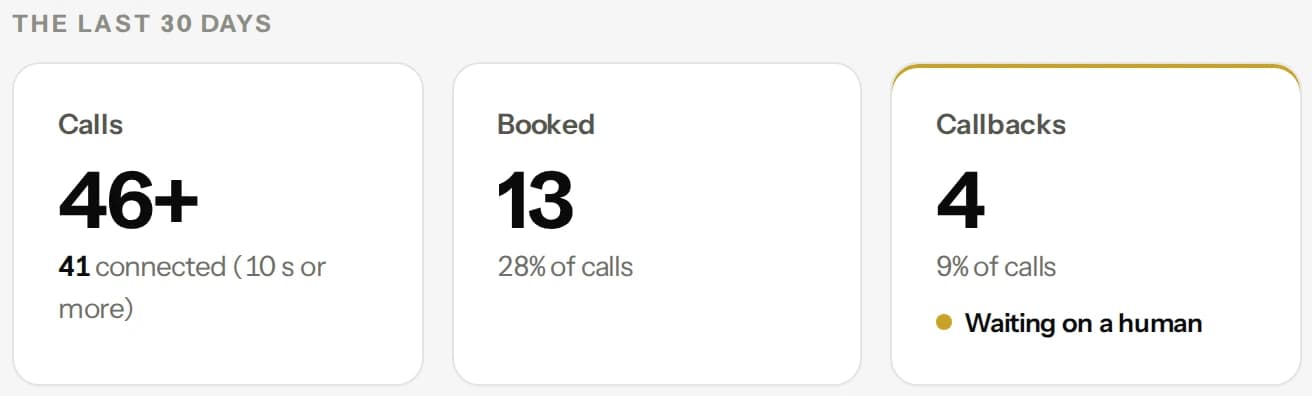
The Calls screen: 46 calls in the last 30 days, 13 booked and 4 callbacks waiting on a person
The last 30 days of calls, shown with a demo account.

It Has to Land on the Dispatch Board

A booked job that lives in the vendor's dashboard is not booked. It is a note waiting to be noticed, and in a trade where the whole business runs off one schedule that is worse than useless.

Most home service operations already have a scheduling and dispatch tool they trust, and a technician's day starts by opening it. Any sales layer that does not write into that tool is creating a second source of truth, and a second source of truth in dispatch is how two vans end up at one address and nobody goes to the other.

So the test is concrete, and you should run it on your own setup rather than watch it on a demo account. When the agent books a job, does it appear on the board the dispatcher and the technician actually use, with the address, the fault and the access notes attached. When a customer says the tenant is only there on Thursdays, does that constrain the slot or vanish into a transcript. When a technician recommends work the customer defers, does it come back later as a call, or does it die in a job note.

Backwards matters just as much. If a job is rescheduled, cancelled or completed, the agent has to know. A follow-up call about work that was finished last week makes you sound like a company that does not know what its own vans are doing.

And ask what happens on your worst day. When the whole board is full and a cold snap has the phone ringing, you want the agent triaging and being honest about lead times, not booking work you cannot reach. Ask to be shown that, not told about it.

A brass ball resting on a dark stone beside a folded white cloth

What to Check Before You Buy Any Home Service Software, Including Ours

Use this against us as much as against anyone. A buyer with a checklist gets a better result from every vendor in the room.

Ask whose list it calls. If the answer involves a bought list of homeowners, think carefully about what that does to a local name you cannot replace. Ours is your own customer history and the businesses that already send you work.

Ask whether it does outbound at all, or only answers. Answering fast is genuinely valuable in this trade. It is also only half the job, and the half that does not touch the deferred recommendations sitting in your own records.

Ask whether it writes into the scheduling tool you already run, and make them prove it on your account. This is the single most common place these projects quietly fail.

Ask what it says at the start of a call and whether recording is disclosed every time. Ask to hear a real call.

Ask how it tells an emergency from a routine job, and what it does when it is not sure. The safe behaviour is to treat it as urgent and get a human involved, not to guess.

Ask what happens when it does not know something. It should stop and fetch a person.

Ask what it stores, where it lives and how you export it. Do that on day one.

Ask who carries the responsibility if a call goes wrong, and get the answer in writing rather than in a conversation.

TRADES AND FIELD SERVICE

Common questions, what it costs and what it will not do are answered back on the home services page.

Hear it run on home services.

Twenty minutes with a real person. See it run on your business, then decide.

Book a demo
Multiply Revenue

AI that calls your leads in a natural voice, follows up by text and email until they answer, and books qualified meetings straight onto your calendar. Outbound and inbound, on one memory.

No setup fee, and no per-text charge from us.

© 2026 Multiply Revenue · 1905 Sherman Street, Ste 200, Denver, CO 80203 · (720) 735-8685
Book a demo