Skip to content
Back to plumbing

The plumbing CRM playbook.

Everything worth knowing, written out in order. Read it end to end or jump to the part you need. No sign-up, nothing hidden behind a click.

What a Plumbing CRM Has to Do That a General One Does Not

Most CRM software was built for a salesperson working a pipeline of deals that move forward in a straight line. Plumbing does not work like that. Half your work is an emergency that did not exist an hour ago, and the other half is a job somebody has been putting off for two years. Neither one is a deal stage, and a system built around deal stages will fight you on both.

So the first thing to look for in plumbing CRM software is whether the record is built around the property rather than the opportunity. You want to open an address and see the plumbing: the water heater you put in and when, the repipe you quoted and what they said, the drain you have snaked twice, what the tech wrote down each time. That history is what turns the third call about the same slow drain into a sewer line conversation rather than a fourth snake.

The second thing is that a plumbing job has two clocks. The emergency needs a truck now, and the planned work needs a call at the right moment, which might be months later. Software that only handles the first clock leaves the profitable half of your business to memory, and nobody remembers.

The third is that your plumbers are under sinks and inside walls. Anything that requires a tech to log in and update a field at the end of a job will not get done, because at the end of a job they are washing their hands and driving to the next one. What works is a system that fills itself in from the call, the text and the booking, and asks the office to type as little as possible.


A tray of small brass balls with one large brass ball on top

The Emergency Pays Today, the Planned Work Pays the Year

An emergency callout is the easiest revenue in the trade and the least profitable per hour once you count the disruption. The pipe is leaking, the homeowner calls whoever answers, you send a truck, you fix it, and you invoice for a repair. Everybody in your market gets a share of that work simply by picking up the phone.

The jobs that decide your year are the other kind. A water heater replacement, a repipe, a sewer line, a bathroom remodel rough-in, a commercial maintenance contract. Those are not emergencies. Nobody wakes up and calls you about them. They get decided slowly, they get quoted by two or three companies, and they go to whoever was in front of the customer at the moment they stopped putting it off.

That is the difference between a plumbing company that grows and one that stays where it is, and it has almost nothing to do with how good the plumbing is. It is a question of whether anybody is making the calls that turn a repair you did last spring into the repipe this autumn.

In most shops nobody is. The owner intends to, the office is answering phones and scheduling trucks, and the list of quotes that never closed sits in a drawer or a spreadsheet. That work is not lost to a competitor. It is lost to nobody, which is worse, because it was yours to take.

Stone steps rising to the right with a brass ball on each step

The Water Heaters You Installed All Have Dates On Them

Every water heater you have ever installed has a life, and you know exactly when you installed it because you invoiced it. Every repipe you quoted and lost has a reason it was lost, and most of those reasons expire. Every service plan you sold comes up for renewal. Every emergency callout you attended for a homeowner who was not your customer before is now a customer who has met you.

That is four lists, they are all in your own records, and they are the cheapest work available to you. They are also almost never called, because calling them is nobody's actual job and there is always a truck to dispatch.

The agent works those lists on a schedule. It calls the addresses where the heater is near the end of its life and offers to look at it before it fails on a Sunday, which is a much easier conversation than the one that starts with a flooded utility room. It follows up the quotes that went quiet, because a homeowner who said not right now in March is a different person in September. It rings the service plans before they lapse. It calls the one-time emergency customers and turns them into people who have your number saved.

The other list is not residential at all. Property managers, restaurants, builders and facility managers all hand out plumbing work on contract, and they are business calls to business numbers during business hours. Those accounts are the ones that make a quiet January bearable, and they are won by being the company that called rather than the company that waited.

Two stone blocks of different heights with a brass ball on the taller one

What the Agent Actually Asks on a Plumbing Call

It is fair to be sceptical about an AI talking to your customers, so here is what the conversation is made of rather than a promise that it is good.

On an inbound emergency it establishes the situation in plain terms. Is water running right now, or has it stopped. Where is it coming from, and is it clean water or waste. Can you get to the shutoff, and do you know where it is. Has the ceiling come down or is it just wet. How many bathrooms does the house have, because a single-bathroom house with a blocked drain is a different urgency from a house with three. That last set of questions is what separates a truck tonight from a booking on Tuesday, and it is exactly what a script without judgement gets wrong in both directions.

Then it books. It reads your real availability rather than promising a window you cannot cover, confirms by text and writes the job up with the answers attached, so the plumber arrives knowing what he is walking into and what to bring.

On a call to your own list it is a different job and a shorter one. It has a specific reason to be calling, the age of the heater or the quote that went quiet, it says so in the first sentence, and it is trying to get somebody on the schedule rather than sell on the phone.

On every call, in every state, it introduces itself as a digital assistant and says the line is recorded. Every call is transcribed and scored by a coach against how you want your company to sound, so you can read a bad call, hear what actually happened and change what the agent says next time. That is the part to insist on from any vendor: you should be able to inspect the conversations, not just the booking count.

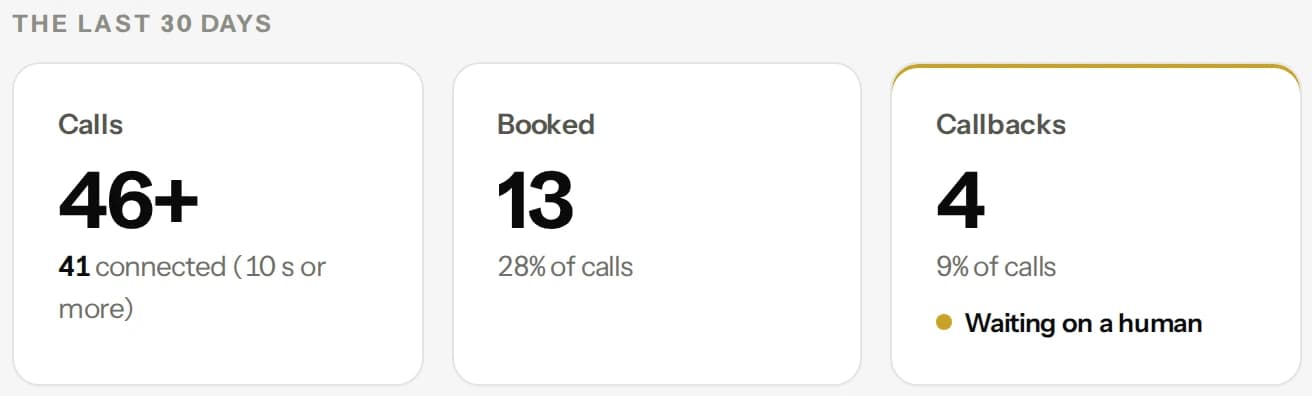
The Calls screen: 46 calls in the last 30 days, 13 booked and 4 callbacks waiting on a person
The last 30 days of calls, shown with a demo account.

It Has to Land Where Your Dispatcher Already Works

A plumbing CRM that becomes a second place to look is worse than no CRM, because now the truth about a job lives in two systems and neither one is complete. If your dispatch and invoicing already run in ServiceTitan, Housecall Pro or Jobber, the test is not whether the new thing has a calendar of its own. The test is whether a booked job appears on the board your dispatcher already has open without anybody retyping it.

Ask that concretely, and do not accept a vague answer. Does the job land on my dispatch board. Does the customer record match the one that is already there, or does it create a second one. When the plumber closes the job, does the outcome come back so the next call knows what happened. If the answers are woolly, what you are being sold is a parallel system, and your office will end up doing double entry to keep it honest, which is how these things quietly get abandoned in month three.

The same goes for your phone number. Changing numbers is the thing that makes plumbing companies put a decision off for a year, and reasonably so, because a dead number on a Monday morning is a catastrophe you cannot undo. It should sit in front of the number you already advertise rather than asking your customers to learn a new one.

What you should end up with is one place where a property's plumbing history is complete and no place where your team types the same thing twice. Everything else a vendor lists matters less than that one thing.

A dark stone card standing upright beside a row of small brass balls and stacked stone tiles

What to Check Before You Buy Any Plumbing CRM, Including Ours

This is the section most vendors leave out, so here is the honest version, including the parts that do not flatter us.

Ask what happens on your worst morning, not your average one. A freeze, a holiday weekend, a main break down the street: the calls arrive together, and software that keeps up with twenty a day can behave differently when thirty arrive in the same hour. That is the exact situation that costs you jobs, so get a specific answer about it.

Ask to hear real calls, not a demo recording. A scripted demo makes any voice product sound competent. What you want is a call where the customer was panicking, interrupted, or was angry about a price, and to hear how it went.

Ask how long until it is doing anything useful. A lot of this category needs months of setup before it pays for itself, and you will not hear that on the sales call. Pin them to a date and have it in writing.

Ask what it costs when you use it hard. Per-minute and per-call pricing looks cheap in a normal month and lands badly in a cold snap, which is the month you bought it for. Work out the bill for your worst week, not your typical one.

Ask about consent and recording. Calls to your own customers and to businesses stand on solid ground. Cold calls to strangers do not, and a vendor who waves the question away is handing you the liability, because the complaint names the plumbing company and not the software.

Ask what happens to your data if you leave. You should be able to take your customer list, your call recordings and your property history out without a negotiation.

And be honest with yourself about whether the problem is software. If you are turning work away because you cannot hire a third plumber, a CRM will show you the work you are turning away in more detail and will not fix it. This is worth buying when the work is arriving and falling through gaps, and when the planned jobs in your own records are going uncalled, which in this trade is almost always true.

TRADES AND FIELD SERVICE

Common questions, what it costs and what it will not do are answered back on the plumbing page.

Hear it run on plumbing.

Twenty minutes with a real person. See it run on your business, then decide.

Book a demo
Multiply Revenue

AI that calls your leads in a natural voice, follows up by text and email until they answer, and books qualified meetings straight onto your calendar. Outbound and inbound, on one memory.

No setup fee, and no per-text charge from us.

© 2026 Multiply Revenue · 1905 Sherman Street, Ste 200, Denver, CO 80203 · (720) 735-8685
Book a demo