Skip to content
Back to landscaping

The landscaping CRM playbook.

Everything worth knowing, written out in order. Read it end to end or jump to the part you need. No sign-up, nothing hidden behind a click.

What a Landscaping CRM Has to Do That a General One Does Not

A general CRM is built around a deal that happens once. Somebody buys, the deal closes, the record goes quiet. Landscaping does not work like that, and the mismatch is the reason so many crews end up running the business out of a notebook and a phone.

You are really running two businesses out of one truck. There is maintenance, which is the same customer every week or every fortnight for years, and there is project work, which is a design, a patio, an irrigation system or a planting, quoted once and either won or lost. The first is a renewal problem. The second is a follow-up problem. Most software is good at one and hopeless at the other.

Then the calendar makes it harder. Demand is not steady and never will be. There is a stretch in spring where every phone call is urgent and you are turning work away, and a stretch in winter where the phone does not ring and the crew is idle. A pipeline that only reacts to inbound will always be busiest when you least need the help and silent when you need it most.

So the record has to hold things a generic contact list has no room for. Which property this is, because the work belongs to an address as much as to a person. What is planted there and when it went in. Whether they are on a maintenance plan and when it renews. What you quoted for the patio last year and what they said when they went quiet. Whether they are a homeowner deciding alone or a property manager with a portfolio and a budget cycle.

And it has to know when to speak. A landscaping CRM that stores all of that and still waits for the customer to call first has automated your filing, not your sales.


Stone steps rising to the right with a brass ball on each step

The Spring Rush Is Won in February

Everyone in this trade knows the shape of the year and almost nobody works against it. The calls come when the grass starts growing, which is exactly when every other company is also being called, and exactly when you have the least time to sell anything.

The crews that are not scrambling in April did their selling in the quiet weeks. They went back to last year's list before the season started and asked a simple question: are we doing your beds again this year. That call is easy, it is welcome, and it is almost never made, because in February nobody feels any urgency and in April there is no time.

That is precisely the work an agent is good at. It has no sense of which month feels urgent. It will work a list of last season's customers in the quiet weeks, ask whether they want the same again, note who says yes, who wants something different and who has moved, and put the yeses on your schedule before the rush starts.

The same applies to the accounts that quietly stopped. A maintenance customer rarely cancels. They just do not come back the following spring, and because they never said no out loud, nobody ever calls to ask why. Half the time the reason is nothing to do with you. They had a bad year, a relative was ill, they tried a cheaper crew and regretted it. The only way to find out is to ask, and the reason nobody asks is that it is a slightly awkward call to make sixty times in a row.

None of this is cold contact. Every one of these people has had your crew on their property.

Brass arcs rising like sound waves over a brass ball on a stone plinth

The One-Off Install Is a Maintenance Contract Nobody Asked For

The most valuable thing in most landscaping businesses is a customer who bought once and was never asked to buy again.

Somebody paid for a planting scheme, an irrigation run or a new lawn. The job went well. Then the relationship ended, because the job ended, and the maintenance conversation never happened. A year later the beds they paid for are overgrown and somebody else is cutting the grass around them.

That conversation is not a hard sell. The plants you chose have a season when they need attention. The irrigation you installed needs a start-up in spring and a blow-out before the freeze. The lawn you laid has a feeding schedule. These are real, specific, dated reasons to call, and they are already sitting in your own records as the date you did the work.

A landscaping CRM that knows what you installed and when can turn each of those into a call at the right time. Not a newsletter to everyone, which is what usually gets tried and abandoned. A call to one person about the thing on their property, in the month it matters.

The commercial side works the same way with different timing. A property manager, an HOA board or a builder runs on a budget cycle and a contract end date, and the moment to be talking to them is before that date, not after the tender has gone out. Those are business relationships on business lines, people who already know your crew and have seen your work. Keeping track of when each of those decisions comes up is a filing job that no busy owner has ever kept on top of by memory, and it is the single thing most likely to grow the commercial half of the business.

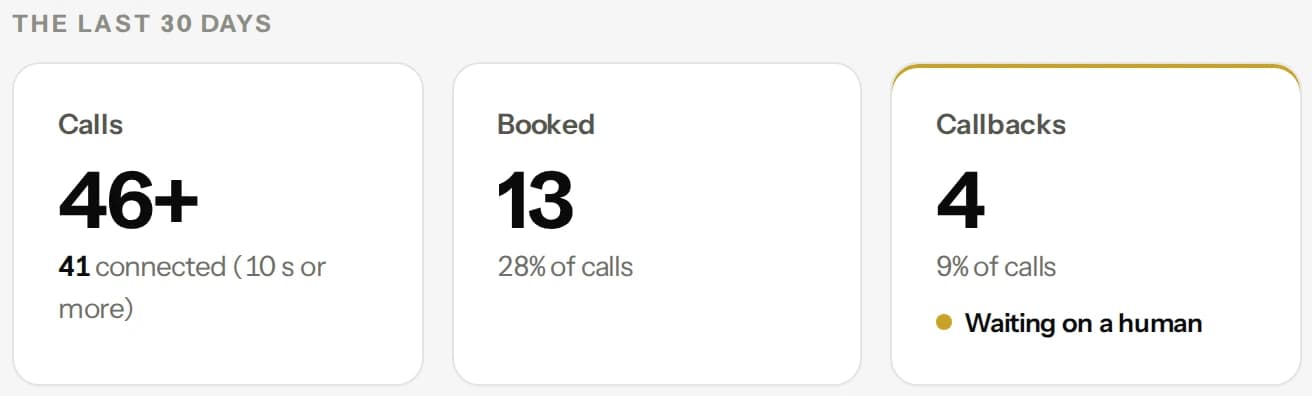
The Calls screen: 46 calls in the last 30 days, 13 booked and 4 callbacks waiting on a person
The last 30 days of calls, shown with a demo account.

What the Agent Actually Asks on a Landscaping Call

A description of an AI that qualifies leads is not much use to somebody deciding whether to buy one, so here is the actual call.

It opens by saying what it is. The agent identifies itself as a digital assistant calling on behalf of your company, and it says the call is recorded. That happens every time, in every state, whether or not the state requires it.

On a new enquiry it works out what would otherwise cost you a wasted drive. What the property is and roughly how big. Whether they want a one-off job or someone regularly. What they are actually trying to fix, because a request to tidy the front can mean anything from a mow to a full replant. Whether they have had somebody do this before and what went wrong. Whether anyone else needs to agree before work starts, which is the question that saves the most time in this trade and the one people forget to ask.

On a call to somebody already on your list it is a different conversation entirely, and it should sound like one. It is calling because they were a customer, so it says so. Are we doing this again this year. Is the irrigation going back on. Do you want the beds redone before the party you mentioned.

It can answer the ordinary things: roughly when you could start, how a maintenance visit works, whether you handle the clippings. It does not quote a price for a project it has not seen, because nobody can and pretending otherwise costs you the job on the day the real number arrives.

When it makes sense, it books the walk-through onto the calendar the estimator actually uses. When it does not, it says so politely and stops. When somebody asks for a person, it gets them a person.

A brass rotary desk phone on a stone block with a row of brass handsets beside it

It Has to Land on the Schedule the Crew Actually Reads

A booked walk-through that lives in a vendor dashboard is not booked. It is a message waiting for somebody to notice.

This is where software sold to this trade tends to fall down. The call goes well, the customer is keen, the system writes a tidy summary, and then nothing happens because the crew leader works off a schedule that never heard about it and the owner is on a mower.

So the test is mechanical and you should run it on your own tools before you sign anything. When the agent books a visit, does it appear on the schedule the person driving there opens in the morning, with the address and the notes attached. When a customer says they want the irrigation started in April, does that turn into something that will actually call them in April, or does it sit in a transcript nobody opens. When a property manager mentions a contract coming up for renewal, does it reach the person who handles contracts.

It has to work backwards too. If the crew moves a visit or an account cancels, the agent needs to know, because nothing sours a relationship faster than a cheerful call about a service the customer stopped months ago.

Seasonality deserves one specific question of its own. Ask what happens when you tell it to stop. There are weeks in spring where you do not want any more work and an agent still filling the calendar is actively harmful. It has to be as easy to pause as it is to start, and you should see that switch demonstrated rather than described.

A chrome funnel catching a stream of small gold spheres into a bowl

What to Check Before You Buy Any Landscaping CRM, Including Ours

The rest of this guide argues for a way of running the work. This part is meant to be used against us as much as anyone else, because a buyer with a checklist gets a better outcome from every vendor in the process.

Ask whose list it calls. If the answer is a bought list of homeowners in a postcode, understand what you are buying and what it does to your name in a town you have to keep working in. Our answer is your own customers and the businesses that already send you work, and you should hold us to it.

Ask whether it does outbound at all. A lot of tools described as AI agents only answer the phone. Answering quickly is worth having, but it does nothing about last year's customers, which is where your spring schedule is actually hiding.

Ask whether it understands a recurring account. Plenty of systems can book an appointment and have no concept of a customer who is due again in a fortnight forever.

Ask what it says at the start of a call and whether recording is disclosed every time. Ask to hear a real call rather than a scripted sample.

Ask what happens when it does not know. The honest answer is that it stops and fetches a human. An agent that never gets stuck is a demo.

Ask how you pause it in a busy week, and watch somebody do it.

Ask what it stores, where that lives and how you get it out. Export your data on day one, not on the day you are leaving. And ask who is responsible if a call goes wrong. Ask that one in writing.

RECURRING PROPERTY SERVICES

Common questions, what it costs and what it will not do are answered back on the landscaping page.

Hear it run on landscaping.

Twenty minutes with a real person. See it run on your business, then decide.

Book a demo
Multiply Revenue

AI that calls your leads in a natural voice, follows up by text and email until they answer, and books qualified meetings straight onto your calendar. Outbound and inbound, on one memory.

No setup fee, and no per-text charge from us.

© 2026 Multiply Revenue · 1905 Sherman Street, Ste 200, Denver, CO 80203 · (720) 735-8685
Book a demo