Skip to content
Back to solar

The solar leads and CRM playbook.

Everything worth knowing, written out in order. Read it end to end or jump to the part you need. No sign-up, nothing hidden behind a click.

What a Solar CRM Has to Do That a General One Does Not

Most CRM software assumes a deal moves in a straight line. A prospect comes in, a rep works it, it closes or it dies. Solar does not behave like that. A homeowner asks for a quote in spring, sits with it through the summer, talks to a spouse, waits for a roof to be replaced, watches a utility bill climb, and signs in the autumn. In a general CRM that deal was marked lost in week three.

The stall is not a failure in solar. It is the normal shape of the sale. So the first thing a solar CRM has to do is treat a quiet quote as an open one, and hold on to the reason it went quiet rather than just the date it stopped moving.

That means the record has to carry things a generic pipeline has no field for. Whether they own the home. How old the roof is and whether it needs work first. Which utility they are on. Roughly what they pay now. Whether the shade problem was the real objection or the polite one. Whether financing was the sticking point and whether their situation has changed since.

The second thing is that those reasons expire. A roof that was too old two years ago has often been replaced. A rate that was tolerable has gone up. An incentive that was not worth the paperwork is about to end. A CRM that only stores the objection is a filing cabinet. One that knows when the objection stops being true is a sales system.


A brass ball resting on a dark stone beside a folded white cloth

The Quote That Went Quiet Is Worth More Than the Next Lead

Ask most solar companies where their next install is coming from and they will point at lead spend. Then look at what is already in their system. Every homeowner who asked for a quote, sat through the consultation, understood the numbers and did not sign is a person who already did the hard part. They learned what solar is, they let you on their property, and they told you exactly why the answer was not yet.

That is a warmer list than anything you can buy, and for most installers it is the largest one they own. It also costs nothing to work again.

What stops companies using it is not disagreement, it is arithmetic. Working a list like that properly means calling people at the moment their reason changed, which is scattered across months and does not fit a rep's day. Reps call the fresh leads because the fresh leads are in front of them. The old quotes sit there, and the longer they sit the more awkward the call feels.

This is the part the agent is actually for. It works the list you already have, in order, on the trigger that matters for each person rather than on a generic follow-up cadence. The homeowner who said the roof was too old gets called when that objection has aged out. The one who balked at the monthly payment gets called when the financing picture changes. The one who said talk to me after the summer gets called after the summer, which is the promise a human made and then did not keep because September was busy.

Nobody is being cold-called here. Every one of these people asked you for a price.

A brass magnifying glass over a stack of stone cards with one brass card lifted out

The Builders and Roofers Who Send You Work Are a List Too

The other list worth working is not homeowners at all. It is the businesses that decide where an install goes: roofing companies replacing a deck that is about to have panels on it, builders speccing new construction, property managers with a portfolio, electricians who get asked about solar and have nobody to name, HOA boards fielding the same question from residents every year.

These are business relationships and they behave differently from consumer leads. They are slower to start and much slower to end. One roofer who reliably passes you work is worth more than a season of shared leads, and unlike a lead they do not get resold to three competitors the moment they raise their hand.

They are also the relationships that decay quietly. You meet a builder at a job, you swap numbers, you send work back and forth for a few months, and then one of you gets busy. Nobody decided to stop. The calls just stopped. A year later they have somebody else's number in their phone.

A solar CRM should treat that as the same problem as the quiet quote, because it is. Somebody who already knows you has gone quiet and there is a reason and a moment to come back. The agent calls those partners on a business line, in business hours, about work. It asks whether anything is coming up, whether they have a job where the roof and the panels should be sequenced together, and whether they want to be the one who brings it. Then it puts the answer where your team can act on it.

This is the whole outbound posture and it is worth saying plainly: the agent works the list you already have and the businesses that already know you. It is not for dialling strangers.

A dark stone card standing upright beside a row of small brass balls and stacked stone tiles

What the Agent Actually Asks on a Solar Call

A vague description of an AI that qualifies leads is not useful to anyone deciding whether to buy one, so here is what the call is.

It opens by saying what it is. The agent identifies itself as a digital assistant calling on behalf of your company, and it says the call is recorded. That happens on every call, in every state, whether or not the state requires it. That is a decision, not a setting, and it is the right one: the first thing a homeowner wants to know when a machine calls about solar is whether they are being handled.

Then it works through the things that actually decide whether a site survey is worth sending a person to. Do they own the home. How old is the roof and is anything already planned for it. Which utility. Roughly what a summer bill looks like. Is there heavy shade on the south side. Have they had quotes before and what happened with them. Is a monthly payment the way they would want to do this or would they rather own it outright.

It is allowed to answer the ordinary questions that come back, the ones about how the payment compares to the bill, what happens when the power goes out, what the roof penetrations mean, how long the install takes. It is not allowed to invent a savings figure for a specific house, and it does not pretend to be a designer.

When the answers are good, it books the site survey on the calendar your installer actually looks at. When the answers are not good, it says so and closes politely rather than booking a survey your crew will drive to and waste. When the homeowner asks for a person, it stops and gets them a person. A qualifying agent that cannot be interrupted is a phone tree with better grammar.

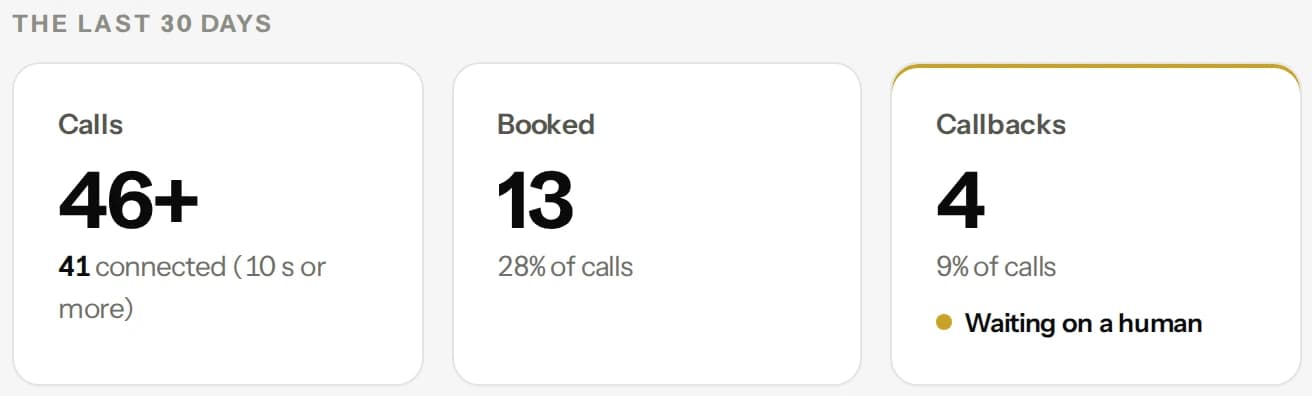
The Calls screen: 46 calls in the last 30 days, 13 booked and 4 callbacks waiting on a person
The last 30 days of calls, shown with a demo account.

It Has to Land Where Your Team Already Works

A booked appointment that lives inside the vendor's dashboard is not booked. It is a message waiting for somebody to notice it.

This is where a lot of solar sales tooling quietly fails. The call goes well, the homeowner is qualified, the system records a beautiful transcript, and then the survey never happens because the person who drives the truck works off a calendar that never heard about it. The install crew, the designer and the sales rep are usually in three different tools, and the CRM that does not write into all three is generating admin work rather than removing it.

So the test is mechanical. When the agent books a site survey, does it appear on the calendar the surveyor opens in the morning, with the address, the roof notes and the utility already attached. When a homeowner says the roof is being replaced in two months, does that date land somewhere that will call them back, or does it live in a transcript nobody reads. When a partner mentions a job, does it reach the person who handles partners.

The same goes backwards. If your team moves an appointment or marks a deal dead, the agent has to know, because nothing damages a relationship faster than a follow-up call about a system that was installed last month.

Ask any vendor, including us, to show you that path end to end on your own tools rather than on a demo account. Watch a call happen and then watch the record appear where your people work. If that takes a Zapier chain and a spreadsheet, you have found the real cost of the product.

Gold spheres travelling around a brass double ring

What to Check Before You Buy Any Solar CRM, Including Ours

Everything above is an argument about how to run the follow-up. This part is meant to be used against us as much as against anyone else, because a buyer with a checklist gets a better outcome from every vendor in the process.

Ask whose list it calls. If the answer is a purchased list of homeowners in a zip code, understand what you are buying and what it does to your name in a market you have to keep selling in. Our answer is your own list and the businesses that already send you work, and you should hold us to it.

Ask whether it does outbound at all. A lot of tools described as AI sales agents only answer. Answering an inbound call fast is worth having, but it does nothing about the quotes already sitting in your system, which is where most installers' next quarter actually is.

Ask what it says at the start of a call and whether recording is disclosed every time. Ask to hear a real call, not a scripted sample.

Ask what happens when it does not know. The honest answer is that it stops and gets a human. A vendor whose agent never gets stuck is describing a demo.

Ask what it stores about a homeowner, where that lives and how you get it out. Export your data on day one, not on the day you are leaving.

Ask who is responsible if a call goes wrong. Ask it in writing.

And ask what happens after the appointment is booked, because that is where solar deals are actually won or lost. A system that books a survey and then forgets about a homeowner who is six months from signing has solved the easy half of your problem.

RECURRING PROPERTY SERVICES

Common questions, what it costs and what it will not do are answered back on the solar page.

Hear it run on solar.

Twenty minutes with a real person. See it run on your business, then decide.

Book a demo
Multiply Revenue

AI that calls your leads in a natural voice, follows up by text and email until they answer, and books qualified meetings straight onto your calendar. Outbound and inbound, on one memory.

No setup fee, and no per-text charge from us.

© 2026 Multiply Revenue · 1905 Sherman Street, Ste 200, Denver, CO 80203 · (720) 735-8685
Book a demo