Skip to content
Back to pest control

The pest control CRM playbook.

Everything worth knowing, written out in order. Read it end to end or jump to the part you need. No sign-up, nothing hidden behind a click.

What a Pest Control CRM Has to Do That a General One Does Not

Pest control is a subscription business that most software treats like a series of jobs, and almost every problem in the trade traces back to that mismatch.

The money is not in the treatment. It is in the plan: the same property, visited quarterly or every other month, for years. A one-off callout is worth a day. A plan is worth as much as you can keep it. So the questions the software has to answer are not really sales questions at all. Which properties are on a plan. Which are due. Which have quietly stopped. Which had a single treatment and were never asked about the plan.

Geography makes it stricter than most trades. Your margin lives in route density, because a technician who drives half an hour between stops earns you far less than one working a tight cluster, whatever either of them charges. That means a new account in the right neighbourhood is worth more than a new account somewhere else, and a cancellation in a dense route hurts more than the invoice suggests. Any system that treats every address as equally valuable is hiding the thing that actually decides your profit.

Season is the third layer. The phone rings about ants at one time of year and rodents at another, and the callers are not new problems so much as returning ones.

So the record has to hold the property, the pest, the treatment, the plan and its status, and the route it sits on. And then it has to act on all of that, because a pest control business rarely fails for lack of records. It fails because the plan lapsed in March and nobody noticed until the summer.


Two stone blocks of different heights with a brass ball on the taller one

The One-Off Treatment Should Have Been a Plan

The most common leak in this trade is not losing customers. It is never converting them in the first place.

Somebody calls with wasps. You go, you treat it, they pay, everyone is happy. That is where it usually ends, and it should not, because the person who just paid to solve a pest problem is the single easiest person in your market to sell a plan to. They have seen your technician work, the problem is real to them right now, and they have just learned what it costs to deal with it after it has become a crisis.

The moment for that conversation is not on the doorstep with the sprayer still in hand. It is a short while later, when the relief has settled and the memory is fresh. Almost nobody makes that call, because it is one small call per job and there are a lot of jobs.

That is a list and a trigger, which is exactly what software is for and exactly what an agent can work through. Every one-off treatment from the last stretch of weeks, called once, politely, about whether they want the property kept clear rather than treated again in a panic.

The other half of the same leak is the plan that lapsed. Plans rarely get cancelled in a conversation. A card expires, a renewal fails, somebody moves, a bill goes unpaid during a bad month and the account quietly drops off the route. Nobody said no. If the only thing that happens next is an automated email, that customer is gone and the reason is nothing more than admin.

Both of these are your own customers. Nothing here involves calling a stranger.

Gold spheres travelling around a brass double ring

The Pests Come Back on a Schedule and So Should the Call

This trade has something most do not: a genuinely predictable reason to call somebody, written into the biology.

You know when ants turn up. You know when rodents start looking for somewhere warm. You know which properties had a problem last year, because you are the one who solved it. A customer who had mice in the autumn is very likely to be thinking about mice again next autumn, and the difference between calling them in early autumn and waiting for them to call you is the difference between a planned visit and an emergency they might give to whoever answers first.

That is not marketing. It is a specific call to a specific person about a specific thing that happened at their address, timed to when it is about to happen again.

The commercial side runs on a different clock and is worth more per account. Restaurants, food premises, warehouses, care homes and schools often need documented, scheduled treatment to satisfy somebody else's requirements, which makes the relationship stickier and the renewal date a real event. Property managers and letting agents have turnover, and a vacant unit between tenants is the easiest time to treat.

Those are business relationships on business lines, and the moment to be talking to them is before the contract renews, not after the tender is out. Keeping track of when each of those dates arrives is a filing job that nobody in a busy office has ever stayed on top of by memory, and it is the most reliable growth available to a pest control company that already does good work.

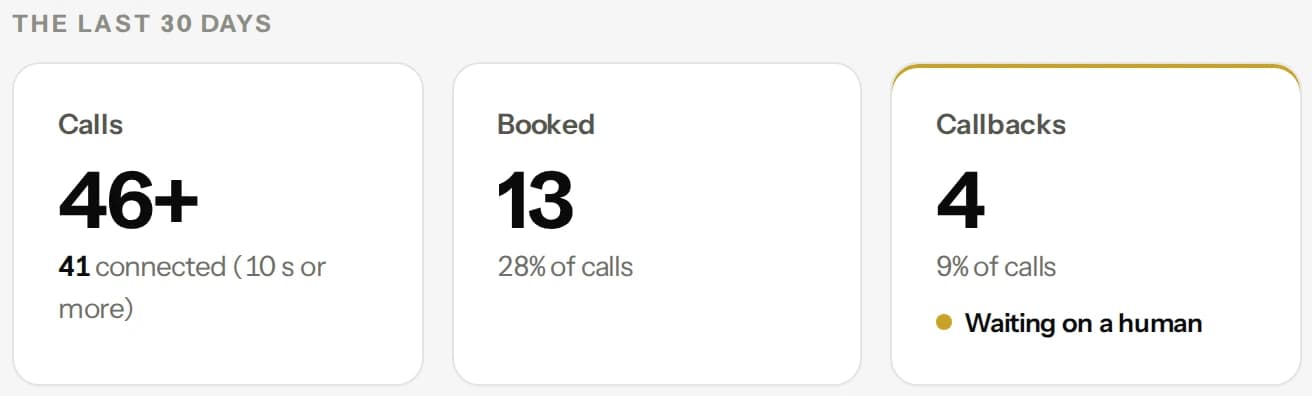
The Calls screen: 46 calls in the last 30 days, 13 booked and 4 callbacks waiting on a person
The last 30 days of calls, shown with a demo account.

What the Agent Actually Asks on a Pest Control Call

Here is the actual call, because a general claim about qualifying leads helps nobody decide anything.

It says what it is at the start. The agent identifies itself as a digital assistant calling on behalf of your company and says the call is recorded. Every call, every state.

On a new enquiry it gets the things that decide whether you can help and what to send. What they are seeing and where. How long it has been going on. Whether it is inside, outside or both. Roughly what kind of property and how big. Whether there are pets or small children, because that changes the treatment and the timing. Whether they own the property or rent it, which decides who can actually authorise work and is the question most often skipped. And the address, because whether it sits on a route you already run changes what you can offer.

On a call to somebody already on your list it says why it is calling: you treated this property last autumn, the season is coming round again. Or the plan lapsed and nobody is sure whether that was deliberate.

It handles the ordinary questions about roughly when you could come, how a plan works, what happens if the problem returns between visits. It does not identify a pest from a description down the phone and it does not price a treatment nobody has seen, because both come back as an argument on the day.

When it is real work it books it. When it is not, it says so and stops rather than sending a technician on a wasted drive. When somebody wants a person, it gets one.

A brass rotary desk phone on a stone block with a row of brass handsets beside it

It Has to Land on the Route, Not in an Inbox

A booked job that lives in the vendor's dashboard is not booked, and in a business built on route density it is worse than that. It is a stop nobody planned around.

Most pest control companies already run scheduling software that builds the technician's day. If the sales layer does not write into that, you have created a second version of the truth, and the person driving the van is working from the other one.

So the test is mechanical, and run it on your own tools rather than a demo. When the agent books a treatment, does it appear on the route the technician opens in the morning, with the address, the pest and the access notes attached. When a customer says they are only home on Fridays, does that constrain the slot or disappear into a transcript. When somebody agrees to a plan on the phone, does the plan actually get created, or does it become a note for somebody at the office to key in later, which is where plans go to die.

Backwards matters too. If a visit is completed, moved or cancelled, the agent has to know. Calling a customer about a treatment your technician did yesterday makes you sound like a company that cannot see its own vans.

And ask about density directly. If you are trying to grow a particular area, can you point the outbound work at that area, and can you stop it in an area that is already full. A system that cannot tell one postcode from another is not helping with the thing that actually sets your margin.

A chrome funnel catching a stream of small gold spheres into a bowl

What to Check Before You Buy Any Pest Control CRM, Including Ours

Use this against us as hard as you use it on anybody else.

Ask whose list it calls. If the answer involves a bought list of households, think about what that does to a local name you cannot replace, and about the rules that govern calling consumers who never asked to hear from you. Our answer is your own customers and the businesses that already send you work.

Ask whether it does outbound at all, or only answers. Answering fast matters here because a pest problem is urgent and people ring several companies. It is still only half the job, and not the half where the plans are.

Ask whether it understands a recurring plan, or only an appointment. A great many tools can book a visit and have no concept of a customer who is due again forever.

Ask whether it can work one area rather than your whole list, and watch somebody set that up.

Ask what it says at the start of a call and whether recording is disclosed every time. Ask to hear a real one.

Ask what it does when it does not know. It should stop and fetch a person.

Ask how somebody is removed from the call list, and how quickly that takes effect.

Ask what it stores, where it lives and how you export it, on day one rather than on the day you leave. And get in writing who answers for it when a call goes wrong on a treatment somebody has to leave the house for.

RECURRING PROPERTY SERVICES

Common questions, what it costs and what it will not do are answered back on the pest control page.

Hear it run on pest control.

Twenty minutes with a real person. See it run on your business, then decide.

Book a demo
Multiply Revenue

AI that calls your leads in a natural voice, follows up by text and email until they answer, and books qualified meetings straight onto your calendar. Outbound and inbound, on one memory.

No setup fee, and no per-text charge from us.

© 2026 Multiply Revenue · 1905 Sherman Street, Ste 200, Denver, CO 80203 · (720) 735-8685
Book a demo