Skip to content
Back to construction

The construction CRM playbook.

Everything worth knowing, written out in order. Read it end to end or jump to the part you need. No sign-up, nothing hidden behind a click.

Why Referrals Alone Cannot Fill a Construction Pipeline

Most contractors run on referrals, plan rooms and word of mouth. It works right up until it does not, and the failure is always the same shape: three good quarters, then a quarter where the phone is quiet and crews are being paid to wait.

The problem is not that referrals are bad. They are the best work you get. The problem is that they arrive on their own schedule and you cannot ask them to arrive faster when the calendar looks thin.

What fills the gap is contact that happens whether or not anyone has time for it. Owners and developers with something starting. Architects and brokers who point work at people they have heard from recently. Past clients with a second building. None of that is complicated, and all of it stops the moment your estimator gets busy, which is precisely when you needed it running.

That is the case for putting it in software rather than in somebody's good intentions. The agent works the list on a schedule, books the meetings into your calendar and writes down what was said. It does not get busy, and it does not stop in the month you are flat out on site, which is the month that decides what next quarter looks like.


A stream of brass balls falling onto a dark stone slab and scattering across the floor

Getting in Front of an Owner Before the RFP Exists

By the time a project reaches a plan room, the decisions that matter have been made. The owner has an architect, probably a shortlist, and often somebody they already trust. You are competing on price for work that was shaped without you.

Everything good in commercial construction happens earlier than that, in the months while a project is still an idea with a budget attached. The contractors who win consistently are simply known to the owner before the document exists.

Being early is a contact problem, not a mystery. It means reaching owners, developers, facility directors and property managers on a regular basis rather than when you happen to hear something. In-market signals help you aim, but the discipline is the point: a list, worked on a schedule, by something that does not get pulled onto a site visit.

The agent makes those calls, gets past the obvious no, books the meeting when there is genuine interest and records the ones who said not yet, so they get called again in a quarter rather than forgotten.

A commercial award can take months. The value of the software is that it is still making the eighth call when a person would have stopped at the third.

A chrome funnel catching a stream of small gold spheres into a bowl

What the Agent Actually Says on a Call to a Project Owner

A vendor can talk about AI agents for an hour and never put one on a call. Here is what the conversation is, so you can judge it.

It opens by saying what it is, a digital assistant calling from your company, and that the call is recorded. Facility directors and developers get called constantly, so it says why it is calling in one sentence and gives them a clean way out.

Then it asks what a good estimator would ask before agreeing to drive out. Is anything actually planned, and roughly when. Is it a fit-out, a renovation or ground-up. Is there an architect involved yet, or is this still a budget on a page. Who else is in the decision. And is it worth half an hour on site to look at it.

It does not give a number. Not a square foot rate, not a range, not a ballpark. Pricing in this trade depends on the site, the schedule, the labour market that month and what is behind the wall, and a figure given by software is a figure your estimator has to walk back in person. It says that plainly rather than dodging the question.

It does not discuss bonding, insurance limits, lien rights or contract terms. Those are the places a confident wrong answer costs real money.

When it does not know, or the owner would rather speak to a person, it hands over. A vendor whose agent never gets stuck is showing you a demo.

The most valuable outcome on most of these calls is not a meeting. It is a date. An owner who says the board approves capital in the autumn has just told you when to ring, and that goes on the record so somebody actually does.

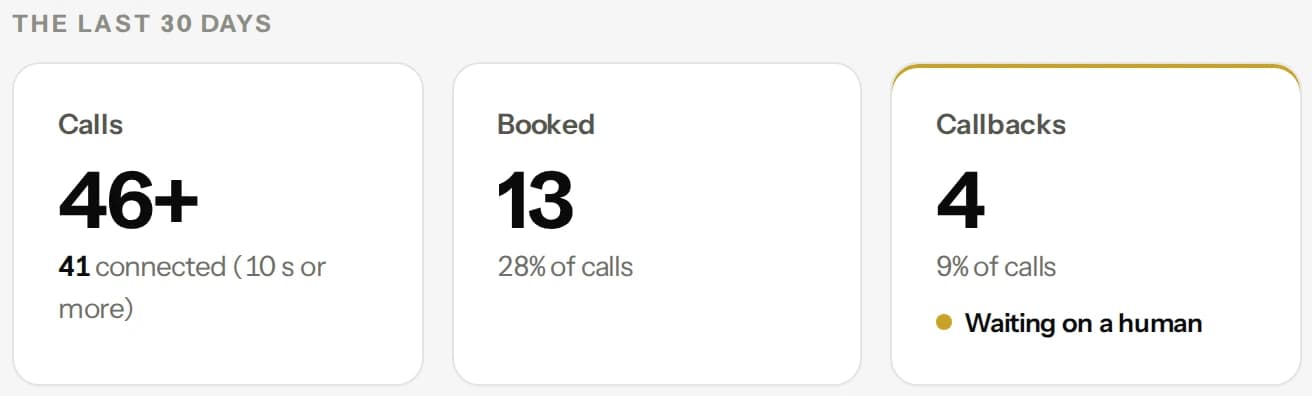
The Calls screen: 46 calls in the last 30 days, 13 booked and 4 callbacks waiting on a person
The last 30 days of calls, shown with a demo account.

Building Backlog That Survives the Construction Cycle

Construction is cyclical and always has been. Backlog is the only thing that makes the valleys shorter, and backlog is built in the quarters when you are too busy to think about it.

That is the whole difficulty. The month you should be calling owners is the month your estimator is on three sites and your project manager is chasing a delivery. Outreach stops exactly when the work is good, which is why the quiet quarter always arrives about six months after the best one.

Three lists keep it filled and none of them are exotic. Owners you have already built for, who tend to have a second building or a second phase. Architects, engineers and brokers, who point work at whoever they spoke to recently. And owners who told you not yet, who are the most under-used records in this industry because a not yet in construction usually comes with a date attached.

That last group is where an agent earns its keep. A person calls a not-yet back once, feels awkward about the second call and never makes the third. The software makes the eighth call in month nine without any feeling about it, and hands you the one that turned into something.

It writes into the tools your office already runs rather than becoming another place to check. Ask any vendor to prove that on your own system before you buy, which is the subject of the next chapter.

The measures worth watching are boring ones: pipeline value, cost of a booked meeting and how much of this year came from clients you already had. Cost of a booked meeting is the honest number, because it is the one that tells you whether the outreach is working or just running.

It Has to Land Where Your Estimators Already Work

A booked site meeting that lives inside a vendor's dashboard is not booked. It is a message waiting for somebody to notice it.

This is where contractor software quietly fails. The call goes well, the owner is interested, the transcript is perfect, and then nobody drives out, because your estimator works off a calendar that never heard about it. A construction business usually runs estimating software, a project management system, a shared calendar and somebody's notebook, and software that does not write into the ones that matter is adding admin rather than removing it.

So the test is mechanical, and you can run it inside a demo. When the agent books a site meeting, does it appear on the calendar your estimator opens in the morning, with the address, the scope as described and the timeline attached. When an owner says the money lands in the next fiscal year, does that date reach something that will call them, or does it sit in a transcript nobody opens again.

It has to work backwards too. When you win the job, the outreach has to stop treating them as a prospect. When a bid is lost, the record needs to say so, with the reason, because the reason is what makes the next call useful.

Ask any vendor, ours included, to show that path end to end on your own tools rather than on a demo account. Watch a call happen, then watch the record land where your people work. If it takes a Zapier chain and a spreadsheet to reach the site foreman, you have found the real price of the product.

A dark stone card standing upright beside a row of small brass balls and stacked stone tiles

The Bid You Lost Is Not a Dead Record

Contractors write off lost bids faster than almost any other trade writes off a lost sale. The number came back, somebody else was cheaper, the file gets closed. That is a mistake, and it is an expensive one, because losing a bid means you did the most expensive part of the work already.

By the time you lose, you have read the drawings, walked the site, priced the job and spoken to the owner. You know the building, you know what it costs and you know the person. That is a warmer position than any first call will ever be, and the industry throws it away on the day the award goes out.

There are three reasons to go back. Awarded jobs fall over, because the winner cannot start when the owner needs it or the number moves once the ground is open. Owners who did one project usually do another, and the second one is often unbid. And the reason you lost is information you will never get anywhere else. Ask, write it down, and you learn whether you are losing on price, on schedule, on a missing qualification or on something you can fix this month.

The reason nobody works this list is human rather than commercial. Calling the owner who chose somebody else feels like asking for a favour, so the call gets put off and then it is too late to be natural.

That is the sort of call software makes easily. The agent goes back on a schedule, asks how the project went, records what it hears and puts anything live in front of an estimator. Every bid you ever priced becomes a list rather than a folder.

The same applies to the estimate that simply went quiet, which is the more common case. A proposal with no answer is not a no. It is usually an owner waiting on financing, a board or a partner, and the contractor still in the conversation when that clears is very often the one who builds it.

A brass box and a small brass ball on a dark stone tray in warm window light

What to Check Before You Buy Any Contractor CRM, Including Ours

The honest checklist, including the parts that are not a pitch.

Ask what happens to a long sales cycle. Most CRMs are built for deals that close in weeks. A commercial award can take a year. Ask what a contact looks like after eleven months of nothing, and whether the system will still put it in front of you.

Ask to hear a real call to a facility director, not a demo. These are direct people, and you want to hear one where the answer was no.

Ask whether booked meetings reach your estimating and project management systems, or whether your office keeps two lists in step by hand. That is where these projects quietly die.

Ask what it costs in a heavy month rather than an average one.

And be straight about the problem. If you are winning work and losing money on it, better outreach fills your schedule with more of the jobs that are hurting you. This is worth buying when the pipeline is the constraint. If margin is the constraint, fix that first.

PROPERTY AND MOVING

Common questions, what it costs and what it will not do are answered back on the construction page.

Hear it run on construction.

Twenty minutes with a real person. See it run on your business, then decide.

Book a demo
Multiply Revenue

AI that calls your leads in a natural voice, follows up by text and email until they answer, and books qualified meetings straight onto your calendar. Outbound and inbound, on one memory.

No setup fee, and no per-text charge from us.

© 2026 Multiply Revenue · 1905 Sherman Street, Ste 200, Denver, CO 80203 · (720) 735-8685
Book a demo