Skip to content
Back to moving

The moving company software playbook.

Everything worth knowing, written out in order. Read it end to end or jump to the part you need. No sign-up, nothing hidden behind a click.

What a Moving Company CRM Has to Do That a General One Does Not

Moving is the most time-boxed sale in any of these trades, and that single fact should shape everything the software does.

A customer has a date. They are out of one place and into another on a particular day, and that day does not move for your convenience. Everything before it is a countdown. That means a lead has a shelf life measured in days, not months, and a follow-up sequence built for a normal sales cycle will still be politely nurturing somebody a week after they hired somebody else.

It also means almost every customer is comparing. Very few people book the first mover they speak to, and a lot of them fill in several forms in one sitting. So you are not really competing on the quote. You are competing on who gets a human conversation first and who makes the process feel least frightening, because underneath the price question people are worried about their possessions and about the day going wrong.

The third thing is that the job is not one number. What it costs depends on volume, access, stairs, parking, distance, date and whether anything needs special handling, and none of that is in a web form. The purpose of the first conversation is not to quote. It is to find out enough to quote properly and to book the survey.

So the record has to carry the date, both addresses, the access problems, what they said when they went quiet and where the referral came from. And the software has to move immediately, because in this trade a lead that waits until morning is usually already gone.


A brass ball balanced on a stack of dark stone tiles

The Quote Is a Race and the Clock Starts at the Form

Ask any owner in this business where they lose work and they will say price. Watch the actual timeline and it is usually speed.

Somebody fills in a form at nine in the evening because they have just had their completion date confirmed and they are anxious about it. Three companies get that enquiry. One calls back within a couple of minutes while they are still sat there thinking about it. The others reply the following working day, by which point the first company has had a friendly conversation, answered the scary questions and booked a survey.

Being first is not a small advantage here. It is most of the job, and it is almost entirely a staffing problem, because the hours when people think about moving are evenings and weekends and those are exactly the hours you are not paying somebody to sit by a phone.

That is the clearest case for an agent in this whole guide. It answers immediately, at any hour, has a real conversation, gathers what a surveyor needs and books the survey before the competition has opened the email.

The other half is the quote that went quiet, and movers write those off far too quickly. A customer who did not book you is not always a customer who booked someone else. Completions fall through and dates slip constantly in this business. A polite call a week or two after the quote, asking whether the date held, catches a real number of jobs that everybody else has already given up on, and it costs one call.

All of these people asked you for a price. None of these are strangers. They all enquired.

A tray of small brass balls with one large brass ball on top

The Realtors and Property Managers Who Know Who Is Moving

The customer is a one-off. The people who know about the move before the customer does are not, and that is where a moving company builds something that does not have to be won again every week.

Realtors and estate agents know about a move at the point of sale, well before anybody searches for a mover. Letting agents and property managers know about every tenancy that ends. Storage facilities meet people mid-move by definition. Builders and developers know when a completion is coming. Corporate relocation and HR departments move employees on a schedule and pay reliably.

These relationships behave nothing like consumer leads. They take longer to start, they are won on reliability rather than price, and they produce steady work without bidding. They also do not end with an argument, they fade, usually because one bad week made you unreachable or because the person who liked you changed jobs.

That fading is the thing worth systemising. Somebody who sent you three jobs last year and none this year is a specific, nameable relationship that went quiet, and there is a reason and a good moment to reappear. The agent calls those contacts on a business line, in business hours, about work: what is completing soon, is anything awkward coming up, do you want us to hold a date.

That is the outbound posture and it is worth saying plainly. The agent works the list you already have and the businesses that already know you. It is not for dialling households who never contacted you, and in a trade where people are nervous about who touches their belongings, your name is the asset.

Stone steps rising to the right with a brass ball on each step

What the Agent Actually Asks on a Moving Call

Here is the actual call, because a general claim about lead qualification decides nothing.

It opens by saying what it is. The agent identifies itself as a digital assistant calling on behalf of your company and says the call is recorded, every call, every state.

On a new enquiry it gets the things a survey and a price actually depend on. The date, and how firm it is. Where from and where to. The size of the property and roughly how much there is. Access at both ends, which is the question that separates a smooth day from a disaster: stairs, lifts, how close a lorry can park, whether a permit is needed. Whether anything needs special handling, a piano, a safe, artwork, anything fragile or very heavy. Whether they need packing as well as moving. Whether storage is involved, because a gap between completion dates is common and profitable.

Then it books the survey, which is the real goal of the call, onto the calendar the surveyor actually works from.

On a follow-up to a quote that went quiet it is shorter and it is genuinely useful rather than pushy: did the date hold, are you still looking, has anything changed. Dates slipping is normal in this trade and the call is welcome more often than people expect.

It does not give a firm price for a job nobody has seen. It can explain how you charge and roughly what drives the number, which is what most callers actually want at that stage. Inventing a figure to sound helpful is how you end up in an argument on the van.

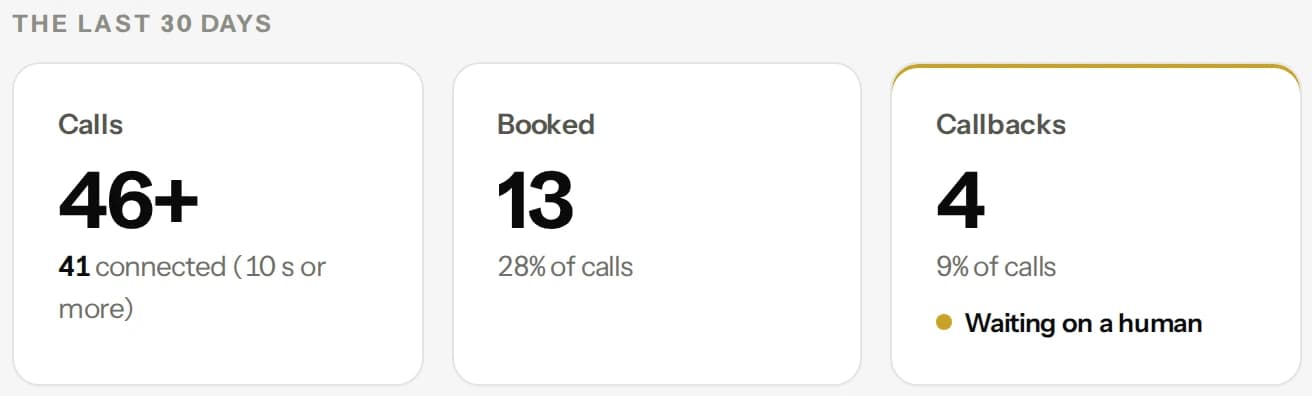
The Calls screen: 46 calls in the last 30 days, 13 booked and 4 callbacks waiting on a person
The last 30 days of calls, shown with a demo account.

It Has to Land on the Crew Calendar

A booked survey that lives in the vendor's dashboard is not booked, and in a business where a single day is the whole product that is a serious failure rather than an inconvenience.

Moving companies run on a calendar of crews, vans and dates, and it is usually the tightest constraint in the business. If the sales layer does not write into it, you have two versions of the truth and the one the crew reads is the other one.

So the test is concrete and should be run on your own tools. When the agent books a survey, does it appear on the surveyor's calendar with both addresses and the access notes attached. When a customer says the date might slip, does that become something that will call them back nearer the time, or does it sit in a transcript. When somebody mentions storage, does that reach whoever prices storage.

Capacity matters more here than in any other trade in this guide. There are dates you simply cannot take more work on, particularly at month end and through the summer. An agent that keeps booking surveys for a day you are already full on is generating disappointment. Ask whether it can see what is already committed, and ask what it says when the date is unavailable, because the right answer is to offer the nearest date you can actually do rather than to take the enquiry and sort it out later.

And ask what happens backwards. If a job cancels or a crew is reassigned, the agent needs to know before it calls anybody about it.

A stone booking board with round slots and a brass ball resting in one

What to Check Before You Buy Any Moving Company CRM, Including Ours

Use this list on us before you use it on the next company.

Ask whose list it calls. If a vendor is offering to call households who never contacted you, be very careful. Ours is your own enquiries, your own past customers and the businesses that already send you work.

Ask how fast it answers a new enquiry, and at what hours. In this trade that single answer is most of the value, so make them show you a real timestamp on a real enquiry rather than quote you a target.

Ask whether it does outbound to quotes that went quiet, or only handles inbound. The quotes that went quiet are the cheapest work available to a mover and almost nobody chases them past one email.

Ask whether it can see your calendar before it books, and what it does when you are full.

Ask what it says at the start of a call and whether recording is disclosed every time. Ask to hear a real call, including one where the caller was anxious, because that is most of them.

Ask what it does when it does not know. It should stop and get a person.

Ask whether it can track which realtor or agent a job came from, because if you cannot see that, you cannot tell which relationships are worth keeping warm.

Ask what it stores, where it lives and how you export it. And get in writing who answers for it when a call goes wrong on a move date somebody has built their week around.

PROPERTY AND MOVING

Common questions, what it costs and what it will not do are answered back on the moving page.

Hear it run on moving.

Twenty minutes with a real person. See it run on your business, then decide.

Book a demo
Multiply Revenue

AI that calls your leads in a natural voice, follows up by text and email until they answer, and books qualified meetings straight onto your calendar. Outbound and inbound, on one memory.

No setup fee, and no per-text charge from us.

© 2026 Multiply Revenue · 1905 Sherman Street, Ste 200, Denver, CO 80203 · (720) 735-8685
Book a demo