Skip to content
Back to property management

The property management CRM playbook.

Everything worth knowing, written out in order. Read it end to end or jump to the part you need. No sign-up, nothing hidden behind a click.

What a Property Management CRM Has to Do That a General One Does Not

A general CRM assumes the relationship ends when the deal does. A property manager tracks two completely different relationships at the same time, and confusing them is what makes most software useless here.

One is the owner. Winning an owner is a sale, it takes months, and once it is won it pays every month for years. The other is the tenant. A tenant is not a sale at all, they are an operations job, and the calls come at midnight.

Software that files both under Contacts cannot tell you the thing you need to know, which is whether your door count is growing. So the first test is whether the owner is a first-class record. Can you see how many units they hold, what they are paying elsewhere, when their current agreement ends and every conversation you have had with them since the first call. That end date is the single most valuable field in this business and most systems do not have anywhere to put it.

The second is whether it does the remembering. The self-managing landlord who said he would rather keep doing it himself is not a dead lead, he is a lead with a date on him, usually the week after his first eviction or his first burst pipe.

The third is whether the tenant side stays out of the way. Maintenance requests and lease questions belong in your operations record, not clogging the pipeline where you are trying to see which owners to call this week.

What you should end up with is one view of every owner you have ever spoken to, and something that tells you who to ring today.


A chrome funnel catching a stream of small gold spheres into a bowl

Door Count Grows One Owner at a Time, and Referrals Are Not a Plan

Ask most property management companies where their last ten owners came from and the answer is a version of luck. A realtor sent one over. A current owner bought another building. Somebody found the website.

That is not a growth plan, it is a weather report. It works until a referral partner retires or an owner sells their portfolio, and then a quarter goes quiet for reasons nobody inside the business can explain or fix.

The alternative is not complicated, it is just work nobody has time for. The owners worth having are identifiable. Landlords with listings up who are clearly managing it themselves. Out-of-state owners with local property, which is the single strongest signal there is. Investors who just closed on something. Owners whose current manager has a visible reputation problem. Every one of those is a name, an address and a reason to call.

The part that breaks is the calling. Reaching an owner takes several attempts, most of them at hours when your office is dealing with a blocked drain. A manual list dies somewhere around attempt three, not because the leads were bad but because the person working them had a real job to do that day.

That is the gap the agent fills. It works the list on a schedule, keeps calling the ones who do not pick up, has the first conversation and books the walkthrough into your calendar. You spend your time in front of owners rather than dialling to find them.

Door count that grows by referral grows when other people decide. Door count that grows by outreach grows when you decide.

A dark stone card standing upright beside a row of small brass balls and stacked stone tiles

The Self-Managing Landlord Is the Easiest Owner You Will Ever Win

Every market has far more self-managed rentals than managed ones. Those owners are not ignoring you because they have a manager they like. They are doing it themselves because the maths looked fine on the day they bought the place.

What changes their mind is never a pitch about service quality. It is an event. A tenant stops paying. A unit sits empty for two months. They take a call about a boiler on holiday. They discover what an eviction actually costs in time. A second property makes the first one a job rather than a hobby.

So the conversation that wins them is not about you at all, and it is not really about price. It is one honest question: what is this actually costing you, counting the vacancy, the late nights and the weekend you lost. Most owners have never added it up, and adding it up out loud is the whole sale.

The reason this segment goes unworked is timing. You cannot know which landlord had a bad month, so the only way to catch them is to be in the rotation when it happens. That means calling a large list regularly and politely, and hearing no from people who genuinely are fine, which is exactly the work a human list dies on and a scheduled agent does not.

The ones who say not right now are the point. The agent records the reason and the date, and calls them back. A landlord who says he will manage it himself for another year has just told you when to ring.

A brass box and a small brass ball on a dark stone tray in warm window light

What the Agent Actually Says on a Call to an Owner

The word agent gets used freely by vendors who will not demonstrate one. Here is what the conversation is, so you can judge it.

It opens by saying what it is, a digital assistant calling from your company, and that the call is recorded. Owners are used to being cold-called by agents and wholesalers, so it says why it is calling in one line and gives them an easy way out.

Then it asks what a good business development person would ask. How many units do you have and where. Are you managing them yourself or is somebody doing it for you. How is that going, and what is the part you would happily never do again. Is anything empty right now. And when it makes sense, is it worth half an hour to walk the property and show you what we would charge.

It does not quote a management percentage. Fees depend on the unit, the condition and the market, and a number given by software is a number your team has to walk back in person. It says that plainly rather than dodging the question.

It does not give legal advice about evictions, notice periods, deposits or fair housing. Those are the places a confident wrong answer costs an owner real money, and the agent is built to stop rather than guess.

When it does not know, or the owner would rather speak to a person, it hands over. A vendor whose agent never gets stuck is showing you a demo.

Everything said is written against the owner record, so the person who walks the property already knows what the owner told it on Tuesday night.

Tenants Call at Midnight, and Here Is Exactly Where the Line Sits

Growth is the reason to buy this. Tenant calls are the reason your team has no time for growth, so it is worth being precise about what the software does on that side and what it does not.

What it does. It answers, at any hour, on the tenant line. It takes a maintenance report properly, which means the unit, the problem, how long it has been happening, whether there is water or heat or gas involved and whether the tenant can be there. It separates the burst pipe from the dripping tap, and only the first kind wakes your on-call person. Routine requests land on the schedule. Lease questions with a factual answer, rent due dates, notice periods stated in the agreement, where to pay, get answered from the documents you give it.

What it does not do. It does not authorise a repair spend or send a contractor on its own judgement. It does not give an opinion on an eviction, a deposit dispute or anything that turns into a fair housing question. It does not promise a tenant a renewal or a rent. When one of those comes up it says so and puts it in front of a person.

This is not an answering service and it is not sold as one. An answering service takes a message. The difference that matters is what happens after the call: the request is triaged, written into the record against the right unit and the right owner, and routed. Your morning is a list of what happened overnight rather than eleven voicemails.

The honest framing is that the tenant side buys you the hours. The owner side is what you spend them on.

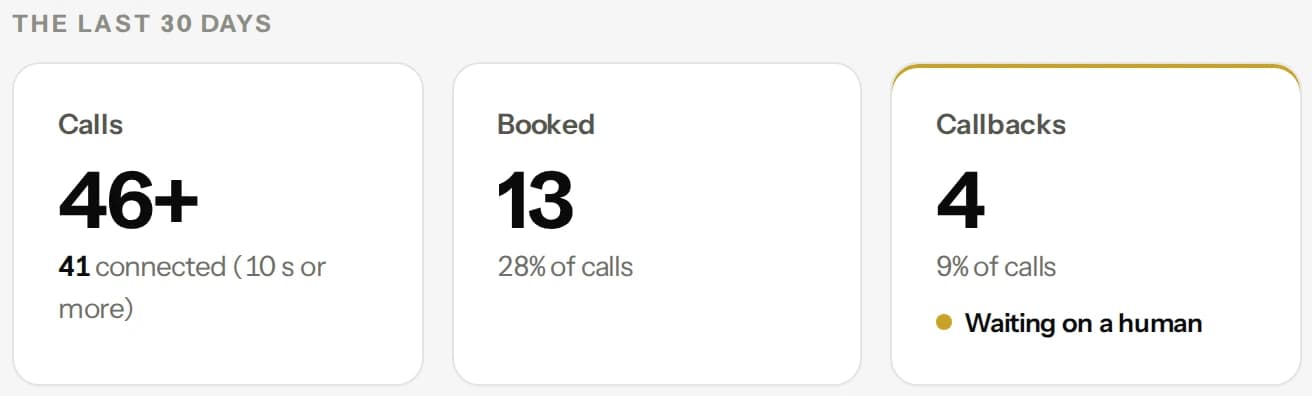
The Calls screen: 46 calls in the last 30 days, 13 booked and 4 callbacks waiting on a person
The last 30 days of calls, shown with a demo account.

It Has to Land in the System That Runs the Portfolio

A booked walkthrough that lives inside a vendor's dashboard is not booked. It is a message waiting for somebody to notice it.

Be clear about what we are and are not. We are not a system of record. AppFolio, Buildium, Rent Manager and the rest hold your ledgers, your leases and your owner statements, and we are not trying to replace any of that. We are the outreach and the conversation layer that feeds it. If a vendor tells you their AI will run your accounting as well, ask them to show you a trust reconciliation.

So the test is mechanical, and you can run it inside a demo. When the agent books a walkthrough, does it appear on the calendar your BD person opens in the morning, with the address, the unit count and what the owner said. When a tenant reports a leak, does it reach the maintenance queue attached to the right unit, or does it sit in a transcript nobody reads. When an owner says their agreement ends in March, does that date land somewhere that will call them in February.

It has to work backwards too. When an owner signs, the outbound has to stop calling them. When a unit is let, the showing calls stop.

Ask any vendor, ours included, to show that path end to end on your own tools rather than on a demo account. Watch a call happen, then watch the record land where your people work. If it takes a Zapier chain and a spreadsheet to reach the person who dispatches the work order, you have found the real price.

A brass ball resting on a dark stone beside a folded white cloth

What to Check Before You Buy Any Property Management CRM, Including Ours

Everything before this is an argument about how the work should run. Use it on us before you use it on anyone else. The buyer holding the checklist sets the terms.

Ask whether it does outbound at all. Most software sold to property managers only answers. Answering tenants well is worth having and it will not add a single door. If growth is why you are buying, make the vendor show you the outbound call, the list it works and what happens on attempt six.

Ask what it does with an owner who says not right now, because that is the majority answer and it is where the value actually sits. If the record cannot hold a reason and a callback date, the tool is a phone system.

Ask what it says at the start of a call and whether recording is disclosed every time. Ask to hear a real call rather than a scripted sample, and ask what it is not allowed to say. Any vendor who cannot name the legal lines in this industry has not thought about them, and in property management those lines have statutes behind them.

Ask what happens when it does not know, and how quickly a person can take the call over.

Ask which property management platform it writes into, by name, and what the integration actually is. Ask who owns the recordings, the owner records and the tenant history if you leave, and export on day one rather than on the way out.

Ask who is responsible if a call goes wrong, and get it in writing.

Then ask what happens after the walkthrough is booked. An owner decision takes weeks and involves reading a management agreement. A system that books the appointment and then forgets the owner has solved the easy half of the problem.

PROPERTY AND MOVING

Common questions, what it costs and what it will not do are answered back on the property management page.

Hear it run on property management.

Twenty minutes with a real person. See it run on your business, then decide.

Book a demo
Multiply Revenue

AI that calls your leads in a natural voice, follows up by text and email until they answer, and books qualified meetings straight onto your calendar. Outbound and inbound, on one memory.

No setup fee, and no per-text charge from us.

© 2026 Multiply Revenue · 1905 Sherman Street, Ste 200, Denver, CO 80203 · (720) 735-8685
Book a demo