Skip to content
Back to insurance

The insurance CRM playbook.

Everything worth knowing, written out in order. Read it end to end or jump to the part you need. No sign-up, nothing hidden behind a click.

What an Insurance CRM Has to Do That a General One Does Not

A general CRM is built for a sale that happens once, then goes quiet. An agency tracks a policy that renews every year, sits inside a household that may hold three more, and belongs to a carrier whose appetite changes without asking you.

That shape breaks a normal pipeline in three specific ways, and they are the three things to test in any demo.

First, the record has to be the HOUSEHOLD, not the contact. The auto policy, the home policy, the teenage driver who is about to need cover and the rental property are one relationship. A CRM that files them as four unrelated contacts will let you sell the same person the same thing twice and miss the bundle entirely.

Second, the renewal date has to be a first-class field that the system acts on by itself. Every agency knows it should call 45 to 60 days out. Almost none do it for every policy, every time, because it depends on somebody remembering. A date sitting in a spreadsheet is not a system.

Third, it has to survive the quote. Gathering drivers, vehicles, VINs, prior carrier and coverage history is the slowest part of the job, and most of it gets collected on a call and then retyped into a rater. Anything that makes your producer enter the same details twice will quietly be abandoned inside a month, whatever anyone agreed in the meeting.


A brass ball balanced on a stack of dark stone tiles

Speed Decides Who Writes the Policy, and Everyone Knows It

An insurance shopper does not call one agency. They fill in a comparison form or ring three or four, and they buy from whoever gets back to them with a real answer first. If you bought the lead, so did three other agencies, and the clock started before you saw it.

That is why speed is the only lever in personal lines that reliably moves anything. It is also the one your team cannot pull by hand, because leads arrive while your producers are on the phone writing something else.

The agent calls the moment an enquiry lands. It works out what they are shopping for, collects the details a quote actually needs, checks whether there is a second line worth quoting, and books the producer's time with the information already gathered. Your producer opens a record, not a phone number.

The second thing it does matters as much and gets less attention. It keeps going. Most enquiries are not answered on the first attempt, and manual follow-up quietly stops after two tries because it is nobody's favourite job. The agent keeps calling and texting on a schedule until the person answers or asks it to stop, and it records which of those happened.

The Renewal List Is the Agency

An agency's book is worth more than its pipeline and it gets a fraction of the attention. Every policy that lapses quietly is revenue you already earned, walking out for want of a phone call.

There are three jobs in the book and all three are mechanical, which is exactly why they suit an agent that never gets bored.

Renewals. A call 45 days out, before the renewal letter arrives and before your client starts shopping. You get to explain a rate change yourself rather than have a competitor explain it for you, and that single conversation is most of retention.

Cross-sell. Every auto-only client is a home policy you have not asked for. Every home-only client may have a boat, a rental or a teenage driver. The agent works the single-line clients systematically, asks what else is in the household and books the review. Monoline clients leave. Multi-line clients stay for years.

Lapses and dead quotes. The policy that cancelled for non-payment, the quote that never closed, the client who moved carriers two years ago. Those people know your agency. Calling them is a warmer conversation than any lead you could buy and it costs nothing but the time nobody has.

None of this is a new idea to anyone who has run an agency. It does not happen because it needs a person with a free afternoon, every week, forever.

Gold spheres travelling around a brass double ring

What the Agent Actually Asks on a Quote Call

It is reasonable to want to know what is being said to your clients, so here is the substance rather than a promise that it is good.

On a personal lines enquiry it establishes what they are shopping for and why, because someone whose rate just jumped is a different conversation from someone who just bought a car. Then the quote data: drivers in the household, dates of birth, vehicles and VINs, current carrier, how long they have been with them, current coverage and limits, any claims or violations, whether they own or rent.

That ownership question is the one that earns its place, because it is where the bundle comes from and it takes four seconds to ask.

On a renewal call it is shorter and it is about change. What has changed at the house, who is driving now, is anything new insured elsewhere, is the coverage still right for what they own. Then it books the review.

On a commercial enquiry it establishes the operation before anything else: what the business actually does, headcount, vehicles, payroll band, whether there are subcontractors. Those four answers decide whether the risk is even in your appetite, and asking them first stops your producer spending an hour on something no carrier will write.

Every call is recorded and transcribed and scored against how you want the agency to sound. When a quote call goes wrong you can read exactly where, and change what is asked next time.

It Has to Fit the Agency Management System You Already Run

Your policies live in an agency management system. If that is Applied Epic, EZLynx, HawkSoft, AMS360 or something else, the question is not whether the new thing has its own contact list. It is whether anything it captures reaches the system your account managers already have open all day.

Ask it concretely, because a vague answer here is the answer. When the agent gathers quote data, where does it land. Does it match the existing household or create a second one. When a renewal review is booked, does it show in the producer's real calendar. When a policy renews or lapses in the AMS, does the CRM know, or is somebody keeping two lists in step by hand.

That last one is where these projects die. An agency that ends up maintaining renewal dates in two systems will trust neither, and within a quarter the newer one is the one that gets ignored.

Ask about the phone number too. The agency number is on every policy document, every business card and every carrier record going back years. It has to keep working exactly as it does.

A dark stone card standing upright beside a row of small brass balls and stacked stone tiles

What to Check Before You Buy Any Insurance CRM, Including Ours

The honest list, including the parts that are not a sales pitch.

Ask hard about your lead sources, because insurance is where this actually bites. Insurance lead generation is the most heavily litigated corner of telemarketing law in the country. If you are buying shared leads, the consent that came with them is somebody else's paperwork, and when a claim arrives it is the agency that gets named, not the lead vendor and not your software.

Before you point any dialler at a purchased list, know exactly what consent came with it and keep the record. No software makes a bad list lawful, and any vendor who tells you their product handles compliance for you is telling you something useful about themselves.

Ask to hear a real quote call, not a demo. Ask for one where the caller was irritated or would not give a date of birth, because that is a normal Tuesday.

Ask what happens with the data you collect. Quote calls capture dates of birth, licence numbers and claims history. That is sensitive under every state privacy law worth naming. Ask where it is stored, who can reach it and what happens if you leave.

Ask how long until it is useful. Configuring quote intake per line of business is real work and most of this category takes weeks. Get a date in writing.

Ask what it costs in a heavy month rather than an average one. Per-minute pricing looks fine until a carrier rate action puts your whole book on the phone at once.

And be straight with yourself about the problem. If quotes are not closing because your rates are not competitive in your state right now, faster contact will get you to a no sooner. It will not get you a yes. This is worth buying when work is arriving and falling through gaps, which in most agencies it is.

CRM for Insurance Agents: Integrations, Automation and Pricing

Insurance agents ask three practical questions before they buy a CRM, and a guide should answer them in order.

First, what does it connect to? Your agency management system and the carrier portals are where policies live, and no CRM replaces them. What a CRM needs is a clean way to see who a client is, what they hold and when it renews. We keep the conversation history and the follow-up and leave the policy record where it already is. Calendar bookings go to Google Calendar.

Second, what does automation actually do? For an agency it means a renewal reminder that goes out on time, a quote that gets a follow-up when it goes quiet, a new lead that is answered in minutes and a client who asked a question outside office hours who still gets a reply. The agent does these jobs on every channel, and it says it is a digital assistant. It does not give coverage advice or quote a premium. That stays with a licensed person.

Third, what does it cost? Plans start at $97 a month with no setup fee, and the prices are on the pricing page for anyone to read. Calling time is billed by use, and your balance stops at zero rather than creating a surprise bill.

A small agency does not need an enterprise platform with a long list of custom apps. It needs the follow-up done every day, with a record you can check. Build on that and the rest of the sales process gets easier to run.

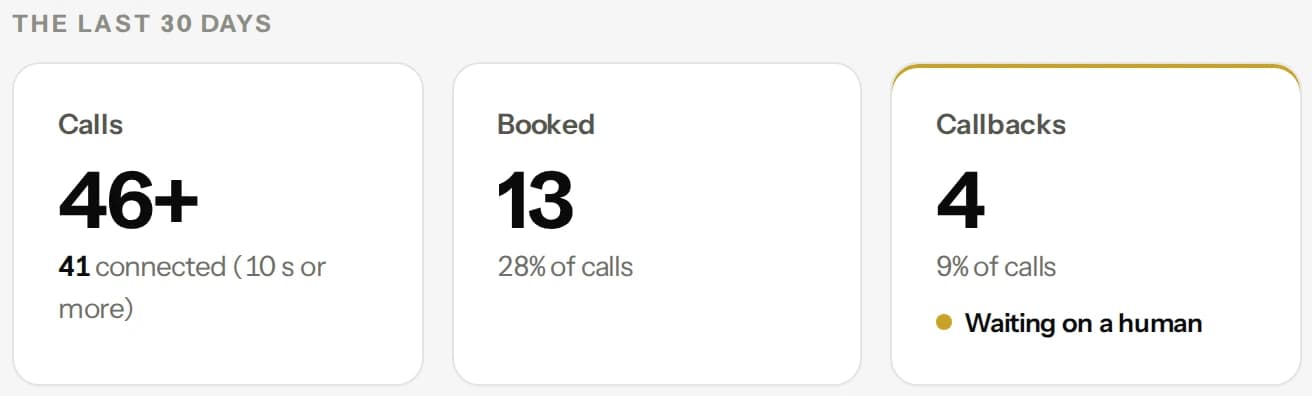
The Calls screen: 46 calls in the last 30 days, 13 booked and 4 callbacks waiting on a person
The last 30 days of calls, shown with a demo account.

Insurance Marketing Automation: Leads, Email and Online Follow-Up for Agents

Most agencies do their marketing in bursts. A mailer goes out, an online ad runs for a month and the leads that come in are worked until the rush ends. What changes the result is not a bigger burst but a steady follow-up on every lead, every day.

A useful way to organise this is by the stage the person is at. A new online lead needs a reply within minutes, because they are comparing agents right now. A prospect who asked for a quote needs a follow-up when the quote goes quiet, by email first and then a call. A current client needs a renewal reminder and an annual check-in, which is also the moment they mention a new car, a new home or a new business.

Each stage can be automated without sounding automated. Emails are short and written for one person, calls are made by an agent that says it is a digital assistant and every message is saved in one place. When the person answers, your licensed agent takes over with the full history on screen.

The results are easy to check. You can see which leads came from which source, how many answered and how many became policies, and you can put your marketing money where it works. For a small agency that is the difference between guessing and knowing.

Insurance Agency Software for Small Business: Platform, Services and Integrations

A small insurance agency does not need a huge platform. It needs software that makes the daily work easy: answering new clients, following up on quotes and keeping renewals on time.

When you compare options, ask four things. Is it easy to set up without code or a consultant? Does it connect to the calendar and tools you already use? Does it cover every channel your clients use, from calls to email to chat? And does it make results visible, so you can see which leads became policies?

Our platform is designed around those questions. It handles sales follow-up, customer service replies and renewal reminders, and it scales as the agency grows. You can build the process in minutes, run it every day and keep the human part, the advice and the licence, with your team.

A tray of small brass balls with one large brass ball on top

Independent Insurance Agency CRM: Carrier Management, Online Marketing and Customer Experience

An independent agency works with several carriers, which means the CRM cannot be built around one. It has to sit above them, holding the client relationship while the carriers hold the policies.

The jobs it should do are practical. Keep a record of each client and their needs, whichever carrier they are with. Make online marketing and new leads easy to follow up. Send a reminder before each renewal so the client hears from you first. And protect the customer experience, so a client who calls with a question gets an answer, not a voicemail.

A group of agents can share the same record, which means a client never has to repeat their story. The platform handles the repeat work and your licensed team handles the advice.

PROPERTY AND MOVING

Common questions, what it costs and what it will not do are answered back on the insurance page.

Hear it run on insurance.

Twenty minutes with a real person. See it run on your business, then decide.

Book a demo
Multiply Revenue

AI that calls your leads in a natural voice, follows up by text and email until they answer, and books qualified meetings straight onto your calendar. Outbound and inbound, on one memory.

No setup fee, and no per-text charge from us.

© 2026 Multiply Revenue · 1905 Sherman Street, Ste 200, Denver, CO 80203 · (720) 735-8685
Book a demo