Skip to content
Back to AI customer service

AI customer service: the complete guide to benefits, features and cost for small business

Everything worth knowing, in order. No sign-up, nothing hidden behind a click.

A brass call-centre headset resting on a charcoal stone
THE GUIDE

Read it end to end, or jump around.

25 chapters.

What AI Customer Service Means for a Small Business and Its Customer Support

In the big company version, AI customer service is a ticketing system with a chatbot in front of it and a support team behind it. The bot deflects what it can, the rest becomes a ticket, and a person works the queue. That model assumes a support team exists.

A small business has no support team. Every question lands on the owner or on whoever is closest to the phone, whenever it arrives. So the useful definition is different. AI customer service for a small business is an agent that takes the whole customer side of the work: it answers calls, website chat, texts and email in a natural voice and in writing, around the clock, from one shared memory of every customer.

That is not a chatbot bolted to a help centre. It is an agent that knows who is asking, what they bought and what they asked last time. It books, reschedules and answers the way a good office manager would, and it hands the hard ones to a person with the conversation attached.

The phrase gets used for at least three different things, and it helps to separate them. Some products are help desk software with a bot on top. Some are phone answering with a transcript at the end. Some are agents that hold a conversation and take an action. This guide is about the third kind, because that is the one that changes what a small business does on a Tuesday night.


A dark stone speech bubble behind a brass speech bubble, with a small brass ball

How AI Customer Service Works, Step by Step

A customer calls, texts, emails or opens the chat on your site. That is the trigger, and the channel does not change what happens next.

Step one is recognition. The agent checks the customer record. If they have been in touch before, by phone last month or by email last week, it starts with that history in front of it. A returning customer is never a stranger.

Step two is the answer. The agent works from the material you approved: hours, prices, service areas, what to bring, what happens next. It does not browse the internet for an answer and it does not guess. If the answer is in your material, it gives it. If it is not, it says so.

The Inbound Agents screen with inbound calls, the share answered, callbacks booked and average call length
Inbound calls at a glance, shown with a demo account.

Step three is the action. If the answer is a booking, the agent offers real openings from your live calendar, confirms the one the customer picks and sends the confirmation. If the customer needs a quote, it collects the details your team needs before anyone picks up the phone.

Step four is the handover, when one is needed. An upset customer, a billing dispute or an emergency goes to a person with a summary attached, so nobody has to repeat themselves.

Step five is the record. Every interaction is written to the contact, transcribed and scored, and any follow-up text or email goes out from the same place. One agent, every channel, one memory.

The Benefits of AI Customer Service and Customer Satisfaction, Measured in Bookings

Support tools measure resolution time and ticket volume. A small business measures something simpler: did the customer book. The benefits below are worth judging against that.

Speed. The agent answers in seconds instead of hours, so customer inquiries get faster answers than a callback queue can give. For a customer comparing three listings, the first one to reply is often the one that gets the job.

Coverage. Evenings, weekends and holidays are covered by default, because coverage does not depend on who is rostered. The conversations most likely to turn into work are often the ones that arrive when nobody is in, and your best customer is as likely to call at eight in the evening as at eight in the morning. Every channel is covered the same way.

Focus. Common questions, rescheduling and status checks stop landing on the owner. The team sees the conversations that need a person and nothing else, so human agents spend less time on routine interactions and the people who are good with customers spend their time on the customers who need them.

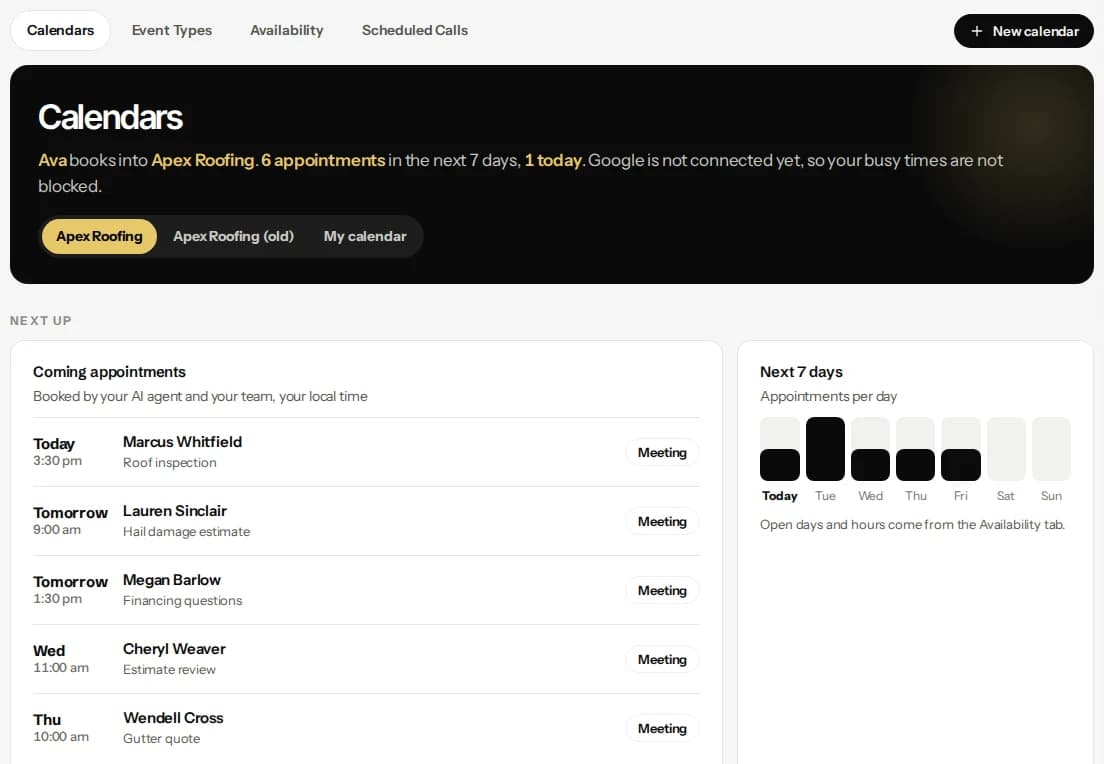
The Calendars screen with the coming appointments booked by the AI agent and the team, and appointments per day for the next seven days
Booked appointments for the week, shown with a demo account.

Consistency. The agent asks the same qualifying questions in the same order every time and gives the same answer to the same question. That sounds minor until you compare it with how a rushed Friday afternoon actually goes.

Visibility. Because every answer is logged, you can finally see what customers keep asking. If the same question keeps coming up, that is not a support problem. It is a page, a quote or a process that needs fixing, and the transcripts show you which one. Those insights come with the efficiency gain rather than as a separate report to build.

Cost shape. A flat monthly fee that does not move with call volume is easier to plan around than a cost that grows every time the phone rings.

Common Use Cases and Examples of AI Customer Service

The same agent fits very different businesses, because the shape of the work is similar. Somebody gets in touch, wants an answer, and either books or does not.

Booking and rescheduling. For example, clinics, salons and home service companies spend a surprising share of the day moving appointments around. The agent reads the calendar, offers real alternatives and writes the change back, so Thursday's cancelled slot is open again for someone else before the office has had its coffee.

Quote follow-up. Contractors and dealers lose deals in the gap between a quote and a yes. The agent answers the three questions that usually come before a yes: what is included, when can you start and what happens if the scope changes.

A dark toolbox with a brass handle and clasp beside a brass ball

Order and delivery status. Furniture and retail customers want to know where their order is. Answering that from your records is exactly the kind of repeatable work that should not need a person.

Intake and general questions. Medical and legal practices get a steady flow of questions that have approved answers. The agent gives those answers and passes anything that needs judgment to a person.

Replies to outbound campaigns. The same agent handles the replies when your outbound agent has been out reaching people. A prospect who answers a text at ten at night gets a real answer and a booking, not an auto-reply. For a business with more leads than time, that reply is where the revenue is.

A round brass-framed mirror on a stand beside a brass ball

Overflow. Even businesses with a front desk use the agent for the moments the desk cannot cover: lunch, a second line ringing, a Monday morning pile-up.

Concerns About AI Customer Service, and the Honest Answers

Most owners have the same handful of worries before they try this. They are reasonable worries, and the answers are better stated plainly than defended.

Will customers know it is AI? Yes. The agent says it is a digital assistant at the start of the call and says the call is recorded, every time, and that line cannot be tuned away. We do not build an agent that passes for a person.

Will it make things up? It answers from your material and your records. When it does not know, it says so and hands over. The failure to worry about is not an agent that is too honest. It is an agent that sounds sure and is wrong, and the design goal is the opposite.

Can it handle a complicated problem? Not on its own, and it is built to recognise that early. A billing dispute, a legal question or an angry customer goes to a person with the full context, so the customer does not have to start again.

Nested dark stone arches over a brass ball

What about my customer data? Conversations live in your account, with your customers, and are not shared across businesses. Every call is recorded and transcribed so you can read exactly what was said.

What if it sounds robotic? The only way to know is to hear it. Ask to speak to an agent on your own business, with your hours and your prices, and judge it the way your customer would. A canned demo proves very little.

The limits are real, and we would rather you know them before the demo than after.

How to Pick the Best AI Customer Service Software: Features to Check

The category is crowded and most of the differences are hidden behind similar marketing. A short checklist cuts through it.

Does it handle the phone, not only chat? Most small business customers still call. A tool that only does chat leaves the biggest channel uncovered.

Does it book into your real calendar? Offering times from a static list is not booking. Ask whether it reads live availability and writes to it, so two people cannot take the same slot.

Does it remember the customer across channels? A caller who emails tomorrow should not be a stranger tomorrow. One shared record across phone, chat, text and email is the difference between a service and a collection of bots.

A brass ball balanced on a stack of dark stone tiles

Can a person take over mid-conversation? There should be a warm transfer with a summary, and a fallback when nobody is free, such as a detailed message and an alert.

Can you hear it on your own business? Ask for a live test with your hours and your prices before you sign anything.

What does it do when it does not know? The right answer is that it says so and hands over. Be wary of any vendor who tells you it never needs to.

A tray of small brass balls with one large brass ball on top

Then look at the bill. Enterprise support platforms usually charge per seat and per resolution, which suits a large team and punishes a small one. Here the customer service agent is included on every plan, with the CRM, the pipeline and the follow-ups, and there is no per-text charge from us. Read the pricing page, then book twenty minutes and judge it on a real conversation.

AI Customer Service Compared With Chatbots, Help Desk Tools and Other Alternatives

Small businesses usually reach this decision from one of four starting points. Each has a real strength and a real gap.

Voicemail. It costs nothing and captures a message, but the customer has usually called the next business by the time you listen to it. It records the problem without starting to solve it.

A traditional answering service. A person takes a message and passes it on. That is better than voicemail, and the person is friendly, but they cannot check your calendar, book the job or know the customer. You get a note, not a booking.

A phone menu. Press one for sales, press two for support. It routes calls but it does not answer anything, and callers tend to dislike it enough to hang up.

Two stone blocks of different heights with a brass ball on the taller one

A website chatbot. Useful for visitors, but it covers only the website and usually only answers from a fixed script. It does not pick up the phone.

An AI customer service agent. It takes the conversation on every channel, answers from your material, books into your calendar and writes the record. What it does not do is replace the judgment, the relationships or the difficult conversations, which stay with your team.

The honest way to compare is against the work rather than against a job title. Count the conversations that arrive, when they arrive, what happens to the ones that arrive at once and what it costs you when one goes unanswered. Whichever option handles that best for your volume is the right one.

What to Measure Once It Is Running: Data Analysis, Insights, Efficiency and Cost

A good setup is easy to check, because the agent writes down everything it does. These are the measures worth looking at in the first weeks, and none of them need a spreadsheet.

Bookings. How many conversations ended with an appointment on the calendar. This is the number the rest of the list supports.

Handovers. How many conversations went to a person, and why. A handover for a genuine emergency is the system working. A handover for a question the agent should have known is a gap to close.

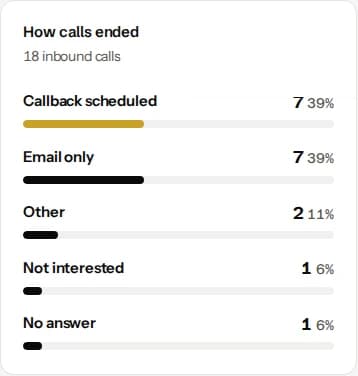
How inbound calls ended, such as callback scheduled, email only, not interested and no answer
What happened on each inbound call, shown with a demo account.

Unanswered questions. Every time the agent said it did not know, that is a line in the transcript. Read those first. Each one is either an answer to add to the knowledge base or a question you did not realise customers were asking.

Drop-off points. Where in the conversation do callers hang up or stop replying. If many leave at the same moment, the wording at that moment is the thing to change.

Hours of arrival. When do conversations actually come in. Many owners are surprised by how much arrives outside the hours they would have guessed.

Escalation accuracy. Are the rules you set firing at the right times. Too often and your team is interrupted for nothing. Too rarely and a customer who needed a person did not get one.

Brass bar chart columns rising behind a brass magnifying glass on a stone base

Read a few dozen transcripts before drawing conclusions. A handful of real conversations will teach you more than any dashboard summary, and the fix is almost always a small edit to what the agent knows.

Rolling It Out: The First Week

Setup is specific work rather than a switch, and it is quicker than most owners expect. Most businesses are live within 48 business hours, and it takes about two to three hours of your time, spread over a day.

Day one is the briefing. We connect your existing number, load your services, prices, hours and service area, and set the rules for when the agent must stop and get a person. You tell us the questions you get asked most and the answers you actually give.

Then the calendar and the CRM. The agent connects to the calendar you already use and to your CRM, so bookings and records land where your team already looks.

A brass ball resting on a dark stone beside a folded white cloth

Then the test call. You listen to a call on your own business before it goes live. This is the step where wording gets fixed, because it is easy to hear a sentence that does not sound like you.

Then it goes live, usually with a limited pilot first. A pilot period lets you check call quality, answer accuracy and booking behaviour on a limited campaign before committing to a full deployment.

The first week after launch is for reading transcripts. Questions the agent could not answer become answers. Escalation rules get tuned. By the end of the week the obvious gaps are closed, and from then on you are improving from a record rather than from memory.

Recording, Privacy and Disclosure

Customer service is a place where trust is easy to lose, so the rules about honesty are not decoration. They are part of how the agent is built.

Disclosure. The agent identifies itself as a digital assistant at the start of the call. A caller who knows what they are talking to and still books is a better lead than one who finds out afterwards.

Recording. Every call states that it is being recorded, in every state, whether or not that state requires it. Recordings and transcripts sit in your account, so any dispute about what was said can be settled by reading it.

Retention. For industries where records matter, including legal, medical and financial, recordings are retained so you can meet your own obligations.

A dark shield with a brass rim beside a brass ball

Separation. Each business's callers and visitors are kept separate from every other business's. Nothing from your conversations is used to answer anyone else.

Limits on what it says. The agent answers from the material you approve. It does not give legal advice, medical advice or financial advice, and it hands those questions to a person.

None of this slows a call down. It takes a couple of seconds at the start and removes a whole category of worry afterwards.

What Happens to the Work You Already Paid to Win

Every inbound conversation your business gets cost something. An ad, a referral, years of reputation, a page that finally started ranking. By the time somebody is on the phone with a question, the expensive part is already done.

The cheap part is what usually goes wrong. The conversation happens at a bad hour, or three of them happen at once, or it lands with somebody who is mid-job and cannot stop. None of that is a sales problem. It is a capacity problem, and the two have different fixes.

There are three shapes it takes, and they are worth naming separately.

The hour. The conversations most likely to turn into work happen in the evening, at the weekend and first thing Monday before anybody has opened a laptop. Whoever holds that conversation holds the job.

A brass ring on a pale floor with brass balls resting along it

The pile-up. Monday at eight. The day a campaign lands. The cold snap that puts every furnace in town on the phone at once. One person holds one conversation. An agent holds all of them, and holds each one the same way.

The interruption. In a practice or a trade, the person best placed to answer is the person least able to stop. Pulling them off the work to answer a question about opening hours is expensive twice over.

An agent on the line handles all three, not by being clever but by being available and not being busy.

What Happens on a Call, Start to Finish: From Customer Inquiries to a Booked Appointment

It answers. The agent picks up on the first ring, in under a second, with your business name and the tone you set. No phone tree, no menu, no press one for sales. That speed is not a gimmick: a caller decides what kind of company you are in the first few seconds, and a ring that goes on and on is the first thing they judge.

It has an actual conversation. The agent knows your services, your price ranges, your service area and the objections you hear most, and it asks the qualifying questions in the order a person would. A roofer's agent asks whether they own the house and whether this is insurance or out of pocket. A dental practice's agent asks whether they are a new patient or an existing one. It does not read a script at somebody, and it does not interrogate them either.

It books, or it hands over. For most callers the agent books the appointment on the spot. It reads your live calendar, offers real times, confirms the one they pick and sends the confirmation to both sides, so there is no back and forth and no double booking. When a caller needs a person, because they are angry, because it is a billing dispute, because it is an emergency, it transfers warm with a summary: I have John on the line, same-day AC repair, fourteen Maple Drive. Your team picks up already briefed.

It writes everything down. After the call the agent logs the interaction to your CRM, texts the caller a confirmation and follows up the next day to confirm or re-engage. Your dashboard holds the recording, the full transcript, the qualification and what was done about it. Read across a few hundred of those and you can see which call types convert, which questions keep coming up and when the volume actually arrives. That record is the part competitors do not have, and it costs you nothing extra to build.

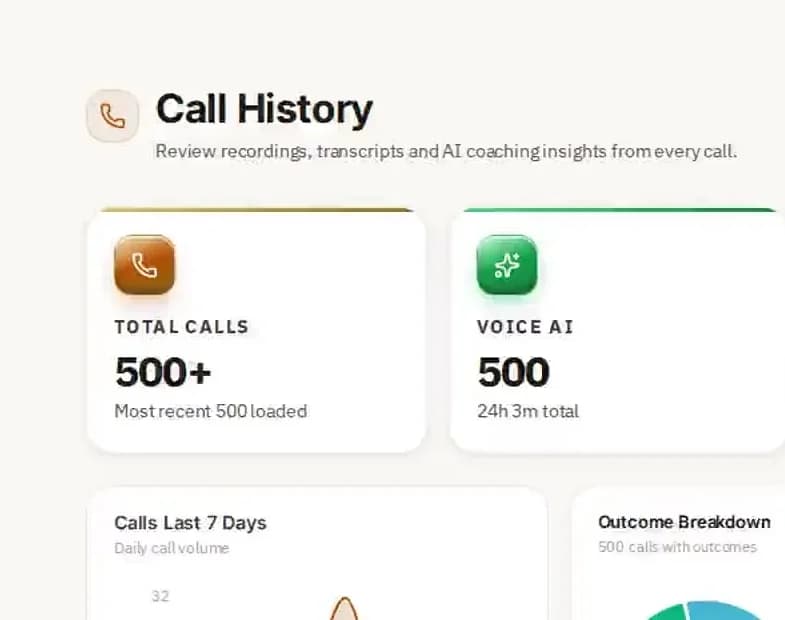
The Call History screen showing total calls, average duration, positive sentiment, calls per day and outcome and sentiment charts
Call history with outcomes and sentiment, shown with a demo account.

Features and Capabilities: What AI Agents Handle on an Inbound Customer Support Line

This is the full working list. It covers most of what a front desk does on the phone, and a few things a phone-based front desk cannot do at all, like holding four conversations at three in the morning.

Around the clock answering. Nights, weekends and holidays included. Coverage does not depend on who is rostered on.

Appointment booking. Connects to Google Calendar, Outlook and the usual booking tools, reads real availability and writes to it, so two callers cannot take the same slot.

Qualification. Asks about intent, budget and fit before anything reaches your team, so the handover is a briefed conversation rather than a name and a number.

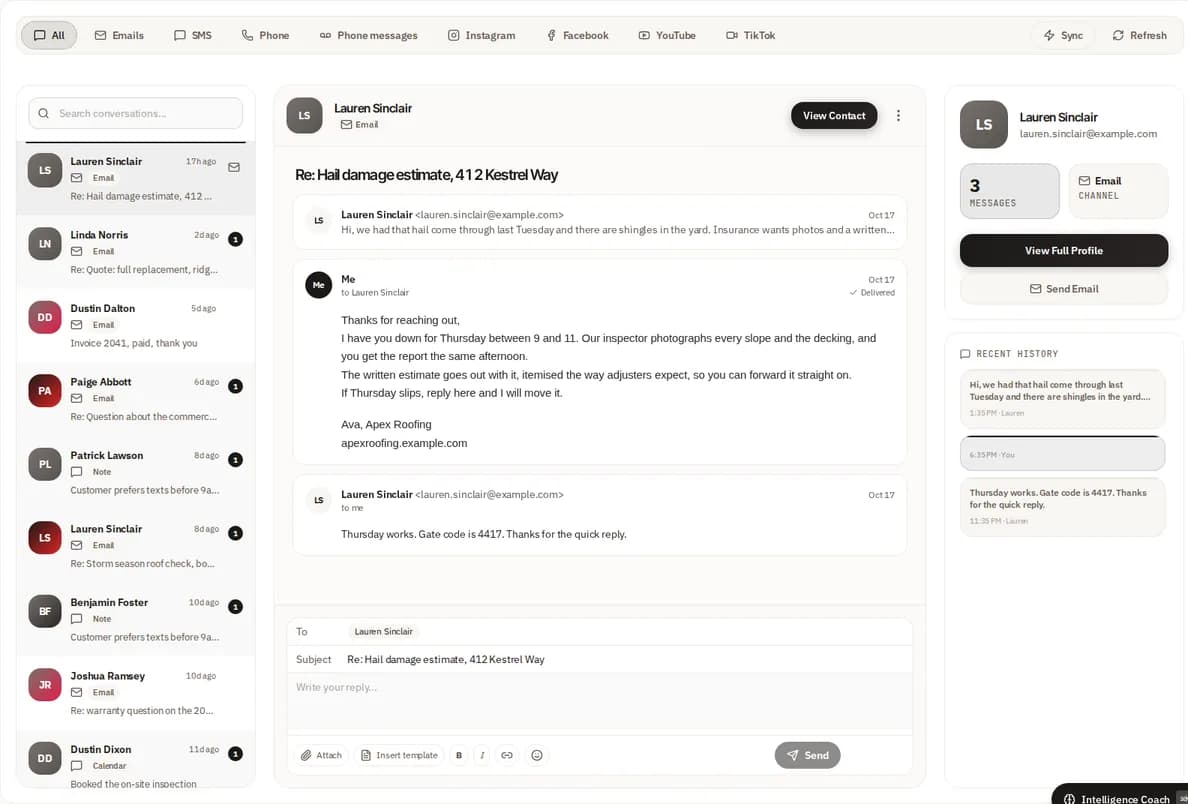
The unified inbox showing an email thread with a customer and her contact details beside it
The unified inbox, shown with a demo account.

Common questions. Hours, pricing, services, service area and policies, answered from the knowledge you gave it. When it does not know, it says so and takes it to a person rather than guessing.

Text follow-up. Confirmations, reminders and re-engagement messages after the call, without anybody remembering to send them.

CRM logging. Every call, contact and outcome sent to your CRM as it happens through Zapier or Make, not at the end of the week from memory.

Recordings and transcripts. Full audio and searchable text for every conversation, which is what makes coaching and disputes straightforward instead of a matter of recollection.

Tone and escalation. The agent reads how the caller is doing and adjusts, and a caller who is plainly frustrated goes to a person rather than through another qualifying question.

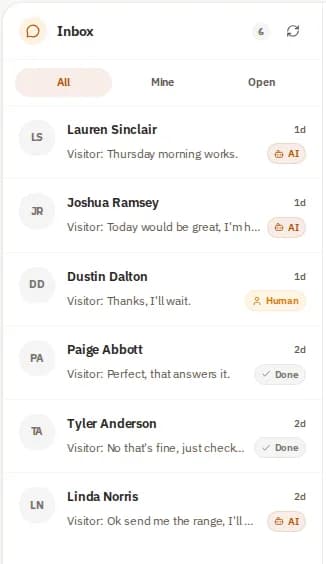
The chat inbox listing website conversations, each marked as handled by the AI, by a person, or done
Website chats marked AI, human or done, shown with a demo account.

One history across channels. Phone, website chat, email, Facebook Messenger, Instagram DMs, WhatsApp and SMS all write to the same record, so the customer journey is one story rather than seven.

Warm transfer. The handover carries a live summary, so nobody starts from the top. If nobody is free it takes a detailed message and alerts your team.

Recording disclosure and storage. Every call says it is recorded, and recordings are retained for the industries where that matters, including legal, medical and financial.

Brass arcs rising like sound waves over a brass ball on a stone plinth

Your existing number. It connects to the line you already publish. No porting, no new number, no transition window.

Every Channel Runs on One Conversation History for a Better Customer Experience

People get in touch however they happen to be holding their phone. The point of running every channel through one agent is not the channel count, it is that all of it writes to one record, so nobody is asked to explain themselves twice.

Phone. The main one. The agent answers, talks, books or routes, on your existing number.

Website chat. The same agent as a widget on your site. Visitors get answers on hours, pricing and availability and can book without picking up a phone.

Text. People who text your business number get the same agent. Good for reminders, confirmations and the quick questions nobody wants to make a call about.

A brass card resting on a stack of pale paper

Facebook Messenger. Connected to your page inbox (every channel also lands together in one inbox in the platform), so messages coming off your ads and your page are answered rather than sitting unread, with the same booking and qualification behind them.

Instagram DMs. Incoming DMs are answered, qualified and booked, and anything complicated goes to your team.

WhatsApp. Same agent, same answers, same booking. For plenty of businesses this is where customers actually are, and it is usually the inbox nobody has time to watch.

Email. Answered from the same memory as everything else, so somebody who called yesterday and emails today is picked up mid-conversation rather than at the start of one.

How AI Customer Service Runs for Different Businesses and Industries

Call patterns differ by trade, and so does what counts as a good answer. Here is what the agent is set up to do in the industries we see most.

HVAC. Emergency calls arrive at the worst hours by definition. The agent picks up at eleven at night when an AC fails in July, on a Sunday morning, and during the hour everyone is at lunch. It triages urgency, separates an emergency from a service call and books routine maintenance without involving anybody.

Dental practices. Scheduling calls pull the front desk away from the patient standing in front of them, which is the real cost. The agent takes new patient intake, booking, insurance questions and reschedules, and only interrupts a person for the things that need one.

A brass thermostat dial on a pale cube beside a brass ball

Real estate. Agents are showing houses, in meetings or off the clock when buyers call. The agent answers, works out buyer or seller, price range and timeline, then books the showing or the consultation straight onto the calendar, at nine on a Tuesday night as readily as at midday.

Legal firms. Consultation calls are high value and time sensitive, and attorneys cannot break off for every one. The agent qualifies case type, reads urgency, captures full contact details and books the initial consultation, asking the same intake questions every time rather than whichever ones got remembered.

Home services. In plumbing, roofing, landscaping and pest control, the person answering the phone is the conversion. The agent handles service area checks, job type, urgency triage and scheduling. In peak season, when every tech is on the road and the phone does not stop, that is the difference between capturing the day's calls and hiring office staff for eight weeks a year.

Three small stone houses with brass roofs and a brass ball in front

Insurance. Quote requests and policy questions arrive in volume and all need the same opening information: coverage type, home or auto, current carrier, current level. The agent collects it, so when an agent picks the lead up they are starting at the quote rather than at the questionnaire. After-hours calls are captured with full context for the morning.

Where Automation Stops, Complex Cases Start and Human Agents Take Over

Automation covers the repeatable work: answering, qualifying, booking, rescheduling and writing it all down. Anything that needs an actual judgment call still reaches somebody on your team, with the conversation already logged so nothing has to be re-explained.

That boundary is set by you, not by us. Which topics escalate, which hours route straight to a person, what the agent must never attempt to answer on its own. Those are configuration, and getting them right in the first week is most of what makes this work.

A brass box and a small brass ball on a dark stone tray in warm window light

Compare It to the Work, Not to a Job Title

The honest comparison is not against a person. It is against the work: how many conversations arrive, when they arrive, what happens to the ones that arrive at once, and what it costs you when one of them goes unanswered.

Run the numbers on your own line. Count the calls that came in outside your working hours last month. Count the ones that arrived while another call was already in progress. Count how many of them you can name the outcome of today. Most businesses cannot answer the third question at all, which is itself the answer.

The agent is a flat monthly cost that does not move with volume. It covers hours nobody is rostered for and handles calls in parallel rather than in a queue. It does not replace the judgment, the relationships or the difficult conversations, which stay with your team where they belong. It takes the part of the job that is answering, asking and writing down.

Why AI Customer Service Is Not the Chatbot You Tried Before

Most people's experience of automated support is a decision tree that failed them, so the scepticism is earned. The difference is worth stating plainly rather than asserting.

Older systems matched keywords to scripted replies. Anything outside the script produced a dead end or a loop. Systems built on modern language models hold context instead: they follow a conversation that changes direction, handle a follow-up question about something said two minutes ago, and generate a reply that fits what was actually asked.

The second difference is that this one does things rather than only saying things. That is the part that matters on a phone line.

A dark stone block set with a large brass button, a small brass ball at its foot

Beyond a Scripted Decision Tree

A caller can say "actually, I changed my mind, can we do Wednesday instead?" and the agent handles the pivot without starting over. It can be asked the same question in three different ways and answer all three. It picks up that a caller is annoyed and changes how it responds, and it knows when the right move is to stop talking and get a person.

What it is built on is a knowledge base you supply: your services, your pricing, your policies, the objections you hear and the answers you actually give. It sounds like your business because it was given your business, not because it was tuned to sound impressive.

Answering Is Not the Same as Doing: Integrations With Your CRM and Calendar

A chatbot answers a question. An agent takes the action. It books the appointment, updates the CRM, sends the confirmation text and creates the follow-up task, and those are four separate things that four separate tools usually do badly.

That is the line between this and an answering service. An answering service hands you a message. The agent hands you a booking that is already on the calendar and a record that is already in the CRM. Add the automations layer on top and the post-call reminders, re-engagement sequences and pipeline updates fire without anybody opening a laptop.

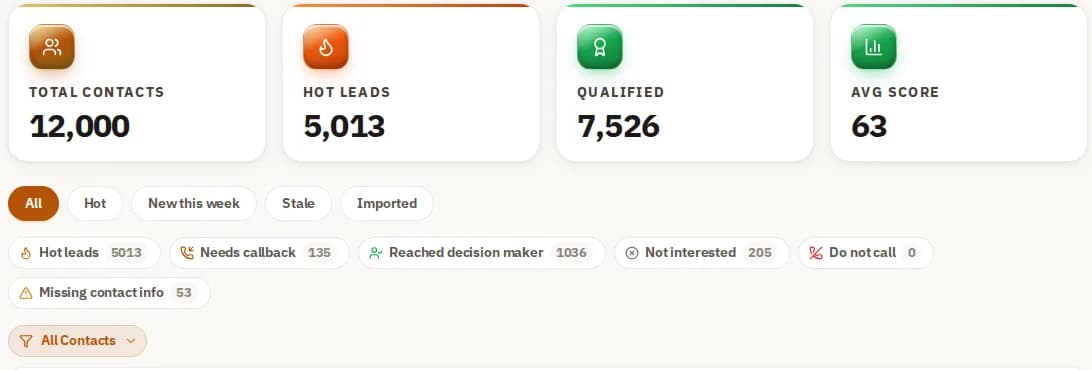
The Contacts screen with total contacts, hot leads, qualified and average score, plus quick filters such as needs callback and do not call
Contacts sorted by what to do next, shown with a demo account.

What Changes After the First Month: Faster Answers, Lower Cost

The first month is where the obvious gaps get closed. Questions the agent could not answer become answers. Wording that made a caller hesitate gets changed. Escalation rules that fired too often or not often enough get tuned.

The mechanism is the transcripts. Every call is written down, so the objections people actually raise, the questions that keep recurring and the point in the conversation where callers drop off are all visible rather than anecdotal. Those go back into what the agent knows.

This is worth being precise about, because it is the claim this category most often overstates. The agent does not teach itself overnight while you sleep. What happens is that the record of every conversation makes it obvious what to change, and changing it is a configuration edit rather than a retraining programme. Most tools plateau because nobody can see what to fix. The transcripts are how you can.

Stone steps rising to the right with a brass ball on each step

The Same Agent as Your Chatbot: A Chat Widget Across Every Channel

The chatbot is not a second product. It is the same conversational engine that answers your phone, with its knowledge of your services, pricing and policies, deployed as a widget on your site. Visitors get the same answers, the same booking and the same qualification without picking up a phone, and a booking made in chat lands in the same calendar and CRM as one made by voice.

It is trained on your business rather than dropped in as a template, so it answers the way your team would rather than reciting generic copy. Setup covers the widget design, the connection to your booking and support systems and a data architecture that keeps each client's caller and visitor data separate.

Because chat and phone run on one platform, somebody who messages the widget and calls in two days later does not start over. Both conversations are on the same dashboard as your recordings and transcripts.

What the Agent Is Told Before It Takes a Call

The agent handles an inbound call the way a well-briefed member of your team would: it picks up quickly, introduces your business by name, works out what the caller needs and gets them to an outcome. A booked appointment, a transferred call, a message taken, a question answered. Setup is where that gets decided, and it is specific work rather than a switch.

We train it on your services, your pricing, your availability, the questions you get asked and the rules for when it must stop and get a person. In a practice, a firm or a home services business, where the first minute of a call sets the tone for everything after it, that briefing is the product.

It says what it is. The agent identifies itself as a digital assistant at the start of the call, and every call states that it is being recorded, in every state, whether or not that state requires it. We do not build an agent that passes for a person, and we would not sell one. A caller who knows what they are talking to and still books is a better lead than one who finds out afterwards.

A stack of dark books with a brass ribbon and a brass ball

AI Customer Service for Enterprise and Small Business: Capabilities Compared With Freshdesk, Intercom, HubSpot and Ada

Enterprise customer service software is built around a support center: queues, ticket routing, a help desk and a team of agents working the backlog. Help desk tools such as Freshdesk and Intercom, the service hub in HubSpot and chatbots from platforms such as Ada were designed for that shape of work, and a copilot that suggests replies to a human agent assumes the human agent exists. If you already use one of them, the agent can sit beside it: every conversation is logged to HubSpot through the CRM integration rather than replacing what you have.

A small business needs the other capabilities. It needs the conversation itself handled, from the first word to the booked appointment, without a team behind it. That is a different job, and it is why the features worth comparing are not ticket counts but whether the agent can pick up the phone, work from your approved answers, book into your calendar and pass the hard cases to a person.

None of this means the enterprise approach is wrong. It means the two are built for different businesses, and a small business that buys the enterprise version pays for a support center it has no one to staff.

How to Automate Customer Support Without Losing the Customer Experience

To automate customer support well, start with the repeatable work: the same ten questions, the same rescheduling requests, the same quote follow-ups. These are the cases where the agent can create a complete result, because the answer is already in your own material and the next step is a booking or a message to the right person.

The customer experience depends on what happens at the edges. A good customer experience is a fast first answer, an honest statement that it is a digital assistant, and a clean handover when a person is needed. Customers forgive an agent that says it does not know. They do not forgive one that guesses.

That is also what protects customer satisfaction over time. Each conversation is logged with the whole exchange, so you can read what customers asked, see where the answers fell short and improve the business information the agent works from.

THE REST OF THE PLATFORM

Questions about pricing, setup and what it will not do are answered back on the AI Customer Service page.

Hear how it answers your line.

Twenty minutes, your industry, real answers.

Book a demo
Multiply Revenue

AI that calls your leads in a natural voice, follows up by text and email until they answer, and books qualified meetings straight onto your calendar. Outbound and inbound, on one memory.

No setup fee, and no per-text charge from us.

© 2026 Multiply Revenue · 1905 Sherman Street, Ste 200, Denver, CO 80203 · (720) 735-8685
Book a demo