AI sales coaching software: how AI powered coaching lifts seller performance
What AI sales coaching is, how an AI coach scores real calls, the best AI sales coaching tools compared from their own websites, what it costs and how to roll it out so reps improve instead of gaming the score.
THE GUIDE
Read it end to end, or jump around.
14 chapters.
01
What Sales Coaching Software Has to Do That a Manager With a Spreadsheet Cannot
Every sales manager already coaches. They sit in on a call, they give feedback afterwards, they run a pipeline review on Monday. The problem has never been that managers do not know how to coach. It is that a manager can only be in one conversation at a time, and the team is having hundreds.
So coaching gets sampled. A manager listens to a handful of calls a week, usually the ones somebody flagged, which means the ones that already went badly or already went well. The quiet middle, where most of the winnable deals actually live, is never reviewed by anyone.
Sampling has a specific failure mode and it is worth naming, because it is the reason this category exists. When you review a few calls, you find the problems in those calls. You do not find the pattern, because a pattern is only visible across the whole set. A rep who consistently skips the budget question on discovery calls looks fine in any single recording. It is only obvious when you look at forty of them together.
That is the job sales coaching software has to do. Not replace the manager's judgement, which is the part that actually changes behaviour, but remove the sampling. Review every conversation so the manager is working from what the team actually does rather than from a small and badly chosen sample of it.
The second thing it has to do is remember. A coaching conversation that starts from scratch every week is a performance review, not coaching. Progress is the point, and progress needs a record of what was said last time and whether anything changed.
02
Scoring Every Call Changes What You Can Ask
Once every conversation is scored rather than a sample of them, the questions available to a manager change completely.
With a sample, the honest questions are narrow. How did this call go. What should this rep do differently next time. Useful, but small.
With full coverage the questions get much better. Which part of the call is where we most often lose people. Do the deals we win sound different at the start, or only at the end. Is the rep who is behind on quota actually doing something different, or just getting fewer good conversations. Does the new pitch we rolled out last month appear in anybody's calls, or did it quietly not get adopted.
That last one is worth dwelling on, because it is the most common and least noticed failure in sales management. A team agrees on a new message, everyone nods, and nothing changes. Nobody is being difficult. The old words are simply what comes out under pressure on a live call. Without a way to check every conversation, the gap between what was agreed and what is being said is invisible for months.
Scoring also makes coaching fair, which matters more than it sounds. A rep reviewed on two calls can reasonably argue those two were unrepresentative, and they are often right. A rep reviewed on everything cannot, and neither can the manager. The conversation stops being about whether the sample was fair and starts being about the work.
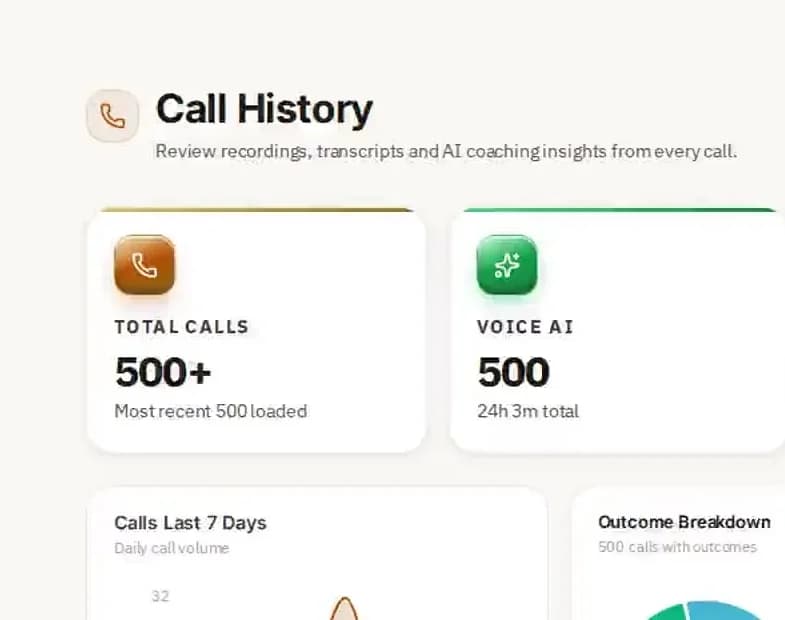
Every call on the record with its outcome and sentiment, shown with a demo account.
03
What the Coach Actually Listens For
A score on its own is not coaching. A number between one and ten tells a rep nothing they can act on, and a tool that produces one is a reporting layer wearing a coach's jacket. What matters is which specific behaviours are being tracked, and whether you get to decide what they are.
The things worth measuring on a sales call are mostly unglamorous. Did the rep establish what the prospect is actually trying to fix, in the prospect's words rather than ours. Did they find out who else decides. Did they ask about timing in a way that produced a real answer rather than a polite one. Did they handle the price question or defer it. Did they agree a specific next step, with a date, before hanging up.
Talk ratio is the one everybody measures because it is easy, and it is genuinely useful, but it is not the whole picture. A rep who talks too much on a discovery call has a real problem. A rep who talks a lot while walking somebody through a technical objection may be doing exactly the right thing. Context decides, which is why the behaviours have to be configurable rather than fixed.
The coach should also catch the things nobody wants to raise. Calls that end without a next step. Promises made on the phone that nobody wrote down. A question a prospect asked twice because it was not answered the first time. None of those are dramatic and all of them cost deals.
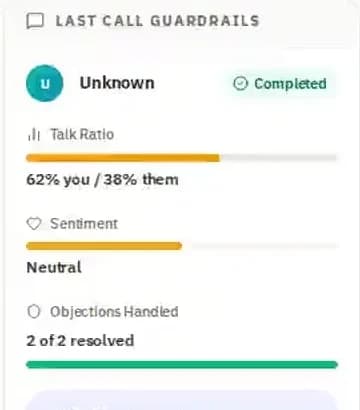
The coach's review of the last call, shown with a demo account.
04
The Manager's Job Changes, It Does Not Disappear
The version of this that fails is the one where the software is installed, scores start appearing, and everybody treats the number as the coaching. Reps learn what the scoring likes and perform for it, which is exactly what people do when a metric becomes a target. You end up with better scores and the same results.
The version that works uses the software to answer the question a manager cannot answer alone, which is where to look, and leaves the actual coaching to the human.
That means the useful output is not a leaderboard. It is a short list: these three calls are worth listening to this week and here is why. The manager still listens. The manager still decides what to say, because the thing that changes a rep's behaviour is a specific conversation with somebody whose opinion they care about, not a dashboard.
It also means the scoring has to be explainable. If a call scored badly, the manager needs to see which moment caused it and be able to disagree. A score that cannot be interrogated will be ignored the first time it is obviously wrong, and it will be obviously wrong at some point, because sales conversations are not simple.
The honest summary is that sales coaching software buys a manager attention, not judgement. Attention is the scarce thing.
05
It Has to Work on Your Calls and Your Definition of Good
Every sales team sells something slightly different to somebody slightly different, and a coaching tool that arrives with a fixed idea of a good call will be wrong about yours in ways that are tedious to correct.
So the practical questions are about fit. Can you define what a good discovery call looks like for your business, or are you accepting somebody else's template. Can you weight the things that matter in your sale and ignore the ones that do not. If half your calls are inbound support conversations that occasionally turn into sales, does the tool understand that those are not discovery calls and score them as though they were.
The second practical question is where the calls come from. A coaching layer is worth nothing if getting your conversations into it is a manual export. It has to sit on the calls you already make, on the system you already use, without anybody remembering to upload anything.
The third is what happens to the output. A score that lives only inside the coaching tool is another tab nobody opens. It should reach the CRM record for that deal, so the person looking at the opportunity sees what actually happened on the call, and it should reach the manager where they already work rather than in a weekly email they archive.
And it has to handle the calls the AI agent makes as well as the ones people make. If part of your outbound is handled by an agent, those conversations need reviewing on the same terms and against the same definition of good, otherwise you are coaching half your pipeline.
06
What to Check Before You Buy Any Sales Coaching Software, Including Ours
Use this on us as hard as on anybody else. A buyer with a checklist gets a better outcome from every vendor in the process.
Ask what share of calls it actually reviews, and what happens to the rest. If the answer is a sample, you are buying a faster version of the problem you already have.
Ask whether you can define what good looks like, or whether you are adopting the vendor's template. Then ask them to show you the screen where you change it.
Ask it to explain a score. Pick a real call, get the score, and make the vendor point at the moments that produced it. A score you cannot interrogate gets ignored the first time it is wrong.
Ask how calls get in. If the answer involves anybody uploading anything, it will stop happening in week three.
Ask where the output lands. The CRM record for that deal is the right answer. A separate dashboard is not.
Ask what it does with a call that is not a sales call, because plenty of them are not.
Ask how the recording is handled: where it is stored, how long it is kept, who can play it back, and what the disclosure says at the start. Recording rules vary by state and the business making the call carries that, not the vendor.
Ask what your reps will see. A tool that only reports upward turns into surveillance, and a team that experiences it that way will work around it rather than improve.
And ask what happens after the first month, when the obvious problems are fixed and the easy wins are gone. That is when a coaching tool either earns its place or becomes a tab nobody opens.
07
What AI Sales Coaching Is: Conversation Intelligence, Roleplay and Call Scoring
AI sales coaching means using artificial intelligence to review sales conversations and tell reps and managers what to do differently. The phrase covers three kinds of tool, and they solve different problems.
Conversation intelligence: The tool records and transcribes real calls and meetings, then analyzes them for talk time, topics, objections and deal risk. Managers use the insights to decide which calls to review and what to coach.
AI roleplay practice: The rep practices against an AI buyer that plays a prospect, and gets scored before they ever speak to a real one. This is mostly used for onboarding and for rehearsing a new pitch.
Scoring of real calls: Every real conversation is graded against what good looks like for your team, so feedback is based on the calls that actually happened rather than a sample or a simulation.
Our AI coach is the third kind, built into the CRM. It scores every call, including the calls your AI agents make, and answers questions about your pipeline from the same memory. It does not run roleplay practice.
08
How AI Coaching Works on Real Calls and Live Deals
Record and transcribe: Every call is recorded and turned into a searchable transcript, so nothing depends on somebody taking notes.
Score against what converts: The coach grades each conversation against what actually converts in your account.
Point at the moment: Feedback links to the exact place in the transcript where the call turned, so a rep can hear it rather than be told about it.
Spot patterns across calls: With every call scored, the coach can show what books meetings and what loses them, and which calls deserve a manager's attention.
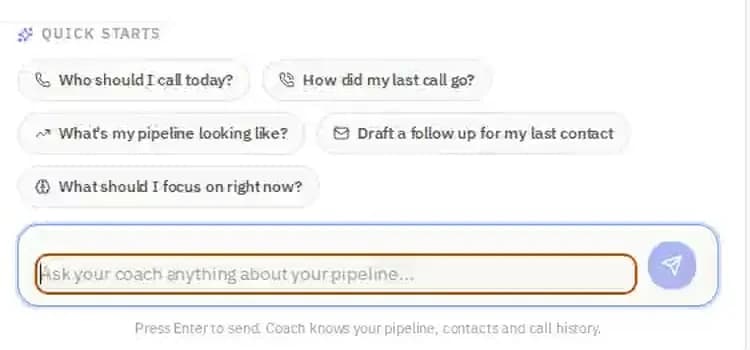
Ask the coach anything about your pipeline, shown with a demo account.
Brief before the next call: Before a call it tells the rep who they are speaking with, what happened last time and what that prospect said they care about.
Answer questions: A manager can ask why a deal was lost or who to call first and get a specific answer, in the app, from the same data.
09
Key Features to Look For in an AI Sales Coaching Platform
Coverage: Does it review every call, or a sample? Coaching built on a sample has the same blind spots as a busy manager.
Your own scorecard: Can you define what a good call looks like for your business, or are you adopting the vendor's template? Ours scores against what converts in your account.
Feedback reps can act on: A score between one and ten is a report. Coaching names the moment, the behaviour and what to try next time.
CRM context: The coach should see the deal, the contact and every earlier touch by call, text and email. Advice without context is generic.
Manager insights: A weekly view of which calls, reps and deals need attention, so coaching time goes where it pays.
AI agent calls: If AI agents make some of your calls, their conversations should be scored on the same scorecard as your reps.
Data and privacy: Who can hear the recordings, how long they are kept and whether call recording disclosure is handled on every call.
10
Best AI Sales Coaching Tools Compared: Gong, Chorus, Avoma, Hyperbound and More
These are the tools that come up most when people search for AI sales coaching. What each one does is taken from its own website, and prices are what its own pricing page showed on October 18, 2026. They change, so check before you buy. We make Multiply Revenue, so weigh our entry accordingly. None of the others paid to be included.
Multiply Revenue: An AI coach built into the CRM. It scores every call, including the calls your AI agents make, points at the moment a deal turned, briefs reps before the next call and answers questions about the pipeline from one memory across calls, texts and email. It is included in every plan, from $97 a month. It does not do AI roleplay practice.
Gong: A revenue AI platform built on recording customer conversations. Its Enable product adds an AI Call Reviewer that scores calls automatically, a coaching inbox for managers and AI roleplay practice built from past calls. Pricing is a custom proposal: licenses per user plus a platform fee.
Chorus by ZoomInfo: Conversation intelligence now sold as part of ZoomInfo. It captures and analyzes calls, meetings and email and is positioned for onboarding, enablement and deal insight. No price is shown on ZoomInfo's pricing page as of October 2026.
Avoma: An AI meeting assistant with recording and transcription in 70+ languages. AI call scoring, custom scorecards and coaching recommendations come in a Conversation Intelligence add-on at $29 per seat a month billed annually, on top of plans at $19, $29 or $39 per recorder seat a month billed annually (the $29 plan includes a limited version). It offers a 14-day free trial.
Hyperbound: AI sales roleplay against AI buyer bots, with a free tier of 45 prebuilt roleplays. Its Perform plan adds real call scoring and conversation intelligence. Paid plans are priced per user through a demo.
Jiminny: Conversation intelligence that records phone, video and email, with coaching scorecards, call libraries and an Ask AI feature. It offers a 14-day trial. We could not find a public pricing page as of October 2026.
Second Nature: AI roleplay sales training with conversational avatars for discovery, objection handling and cold call practice, scored automatically. The pages we read describe practice only, not scoring of real calls. We could not find a public pricing page as of October 2026.
Mindtickle: A revenue enablement platform with AI roleplays against an AI buyer, Call AI that analyzes and scores calls and sales training. We found no public pricing page as of October 2026.
Highspot: A sales enablement platform sold in three tiers through its sales team. Roleplay with AI feedback is in the middle tier, and meeting intelligence with AI feedback on meetings in the top tier.
Salesloft: A revenue workflow platform whose conversation intelligence gives AI call summaries, follow-up emails, CRM updates and coaching moments from conversations. Pricing is through its sales team.
How to choose: If your reps need practice before they talk to buyers, look at a roleplay tool. If you have a large team and a sales enablement budget, look at the enterprise platforms in the list. If you want every real call scored inside the same CRM that makes and logs the calls, without another tool to wire in, that is what we built.
11
What AI Sales Coaching Software Costs
Most AI sales coaching platforms do not publish prices. Of the nine other tools above, only Avoma shows dollar figures on its pricing page, and Hyperbound shows a free tier. For the rest we found no public price as of October 2026, and Gong says it adds a platform fee on top of its per user licenses.
Per seat: Expect to pay per rep a month, usually billed annually, often with a seat minimum for the larger plans. Avoma's coaching add-on is $29 per seat a month on top of its base plan (its own pricing page, October 2026), as an example of what a published price looks like.
Included in the CRM: Our AI coach comes with every plan rather than as a separate seat license, with extra coach answers available as an add-on. Plans are $97, $297 and $497 a month with no setup fee.
The hidden cost: Whatever you choose, budget the manager's time. A coaching tool saves the hours spent finding the right calls. It does not save the hours spent coaching, and those are the hours that change results.
12
How Managers Roll Out AI Sales Coaching Without Reps Gaming the Score
Start with three behaviours: Pick the three things that most often decide a deal on your calls and score only those for the first month. A scorecard with twenty lines gets ignored.
Share the calls, not just the numbers: In the weekly meeting, play one call that went well and one that did not, at the moment the coach flagged. Reps learn more from hearing it than from a dashboard.
Coach the pattern, not the person: When the data shows most lost deals stall at the same point, fix the script or the process for everyone before you single anybody out.
Keep the manager in the room: The software finds the calls worth reviewing. The manager still does the coaching. Treating the score as the coaching can leave you with better scores and the same results.
Review the scorecard every quarter: As your offer and market change, so does what a good call looks like.
13
How to Measure AI Coaching: Onboarding Time, Deals and Performance Insights
Judge it on sales results, not on scores. Scores are the input.
Conversion by stage: Track how many conversations turn into meetings and how many meetings turn into deals, before and after. That is where better calls show up.
Ramp time for new reps: How long until a new hire books their first meeting and closes their first deal.
The behaviours you chose: Whether the three behaviours on your scorecard happen more often over the first three months.
Manager time: How many hours a week managers spend finding calls to review, against how many they spend coaching.
Results depend on your team, your offer and how the coaching is used, and no tool guarantees them.
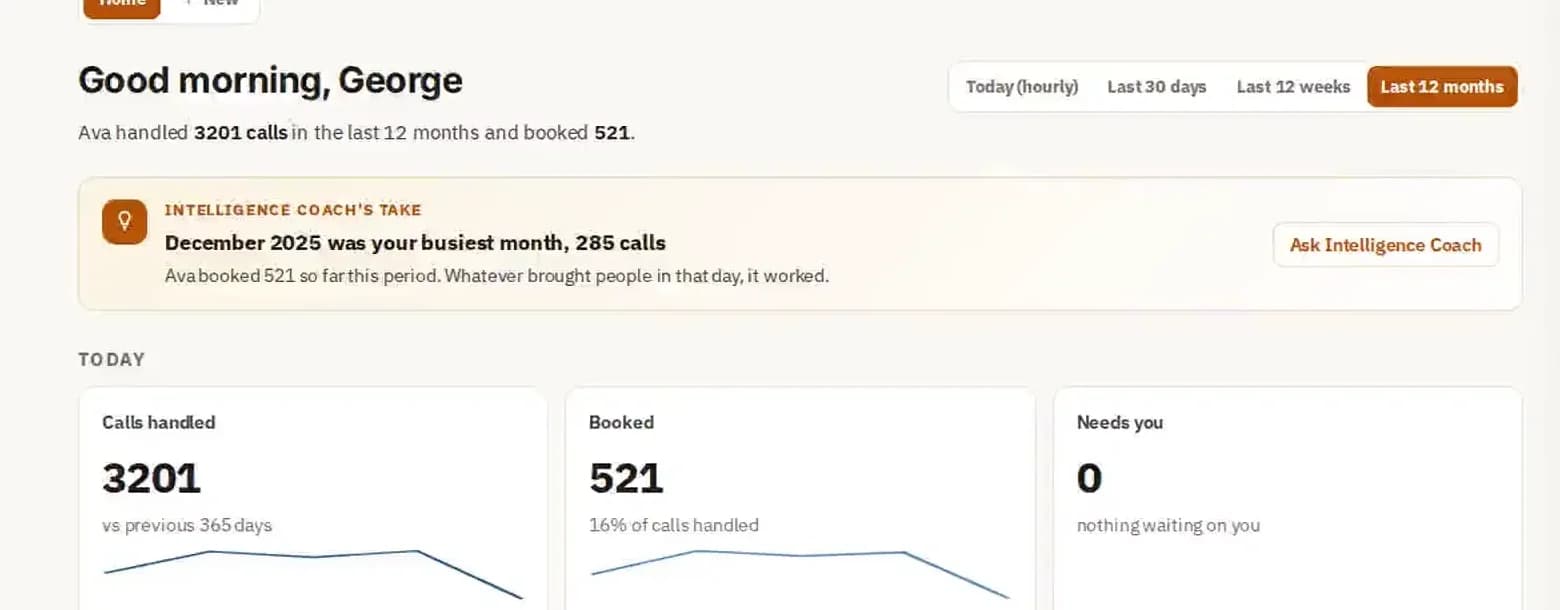
The morning dashboard, shown with a demo account.
14
Pros and Cons of AI Sales Coaching
Pros: Every call gets reviewed, not the few a manager had time for. Feedback arrives the same day and points at the moment that mattered. Patterns across hundreds of calls become visible, and new reps get coaching without waiting for a manager's calendar.
Cons: A score can become the target, and reps start performing for the software. Recording calls needs disclosure and a clear policy on who can listen. A coach that does not know your definition of a good call will be confidently wrong. And software does not replace a manager who actually coaches.
Who it suits: Any team making enough calls that nobody can review them all, from a two person team to a full sales floor, and any business where AI agents now make some of the calls.
QUESTIONS
More questions, answered
What is AI sales coaching?+
Using artificial intelligence to review sales conversations and tell reps and managers what to change. It covers conversation intelligence, AI roleplay practice and scoring of real calls. Ours scores every real call inside the CRM.
Can AI replace a sales coach?+
No. It replaces the part a manager cannot do by hand, which is listening to every call and finding the patterns. Deciding what to change and helping a rep change it is still a manager's job.
What is the difference between AI sales coaching and conversation intelligence?+
Conversation intelligence records and analyzes calls and gives managers insights. AI sales coaching goes a step further and turns those insights into feedback a rep can act on, ideally at the exact moment in the call.
Does the AI coach score calls made by AI agents?+
Yes. The coach reviews the calls your AI agents make as well as your people's, so no part of the pipeline goes unexamined.
How much does AI sales coaching cost?+
Many coaching platforms quote on request. Our AI coach is included in every plan, which start at $97 a month, with extra coach answers available as an add-on.
AI that calls your leads in a natural voice, follows up by text and email until they answer, and books qualified meetings straight onto your calendar. Outbound and inbound, on one memory.













 Multiply Revenue